
- LIVE QUOTES
- LEARN
- HELP
 Nasdaq
 Wall Street Journal
EN
Platinum is rising like a rainbow! Shilianyang broke 2,300 US dollars/ounce for the first time, and the imbalance between supply and demand detonated the market
The Zhitong Finance App learned that platinum prices soared to a record high, driven by multiple factors such as scarce supply and resilient demand. As of press release, platinum spot prices rose 2.6% to 2355.61 US dollars/ounce, breaking the 2,300 US dollars/ounce mark for the first time. Meanwhile, this is the 10th consecutive trading day that platinum has risen, setting a record for the longest continuous increase since 2017. Platinum spot has risen by more than 23% in the past week and by more than 52% in the past month. The cumulative increase since this year is close to 150%.
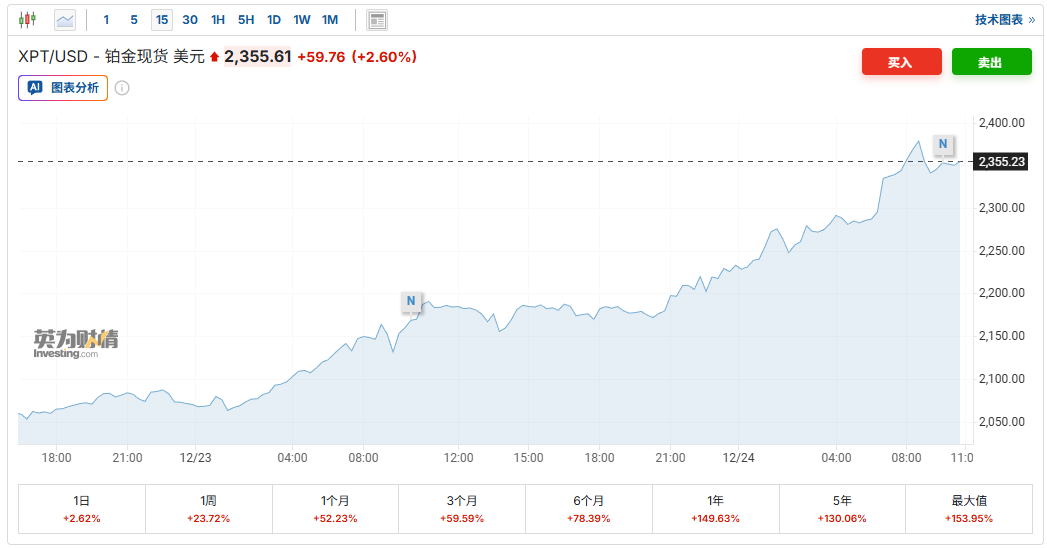
Some analysts point out that the current upward trend in platinum has solid fundamental support. On the supply side, mining areas in South Africa, a major producer, continue to face structural problems such as electricity shortages and aging infrastructure. Due to insufficient investment, South Africa's platinum group metal production fell 13% year on year in the first quarter, and production is expected to drop 6% for the full year of 2025. Data from the World Platinum Investment Association (WPIC) further supports bullish confidence. It is expected that the global platinum market will face a shortage for the third consecutive year in 2025, and the gap may widen to 30 tons.
On the demand side, the increase in the use of traditional automotive catalysts combined with growth in the hydrogen energy industry has jointly boosted demand for platinum. On the one hand, demand for traditional automotive catalysts has shown resilience beyond expectations. Despite the rapid development of electric vehicles, the number of fuel vehicles currently in existence and being added in the next few years is still huge, and stricter emission regulations require actual increases in the amount of platinum used in bicycles. Europe's decision to ease the 2035 ban on fuel vehicles has further strengthened the automotive industry's demand expectations for platinum.
On the other hand, the rise of the hydrogen energy industry has opened up a new growth track for platinum. China's “15th Five-Year” development plan positions hydrogen energy as a “key pawn,” and the strategic value of platinum as an irreplaceable catalyst in fuel cells and hydrogen production from electrolyzed water is being re-recognized. There is huge room for imagination in this emerging demand, and it is expected to support the metal's medium- to long-term price.
The “substitution effect” triggered by the high price of gold also cannot be ignored. Since this year, the price of gold has been rising. Against this backdrop, platinum, which is more cost-effective, has become an alternative choice for many consumers and investors, and demand has increased significantly. According to data released by the World Platinum Investment Association, demand for platinum jewelry is expected to increase 7% to 67 tons in 2025, the highest level since 2018; investment demand is expected to increase 6% to 23 tons year on year. It is worth mentioning that the Chinese market has become the core force driving demand for platinum bars — total demand for platinum bars is expected to increase 47% year-on-year to 16 tons in 2025, reaching a four-year high.
As a weather vane reflecting the degree of tightness in the spot market, the one-month rental interest rate for platinum has recently risen to a high level. This phenomenon usually means that metals that can be loaned in the spot market are extremely scarce, and industrial users are forced to buy metals directly from the market rather than borrow them, thereby driving up spot prices. This shortage, along with changes in NYMEX inventories and rising global ETF holdings, forms “paper evidence” that futures are resonating upward.
In fact, in addition to platinum, precious metals such as gold, silver, and palladium have also performed well recently. Gold spot rose more than 8% in the past month, breaking through 4,500 US dollars/ounce on Wednesday; spot silver surpassed 70 US dollars/ounce, a record high; palladium spot rose to 1,883 US dollars/ounce, rising about 35% over the past month, and over 13% in the past week alone.
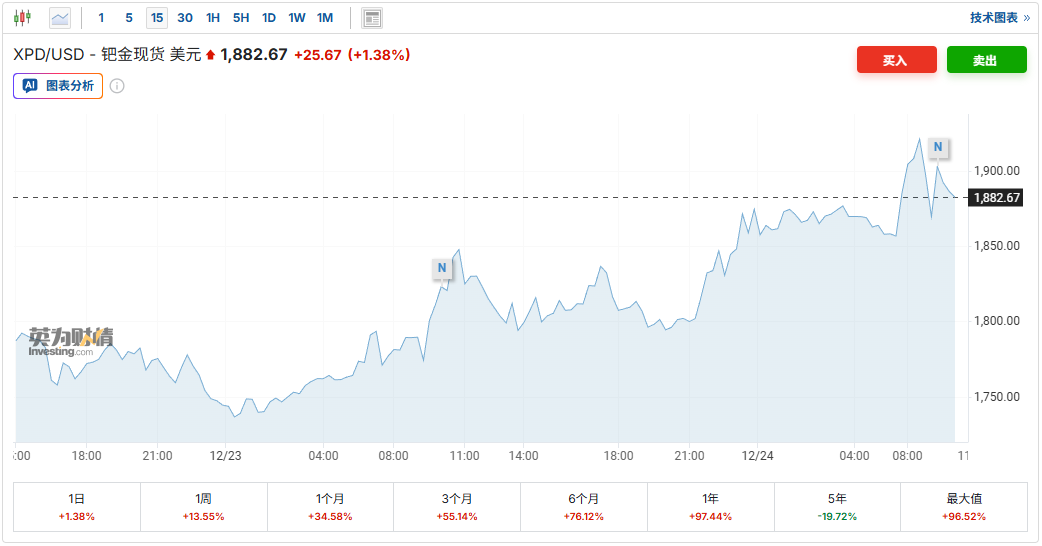
Some analysts pointed out that behind this round of the precious metals bull market is a combination of factors such as macro-easing expectations, tight spot supply, demand resilience, and resonance in the precious metals sector. The weakening dollar and rising expectations for the Fed to cut interest rates — in particular, the market's bets that Kevin Warsh (Kevin Warsh) may be nominated by the Federal Reserve Chairman have lowered US bond yields and precious metals holding costs. UBS analyst Giovanni Staunovo pointed out that strong investor demand, continued central bank purchases, and expectations of lower interest rates in 2026 are all supporting precious metals prices.
In the context of global competition for key resources, “money” and “resources” are undergoing rebalanced pricing. Platinum and palladium, as members of the precious metals sector, have strong production constraints and a high degree of monopoly on the resource side. Looking ahead to the future market, judging from the experience that gold and silver prices have continuously reached record highs, there is still room for platinum and palladium prices in the future.
Market participants believe that the strong pattern of platinum is expected to continue. On the one hand, the tight supply and demand situation of platinum is difficult to improve in the short term, and with the continued development of the hydrogen energy industry, the industrial demand space for platinum will further open up, and the gap between supply and demand may continue to expand. On the other hand, under the logic that capital pursues cost performance, platinum's valuation advantage over gold may continue to attract financial follow-up.
However, some analysts pointed out that whether platinum and palladium prices can remain strong mainly depends on the following key variables: whether rental interest rates and spot price increases can remain high, whether the macroeconomic direction of gold/dollar/interest rates continues to be beneficial, and the rate of supply-side recovery and the extent to which “ground inventory” is released. If high rental interest rates fall back and spot tension abates, the platinum futures side is often prone to fluctuation or backlash. Once gold weakens or interest rate expectations are reversed, platinum will also face pressure, especially in the current volatile environment.
Additionally, some traders and analysts warned that although supply is tight on the platinum mine side, there is still a huge amount of ground inventory around the world. Metals Focus data shows that even when the supply deficit is taken into account, the total inventory may still be equivalent to about 14 months of demand, which forms a pretty comfortable cushion. The possibility of supply recovery also cannot be ignored. South African minerals are expected to show signs of recovery after the second quarter of next year, and the decline in mineral supply for the whole year is expected to be controlled at around 6%. At the same time, high platinum prices may cause material substitution risks. When the price difference between platinum and palladium exceeds 30%, catalyst manufacturers may increase the proportion of palladium used.