
- LIVE QUOTES
- LEARN
- HELP
 Nasdaq
 Wall Street Journal
EN
KPMG releases “China Outlook for Multinational Enterprises 2025” (Chinese version): Multinational companies cast a vote of confidence in the Chinese economy
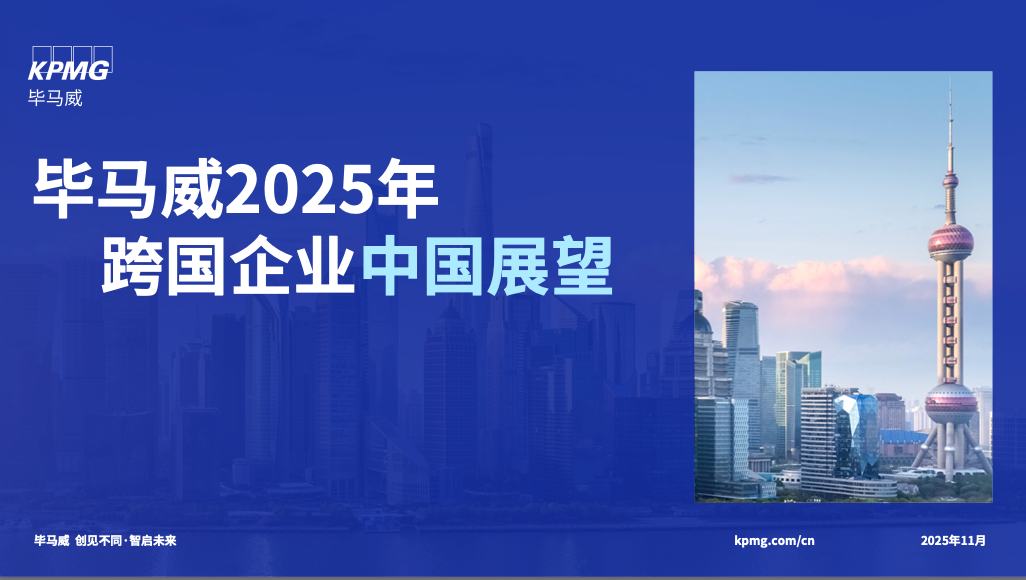
The Zhitong Finance App learned that currently, China is undergoing a deep evolution from a “world factory” to a “global innovation center”. The “dual carbon” goal is driving green transformation, and the digital economy is accelerating integration with the real economy, bringing unprecedented opportunities to multinational enterprises. Accurately grasping the pulse of the Chinese market and forward-looking layout of the future has become a core issue for multinational enterprises to achieve sustainable development. To this end, KPMG recently released the Chinese version of the “China Outlook for Multinational Enterprises 2025” (hereinafter referred to as the “Report”). The “Report” revealed new trends in the development of multinational enterprises in China based on in-depth research on 137 multinational enterprises.
Jiang Liqin, KPMG's partner in charge of customer and business development in China, pointed out that structural innovation and upgrading in the Chinese market is driving multinational companies to re-examine their strategies in China. It can also be seen from this report that multinational enterprises have expressed confidence in long-term development in China. More and more enterprises are shifting their strategic focus from simply pursuing expansion to focusing on profit models, improving operational efficiency, optimizing pricing strategies, increasing profit margins, and building strategic competitiveness in the Chinese market.
Over 90% of enterprises have identified digital transformation as the core of their strategy in China
Digital transformation drives changes in production, life, and governance methods. It is not only a strategic choice for enterprises themselves, but also the key to resonating with China's national strategy. Facing China's increasingly fierce market competition and rapidly iterative technological environment, digital transformation has become a key gripper for multinational enterprises to enhance their competitiveness. According to the “Report”, more than 90% of the companies surveyed plan (or have) invested in digitalization. Among them, 52% of companies make “strengthening data analysis capabilities” a top priority, 46% are committed to “upgrading information technology infrastructure,” and 36% are actively “investing in emerging technologies.”
In terms of applying artificial intelligence, the “Report” shows that 58% of multinational enterprises have already used artificial intelligence tools in their business operations. Furthermore, cybersecurity has become a strategic driver of China's digital transformation, and as multinational companies seek to promote the technology and artificial intelligence capabilities developed in China on a global scale, differences in domestic and international cybersecurity standards have led to more and more operational and compliance challenges, and bridging these differences is critical to maintaining trust and resilience. Only by adapting governance frameworks, strengthening cross-border cooperation, and integrating cybersecurity into every stage of innovation can enterprises better achieve secure and sustainable growth.
The marked increase in mergers and acquisitions of multinational enterprises shows confidence in investing in China
Looking at industry differentiation, multinational enterprises in most industries believe that the Chinese economy will clearly recover in the short to medium term, and are more optimistic about the revenue growth prospects in China over the next three to five years. 94% of companies are still investing and betting on the Chinese market, and 75% of the multinational companies surveyed will maintain or increase their investment in mainland China in 2025.
Mark Harrison (Mark Harrison), KPMG's China Multinational Enterprise Channel Co-Managing Partner, said that in the past six months, there has been a significant increase in M&A activity by multinational companies in China, mainly driven by two key strategies. First, global multinational companies are acquiring outstanding companies in the fields of electric vehicles, medical technology, biotechnology, water technology, advanced materials, and robotics to help tap global business potential and make full use of production capacity. Second, in the field closer to consumers, in the face of fierce local competition and challenging markets, multinational companies are vertically integrating through acquisitions of distributors, agents, and foundries to better understand and serve Chinese consumers.
In the context of the beginning of the “15th Five-Year Plan” and China's continued promotion of institutional openness, for multinational enterprises, this is not only a period of strategic opportunity to continue to deeply cultivate the Chinese market, but also a critical period for them to transform from participants to co-builders. Standing at a new starting point, digital transformation is no longer just a technological upgrade. The depth of digital insight and resilience in compliance management are becoming the core capabilities of enterprises to integrate into China's high-quality development process. Only through technological empowerment, compliance management, and strategic collaboration can multinational enterprises truly achieve the leap from “entering” to “integration”, and grow and develop together with the Chinese market.