
- LIVE QUOTES
- LEARN
- HELP
 Nasdaq
 Wall Street Journal
EN
What to Expect From PNC Financial Services’ Next Quarterly Earnings Report
Pittsburgh, Pennsylvania-based The PNC Financial Services Group, Inc. (PNC) operates as a diversified financial services company. With a market cap of $82.5 billion, the company provides regional banking, wholesale banking, and asset management services nationally and in its primary regional markets. The company is expected to announce its fiscal fourth-quarter earnings for 2025 before the market opens on Friday, Jan. 16, 2026.
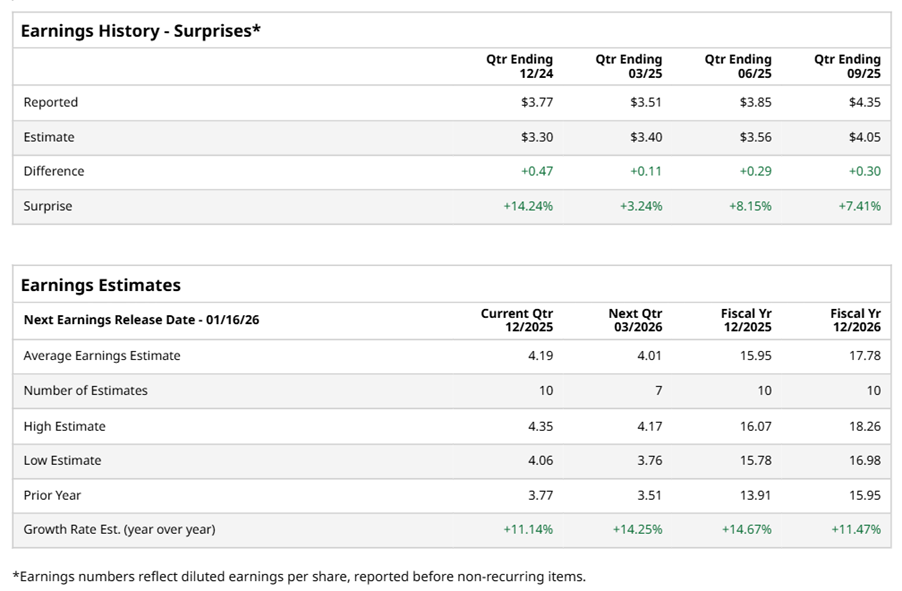
Ahead of the event, analysts expect PNC to report a profit of $4.19 per share on a diluted basis, up 11.1% from $3.77 per share in the year-ago quarter. The company has consistently surpassed Wall Street’s EPS estimates in its last four quarterly reports.
For the full year, analysts expect PNC to report EPS of $15.95, up 14.7% from $13.91 in fiscal 2024. Its EPS is expected to rise 11.5% year over year to $17.78 in fiscal 2026.
PNC stock has underperformed the S&P 500 Index’s ($SPX) 15.4% gains over the past 52 weeks, with shares up 9.1% during this period. Similarly, it underperformed the Financial Select Sector SPDR Fund’s (XLF) 14.5% returns over the same time frame.
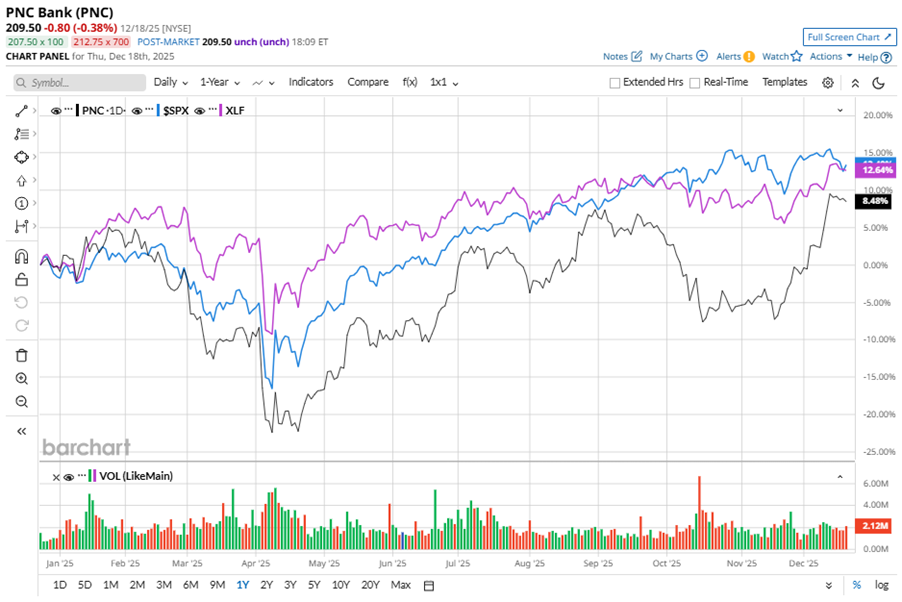
PNC's underperformance is attributable to weaknesses in core lending operations, indicating a potential slowdown in profitability. This led to a negative market reaction despite a solid report.
On Oct. 15, PNC shares closed down by 3.9% after reporting its Q3 results. Its revenue stood at $5.9 billion, up 8.9% year over year. The company’s EPS increased 24.6% year over year to $4.35.
Analysts’ consensus opinion on PNC stock is moderately bullish, with a “Moderate Buy” rating overall. Out of 24 analysts covering the stock, 14 advise a “Strong Buy” rating, three suggest a “Moderate Buy,” six give a “Hold,” and one recommends a “Strong Sell.” PNC’s average analyst price target is $223.19, indicating a potential upside of 6.5% from the current levels.
On the date of publication, Neha Panjwani did not have (either directly or indirectly) positions in any of the securities mentioned in this article. All information and data in this article is solely for informational purposes. For more information please view the Barchart Disclosure Policy here.