
- LIVE QUOTES
- LEARN
- HELP
 Nasdaq
 Wall Street Journal
EN
We Think Booking Resort (TSE:324A) Can Manage Its Debt With Ease
Some say volatility, rather than debt, is the best way to think about risk as an investor, but Warren Buffett famously said that 'Volatility is far from synonymous with risk.' So it might be obvious that you need to consider debt, when you think about how risky any given stock is, because too much debt can sink a company. We note that Booking Resort Co., Ltd. (TSE:324A) does have debt on its balance sheet. But is this debt a concern to shareholders?
When Is Debt Dangerous?
Debt assists a business until the business has trouble paying it off, either with new capital or with free cash flow. In the worst case scenario, a company can go bankrupt if it cannot pay its creditors. However, a more common (but still painful) scenario is that it has to raise new equity capital at a low price, thus permanently diluting shareholders. Of course, plenty of companies use debt to fund growth, without any negative consequences. When we think about a company's use of debt, we first look at cash and debt together.
What Is Booking Resort's Debt?
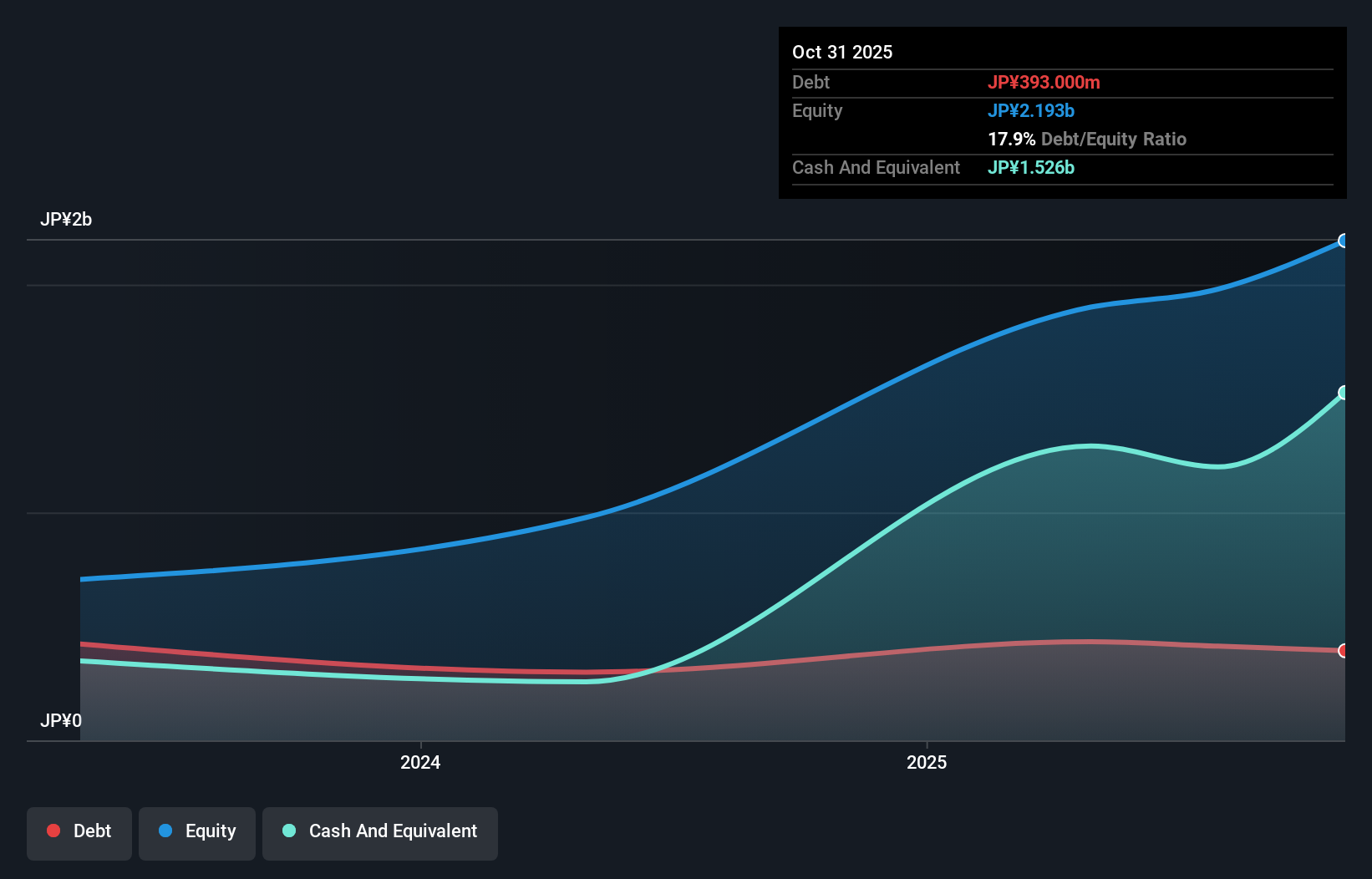
As you can see below, Booking Resort had JP¥393.0m of debt at October 2025, down from JP¥433.0m a year prior. However, its balance sheet shows it holds JP¥1.53b in cash, so it actually has JP¥1.13b net cash.
A Look At Booking Resort's Liabilities
Zooming in on the latest balance sheet data, we can see that Booking Resort had liabilities of JP¥359.0m due within 12 months and liabilities of JP¥315.0m due beyond that. On the other hand, it had cash of JP¥1.53b and JP¥206.0m worth of receivables due within a year. So it actually has JP¥1.06b more liquid assets than total liabilities.
This surplus suggests that Booking Resort is using debt in a way that is appears to be both safe and conservative. Because it has plenty of assets, it is unlikely to have trouble with its lenders. Simply put, the fact that Booking Resort has more cash than debt is arguably a good indication that it can manage its debt safely.
See our latest analysis for Booking Resort
Another good sign is that Booking Resort has been able to increase its EBIT by 22% in twelve months, making it easier to pay down debt. When analysing debt levels, the balance sheet is the obvious place to start. But you can't view debt in total isolation; since Booking Resort will need earnings to service that debt. So if you're keen to discover more about its earnings, it might be worth checking out this graph of its long term earnings trend.
Finally, while the tax-man may adore accounting profits, lenders only accept cold hard cash. Booking Resort may have net cash on the balance sheet, but it is still interesting to look at how well the business converts its earnings before interest and tax (EBIT) to free cash flow, because that will influence both its need for, and its capacity to manage debt. Looking at the most recent three years, Booking Resort recorded free cash flow of 25% of its EBIT, which is weaker than we'd expect. That's not great, when it comes to paying down debt.
Summing Up
While we empathize with investors who find debt concerning, you should keep in mind that Booking Resort has net cash of JP¥1.13b, as well as more liquid assets than liabilities. And we liked the look of last year's 22% year-on-year EBIT growth. So is Booking Resort's debt a risk? It doesn't seem so to us. There's no doubt that we learn most about debt from the balance sheet. However, not all investment risk resides within the balance sheet - far from it. Be aware that Booking Resort is showing 2 warning signs in our investment analysis , you should know about...
If, after all that, you're more interested in a fast growing company with a rock-solid balance sheet, then check out our list of net cash growth stocks without delay.
Have feedback on this article? Concerned about the content? Get in touch with us directly. Alternatively, email editorial-team (at) simplywallst.com.
This article by Simply Wall St is general in nature. We provide commentary based on historical data and analyst forecasts only using an unbiased methodology and our articles are not intended to be financial advice. It does not constitute a recommendation to buy or sell any stock, and does not take account of your objectives, or your financial situation. We aim to bring you long-term focused analysis driven by fundamental data. Note that our analysis may not factor in the latest price-sensitive company announcements or qualitative material. Simply Wall St has no position in any stocks mentioned.