
- LIVE QUOTES
- LEARN
- HELP
 Nasdaq
 Wall Street Journal
EN
Hanyang Digitech (KOSDAQ:078350) Takes On Some Risk With Its Use Of Debt
Howard Marks put it nicely when he said that, rather than worrying about share price volatility, 'The possibility of permanent loss is the risk I worry about... and every practical investor I know worries about.' When we think about how risky a company is, we always like to look at its use of debt, since debt overload can lead to ruin. Importantly, Hanyang Digitech Co., Ltd. (KOSDAQ:078350) does carry debt. But is this debt a concern to shareholders?
Why Does Debt Bring Risk?
Debt assists a business until the business has trouble paying it off, either with new capital or with free cash flow. Ultimately, if the company can't fulfill its legal obligations to repay debt, shareholders could walk away with nothing. However, a more frequent (but still costly) occurrence is where a company must issue shares at bargain-basement prices, permanently diluting shareholders, just to shore up its balance sheet. Of course, debt can be an important tool in businesses, particularly capital heavy businesses. The first step when considering a company's debt levels is to consider its cash and debt together.
What Is Hanyang Digitech's Net Debt?
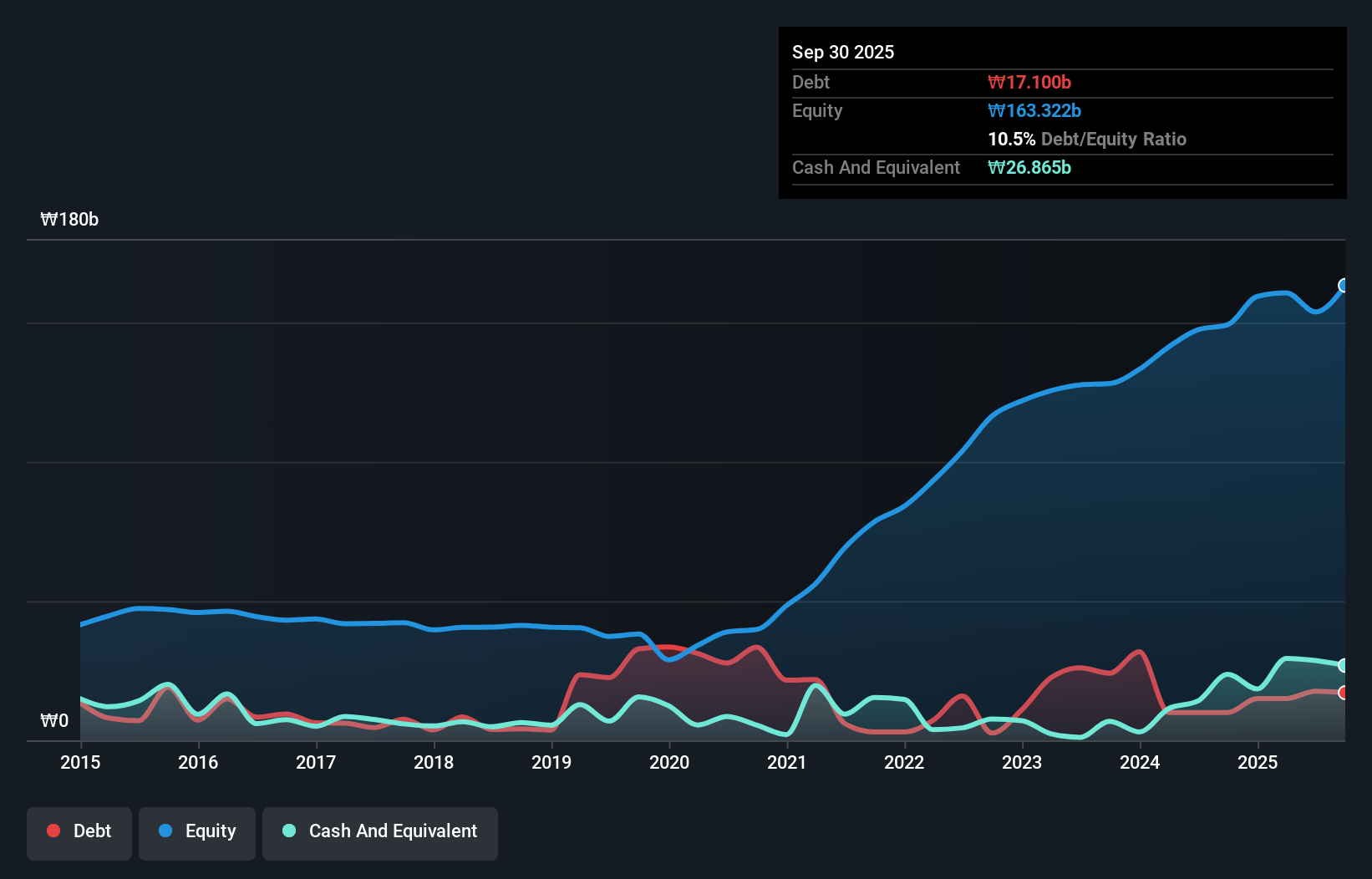
You can click the graphic below for the historical numbers, but it shows that as of September 2025 Hanyang Digitech had ₩17.1b of debt, an increase on ₩10.0b, over one year. However, it does have ₩26.9b in cash offsetting this, leading to net cash of ₩9.76b.
How Strong Is Hanyang Digitech's Balance Sheet?
According to the last reported balance sheet, Hanyang Digitech had liabilities of ₩115.5b due within 12 months, and liabilities of ₩8.02b due beyond 12 months. On the other hand, it had cash of ₩26.9b and ₩64.6b worth of receivables due within a year. So its liabilities outweigh the sum of its cash and (near-term) receivables by ₩32.1b.
Of course, Hanyang Digitech has a market capitalization of ₩267.3b, so these liabilities are probably manageable. But there are sufficient liabilities that we would certainly recommend shareholders continue to monitor the balance sheet, going forward. Despite its noteworthy liabilities, Hanyang Digitech boasts net cash, so it's fair to say it does not have a heavy debt load!
See our latest analysis for Hanyang Digitech
The modesty of its debt load may become crucial for Hanyang Digitech if management cannot prevent a repeat of the 26% cut to EBIT over the last year. When it comes to paying off debt, falling earnings are no more useful than sugary sodas are for your health. When analysing debt levels, the balance sheet is the obvious place to start. But you can't view debt in total isolation; since Hanyang Digitech will need earnings to service that debt. So if you're keen to discover more about its earnings, it might be worth checking out this graph of its long term earnings trend.
Finally, while the tax-man may adore accounting profits, lenders only accept cold hard cash. While Hanyang Digitech has net cash on its balance sheet, it's still worth taking a look at its ability to convert earnings before interest and tax (EBIT) to free cash flow, to help us understand how quickly it is building (or eroding) that cash balance. Over the last three years, Hanyang Digitech reported free cash flow worth 11% of its EBIT, which is really quite low. That limp level of cash conversion undermines its ability to manage and pay down debt.
Summing Up
While Hanyang Digitech does have more liabilities than liquid assets, it also has net cash of ₩9.76b. So while Hanyang Digitech does not have a great balance sheet, it's certainly not too bad. The balance sheet is clearly the area to focus on when you are analysing debt. However, not all investment risk resides within the balance sheet - far from it. For instance, we've identified 3 warning signs for Hanyang Digitech (1 is a bit unpleasant) you should be aware of.
Of course, if you're the type of investor who prefers buying stocks without the burden of debt, then don't hesitate to discover our exclusive list of net cash growth stocks, today.
Have feedback on this article? Concerned about the content? Get in touch with us directly. Alternatively, email editorial-team (at) simplywallst.com.
This article by Simply Wall St is general in nature. We provide commentary based on historical data and analyst forecasts only using an unbiased methodology and our articles are not intended to be financial advice. It does not constitute a recommendation to buy or sell any stock, and does not take account of your objectives, or your financial situation. We aim to bring you long-term focused analysis driven by fundamental data. Note that our analysis may not factor in the latest price-sensitive company announcements or qualitative material. Simply Wall St has no position in any stocks mentioned.