
- LIVE QUOTES
- LEARN
- HELP
 Nasdaq
 Wall Street Journal
EN
Is Cabot’s Recent Share Price Rebound Creating a 2025 Value Opportunity?
- If you have been wondering whether Cabot is quietly turning into a value opportunity, you are not alone. The recent setup makes it worth a closer look.
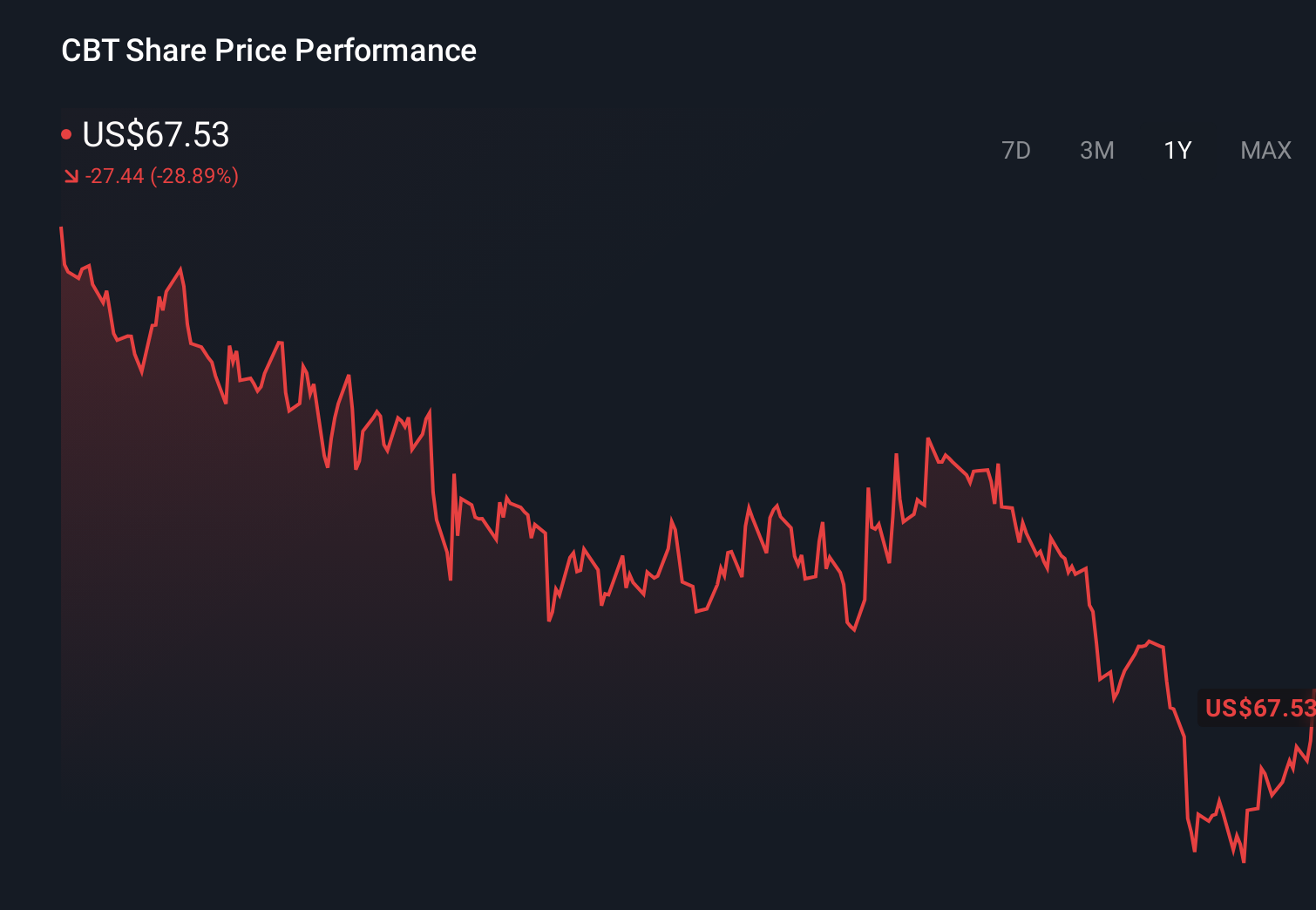
- The stock has bounced about 4.6% over the last week and 10.9% over the last month. Yet it is still down roughly 23.1% year to date and 32.3% over the past year, which is a classic profile for a potential mispricing rather than a broken business.
- Recent headlines have focused on Cabot's positioning in performance materials and specialty chemicals, with investors paying attention to how the company is leaning into higher value applications across industrial and sustainability linked end markets. At the same time, broader sentiment toward cyclical materials names has been shifting, which helps explain both the earlier sell off and the more recent recovery in the share price.
- On our framework Cabot scores a 3/6 valuation check score, suggesting the market may be underestimating part of the story. Next we will walk through the different valuation approaches investors are using today before circling back to an even more useful way of thinking about what the shares are really worth in the long run.
Find out why Cabot's -32.3% return over the last year is lagging behind its peers.
Approach 1: Cabot Discounted Cash Flow (DCF) Analysis
A Discounted Cash Flow, or DCF, model estimates what a business is worth by projecting the cash it can generate in the future and then discounting those cash flows back to today in dollar terms. For Cabot, the 2 Stage Free Cash Flow to Equity model starts from last twelve months free cash flow of about $414.2 million and then uses analyst forecasts and extrapolated estimates to map out the next decade.
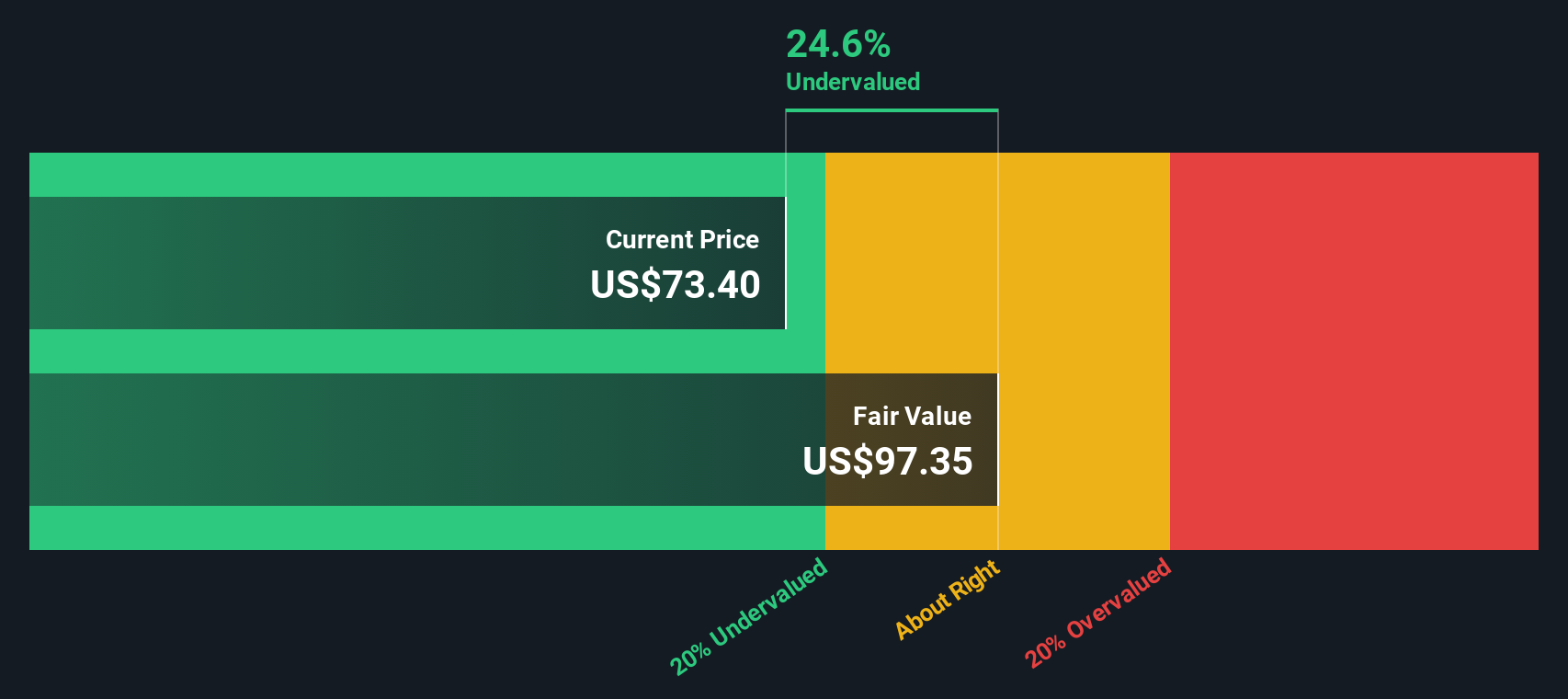
Analysts currently project free cash flow of around $296 million by 2027, with Simply Wall St extending those forecasts out to 2035, where free cash flow is estimated at roughly $258.2 million. Discounting all of those projected cash flows back to today results in an estimated intrinsic value of about $82.67 per share. Compared with the current share price, this implies Cabot is trading at roughly a 17.3% discount. This suggests the market may be too pessimistic about its long term cash generating power.
Result: UNDERVALUED
Our Discounted Cash Flow (DCF) analysis suggests Cabot is undervalued by 17.3%. Track this in your watchlist or portfolio, or discover 908 more undervalued stocks based on cash flows.
Approach 2: Cabot Price vs Earnings
For a steady, profitable business like Cabot, the price to earnings, or PE, ratio is often the cleanest way to see how much investors are paying for each dollar of current profit. In general, faster growth and lower risk justify a higher PE, while slower growth, more cyclicality, or balance sheet concerns usually mean a lower “normal” or “fair” PE.
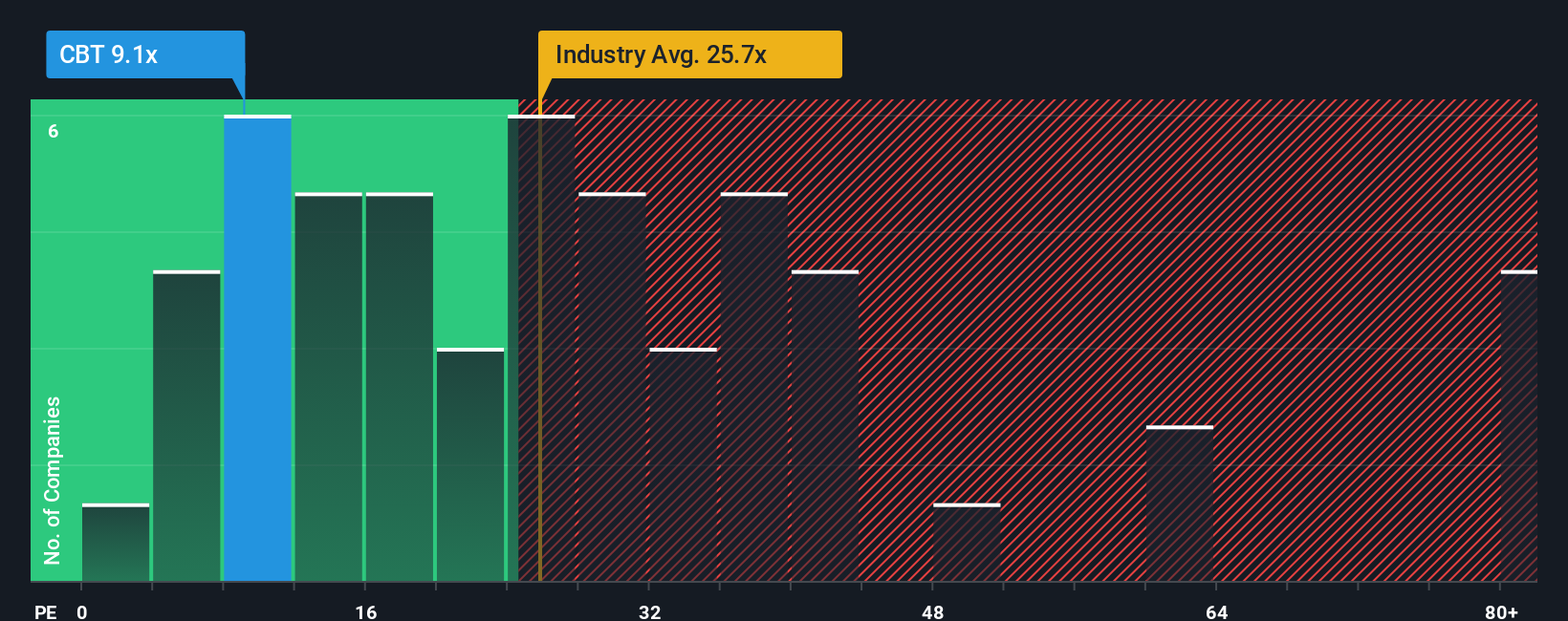
Cabot currently trades on a PE of about 11.1x, which is well below both the Chemicals industry average of roughly 24.0x and the broader peer group sitting near 33.1x. That gap suggests the market is treating Cabot as a much lower quality or riskier name than many of its competitors.
Simply Wall St’s Fair Ratio framework goes a step further by estimating what PE Cabot should trade on once you factor in its earnings growth profile, margins, industry, market cap, and company specific risks. Because it ties the multiple directly to Cabot’s fundamentals rather than blunt comparisons, it is a more precise yardstick than simply lining the stock up against peers or industry averages. On this basis, Cabot’s intrinsic Fair Ratio sits meaningfully above its current 11.1x multiple, which indicates that the market may still be discounting the stock too heavily.
Result: UNDERVALUED
PE ratios tell one story, but what if the real opportunity lies elsewhere? Discover 1445 companies where insiders are betting big on explosive growth.
Upgrade Your Decision Making: Choose your Cabot Narrative
Earlier we mentioned that there is an even better way to understand valuation, so let us introduce you to Narratives, which are simply your story about a company, captured in a set of assumptions about its future revenue, earnings, margins, and ultimately its fair value. A Narrative connects three things: what you believe about Cabot’s business, how that belief translates into a forecast, and what price those cash flows imply the shares are worth today. Narratives on Simply Wall St, available to millions of investors via the Community page, make this process easy and accessible by turning your expectations into a structured valuation you can compare with Cabot’s current market price to help decide whether to buy, hold, or sell. Because Narratives are updated dynamically as new information arrives, such as earnings reports or major news, your fair value view stays current rather than going stale. For example, one Cabot Narrative might assume robust demand for specialty materials and justify a materially higher fair value, while another could assume slower growth and cyclical headwinds, leading to a meaningfully lower estimate.
Do you think there's more to the story for Cabot? Head over to our Community to see what others are saying!
This article by Simply Wall St is general in nature. We provide commentary based on historical data and analyst forecasts only using an unbiased methodology and our articles are not intended to be financial advice. It does not constitute a recommendation to buy or sell any stock, and does not take account of your objectives, or your financial situation. We aim to bring you long-term focused analysis driven by fundamental data. Note that our analysis may not factor in the latest price-sensitive company announcements or qualitative material. Simply Wall St has no position in any stocks mentioned.
Have feedback on this article? Concerned about the content? Get in touch with us directly. Alternatively, email editorial-team@simplywallst.com