
- LIVE QUOTES
- LEARN
- HELP
 Nasdaq
 Wall Street Journal
EN
Is Colbún S.A.'s (SNSE:COLBUN) Recent Price Movement Underpinned By Its Weak Fundamentals?
It is hard to get excited after looking at Colbún's (SNSE:COLBUN) recent performance, when its stock has declined 3.9% over the past three months. It seems that the market might have completely ignored the positive aspects of the company's fundamentals and decided to weigh-in more on the negative aspects. Stock prices are usually driven by a company’s financial performance over the long term, and therefore we decided to pay more attention to the company's financial performance. In this article, we decided to focus on Colbún's ROE.
Return on equity or ROE is an important factor to be considered by a shareholder because it tells them how effectively their capital is being reinvested. In other words, it is a profitability ratio which measures the rate of return on the capital provided by the company's shareholders.
How Is ROE Calculated?
The formula for return on equity is:
Return on Equity = Net Profit (from continuing operations) ÷ Shareholders' Equity
So, based on the above formula, the ROE for Colbún is:
6.3% = US$210m ÷ US$3.3b (Based on the trailing twelve months to September 2025).
The 'return' refers to a company's earnings over the last year. So, this means that for every CLP1 of its shareholder's investments, the company generates a profit of CLP0.06.
See our latest analysis for Colbún
Why Is ROE Important For Earnings Growth?
We have already established that ROE serves as an efficient profit-generating gauge for a company's future earnings. Based on how much of its profits the company chooses to reinvest or "retain", we are then able to evaluate a company's future ability to generate profits. Generally speaking, other things being equal, firms with a high return on equity and profit retention, have a higher growth rate than firms that don’t share these attributes.
Colbún's Earnings Growth And 6.3% ROE
It is quite clear that Colbún's ROE is rather low. However, when compared to the industry average of 5.1%, we do feel there's definitely more to the company. Having said that, Colbún's net income growth over the past five years is more or less flat. Remember, the company's ROE is quite low to begin with, just that it is higher than the industry average. Hence, this goes some way in explaining the disappointing earnings growth.
From the 0.5% decline reported by the industry in the same period, we infer that Colbún and its industry are both shrinking at a similar rate.
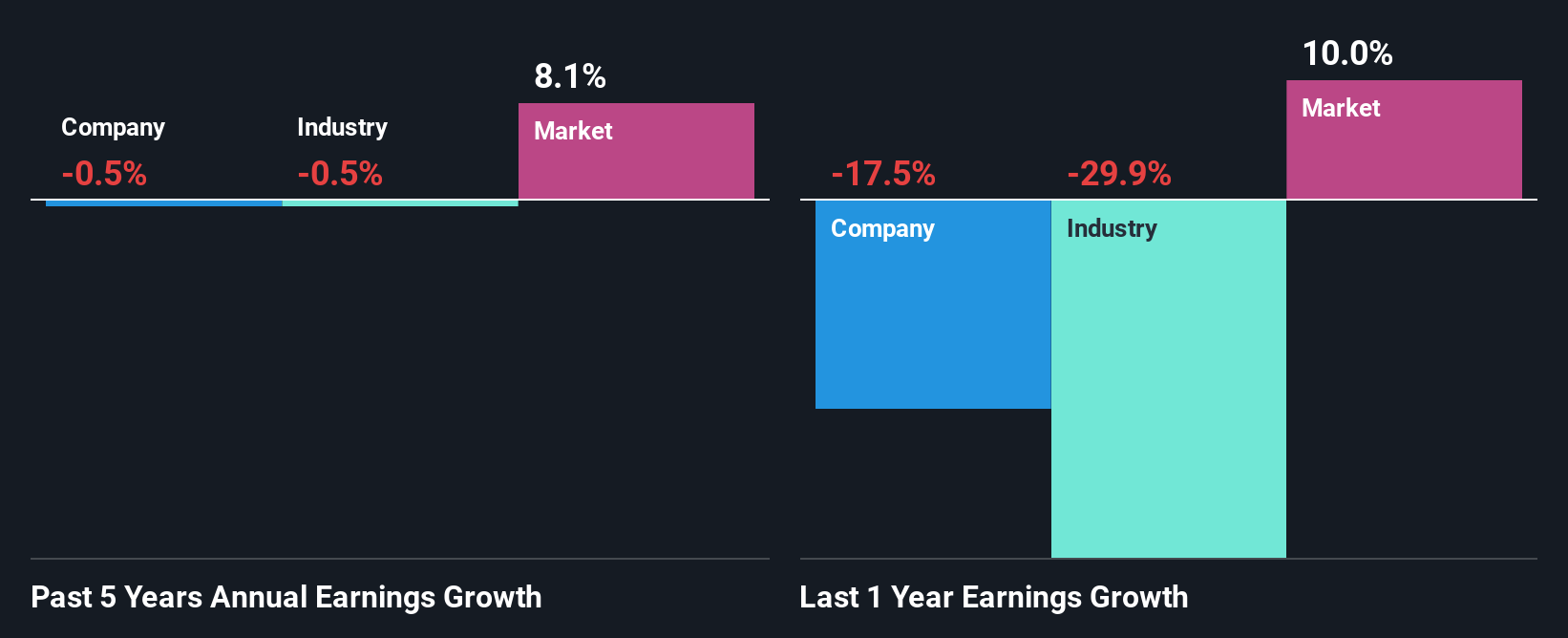
Earnings growth is a huge factor in stock valuation. What investors need to determine next is if the expected earnings growth, or the lack of it, is already built into the share price. By doing so, they will have an idea if the stock is headed into clear blue waters or if swampy waters await. Is Colbún fairly valued compared to other companies? These 3 valuation measures might help you decide.
Is Colbún Using Its Retained Earnings Effectively?
The high three-year median payout ratio of 50% (meaning, the company retains only 50% of profits) for Colbún suggests that the company's earnings growth was miniscule as a result of paying out a majority of its earnings.
In addition, Colbún has been paying dividends over a period of at least ten years suggesting that keeping up dividend payments is way more important to the management even if it comes at the cost of business growth. Looking at the current analyst consensus data, we can see that the company's future payout ratio is expected to rise to 63% over the next three years. Regardless, the future ROE for Colbún is speculated to rise to 8.7% despite the anticipated increase in the payout ratio. There could probably be other factors that could be driving the future growth in the ROE.
Conclusion
In total, we're a bit ambivalent about Colbún's performance. Specifically, the low earnings growth is a bit concerning, especially given that the company has a respectable rate of return. Investors may have benefitted, had the company been reinvesting more of its earnings. As discussed earlier, the company is retaining a small portion of its profits. That being so, the latest industry analyst forecasts show that the analysts are expecting to see a huge improvement in the company's earnings growth rate. To know more about the latest analysts predictions for the company, check out this visualization of analyst forecasts for the company.
Have feedback on this article? Concerned about the content? Get in touch with us directly. Alternatively, email editorial-team (at) simplywallst.com.
This article by Simply Wall St is general in nature. We provide commentary based on historical data and analyst forecasts only using an unbiased methodology and our articles are not intended to be financial advice. It does not constitute a recommendation to buy or sell any stock, and does not take account of your objectives, or your financial situation. We aim to bring you long-term focused analysis driven by fundamental data. Note that our analysis may not factor in the latest price-sensitive company announcements or qualitative material. Simply Wall St has no position in any stocks mentioned.