
- LIVE QUOTES
- LEARN
- HELP
 Nasdaq
 Wall Street Journal
EN
Is Apple’s AI Expansion Enough to Support Its Current Valuation in 2025?
- Wondering if Apple is still worth buying at these levels, or if most of the upside is already priced in? You are not alone. This article will walk through what the current share price really implies.
- Apple has delivered a 14.1% gain year to date and is up 12.7% over the last year. The last week was basically flat at around a 0.2% dip, and the past month saw a modest 1.8% rise, keeping it firmly in long-term compounder territory with a 110.0% 3 year and 125.7% 5 year return profile.
- Recent headlines have focused on Apple expanding deeper into AI features across its ecosystem and ramping investment in on-device intelligence, while also navigating ongoing regulatory scrutiny in the US and Europe around app store practices and competition rules. Those two forces, innovation optimism and regulatory risk, help explain why the stock has been grinding higher but with occasional bouts of volatility as sentiment swings between excitement and caution.
- On our checks, Apple scores just 1 out of 6 for being undervalued, which suggests the market is far from sleeping on this name. Next, we will unpack the usual valuation tools like discounted cash flow and multiples, and then finish with a more holistic way to think about what Apple is really worth.
Apple scores just 1/6 on our valuation checks. See what other red flags we found in the full valuation breakdown.
Approach 1: Apple Discounted Cash Flow (DCF) Analysis
A Discounted Cash Flow, or DCF, model estimates what a company is worth by projecting its future cash flows and then discounting them back to today using a required rate of return. In Apple’s case, this uses a 2 Stage Free Cash Flow to Equity model built on cash flow projections.
Apple currently generates roughly $100 billion in free cash flow. Analysts and extrapolations from Simply Wall St see this rising to around $186.8 billion by 2030. Across the 2026 to 2035 period, projected annual free cash flows range from about $127.7 billion to $229.5 billion. Each year is discounted back to today in dollar terms to reflect risk and the time value of money.
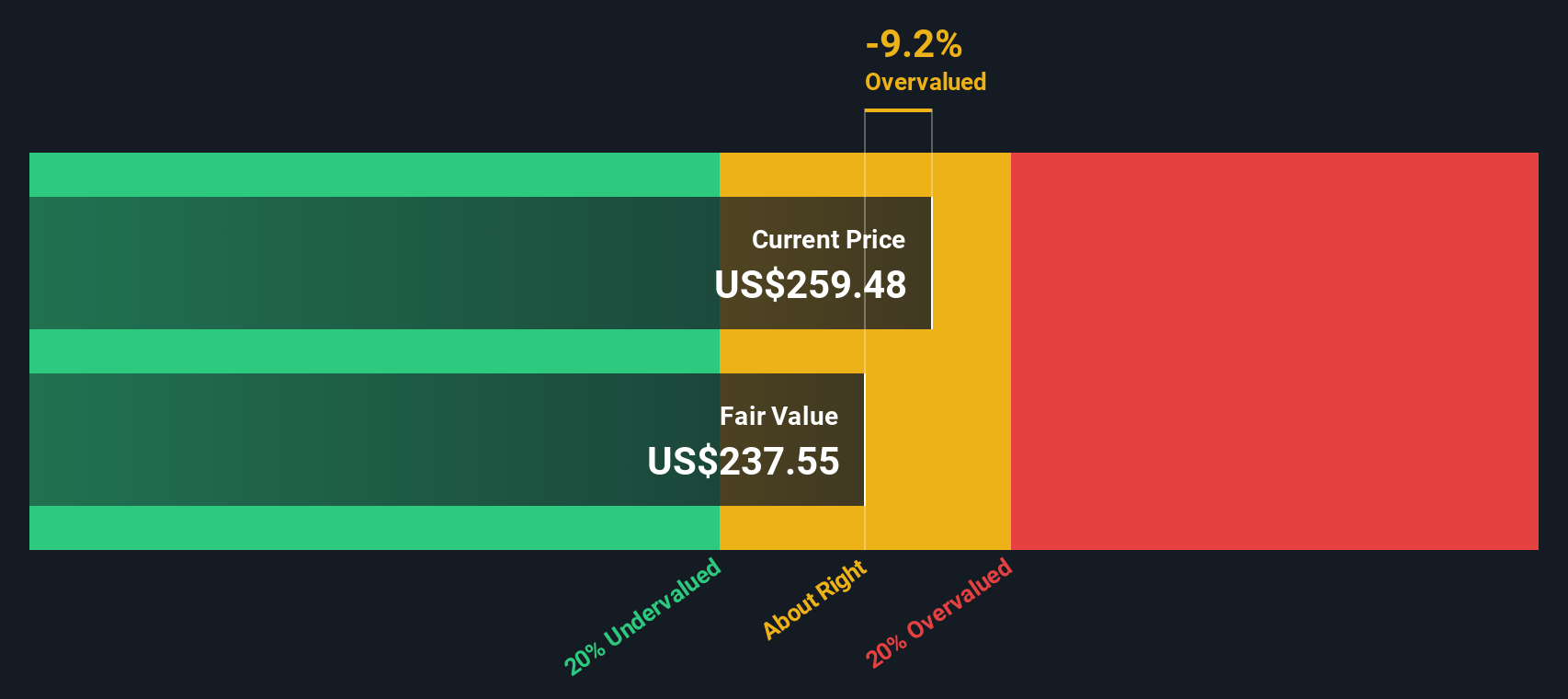
Adding up these discounted cash flows gives an estimated intrinsic value of about $224.06 per share. This is roughly 24.2% above where the stock trades today. This implies that the market price already sits well ahead of what the cash flow math supports and that optimism is baked in.
Result: OVERVALUED
Our Discounted Cash Flow (DCF) analysis suggests Apple may be overvalued by 24.2%. Discover 907 undervalued stocks or create your own screener to find better value opportunities.
Approach 2: Apple Price vs Earnings
For a consistently profitable giant like Apple, the price to earnings ratio is a useful lens because it links what investors pay today to the earnings power the business is already generating. In general, faster, more reliable growth and lower perceived risk justify a higher normal PE ratio, while slower or more uncertain growth should trade on a lower multiple.
Apple currently trades on about 36.7x earnings. That is well above the broader Tech industry average of roughly 22.7x, and also a premium to its peer group at around 33.3x. This suggests investors are paying up for Apple’s scale, brand and ecosystem. Simply Wall St’s Fair Ratio framework estimates what multiple would make sense given Apple’s specific growth profile, margins, industry and risk, and arrives at a fair PE of about 38.3x. This company specific Fair Ratio is more informative than a simple peer or sector comparison because it adjusts for factors like profitability, size and risk.
With the current 36.7x multiple sitting slightly below the 38.3x Fair Ratio, Apple screens as modestly undervalued on this metric, even after its strong run.
Result: UNDERVALUED

PE ratios tell one story, but what if the real opportunity lies elsewhere? Discover 1448 companies where insiders are betting big on explosive growth.
Upgrade Your Decision Making: Choose your Apple Narrative
Earlier we mentioned that there is an even better way to understand valuation, so let us introduce you to Narratives, a simple way to turn your view of a company into a structured story that connects your assumptions to numbers. A Narrative on Simply Wall St lets you describe how you think Apple’s business will evolve, then link that story to a financial forecast for revenue, earnings and margins, and finally to a Fair Value estimate. These Narratives live on the Community page used by millions of investors, and they are easy to create or explore, even if you are not a valuation expert. Once you have a Narrative, you can quickly compare its Fair Value to Apple’s current share price to see how it aligns with your own view, and the platform automatically updates those Narratives as new news, earnings and forecasts come in. For example, some Apple Narratives on the platform see fair value near $177 per share while others are closer to $282 per share, showing how different investors can look at the same company and reach very different, but clearly articulated, conclusions.
For Apple however we'll make it really easy for you with previews of two leading Apple Narratives:
Fair value: $281.75 per share
Implied undervaluation: -1.2%
Revenue growth assumption: 7.02%
- Sees Apple’s expanding installed base in emerging markets and a fast growing, high margin Services ecosystem as key drivers of steadier revenue and margin expansion.
- Expects AI powered features, new device categories, wearables and supply chain optimization to support differentiation, new revenue streams and resilient profitability.
- Recognizes tariff, regulatory and competitive risks but concludes that product momentum and ecosystem depth justify a fair value slightly above the current market price.
Fair value: $177.34 per share
Implied overvaluation: 56.9%
Revenue growth assumption: 14.68%
- Argues that Apple’s elevated PE multiple is not supported by its maturing product portfolio and slowing iPhone driven growth.
- Highlights margin pressure from rising costs, supply chain challenges, saturation in key markets and heavy reliance on China for demand and production.
- Believes the market is overly optimistic, with cash deployment, innovation pace and competitive dynamics failing to justify today’s valuation level.
Do you think there's more to the story for Apple? Head over to our Community to see what others are saying!

This article by Simply Wall St is general in nature. We provide commentary based on historical data and analyst forecasts only using an unbiased methodology and our articles are not intended to be financial advice. It does not constitute a recommendation to buy or sell any stock, and does not take account of your objectives, or your financial situation. We aim to bring you long-term focused analysis driven by fundamental data. Note that our analysis may not factor in the latest price-sensitive company announcements or qualitative material. Simply Wall St has no position in any stocks mentioned.
Have feedback on this article? Concerned about the content? Get in touch with us directly. Alternatively, email editorial-team@simplywallst.com