
- LIVE QUOTES
- LEARN
- HELP
 Nasdaq
 Wall Street Journal
EN
IPO Prospects|Shengtong Special Medicine 2nd Report: The Profit Paradox and Growth Challenge of the “Invisible Champion” of the 10 billion specialty medicine circuit
As China's aging process accelerates and the incidence of chronic non-communicable diseases rises year by year, specialty food is no longer a “niche product” in hospitals. According to the data, the global market size will exceed 14.1 billion US dollars (about 100 billion yuan) in 2023, and is expected to reach 21.8 billion US dollars in 2030, with an annual growth rate of more than 6%. China, as the fastest growing market, is about 14 billion yuan in 2023, and is expected to break the 20 billion mark in 2025, with a compound annual growth rate of 14.16%.
Among the 10 billion racetracks, some runners entered the capital market. According to the Hong Kong Stock Exchange disclosure on December 5, Shengtong Medical (Qingdao) Nutrition and Health Technology Co., Ltd. (abbreviation: Shengtong Medical) submitted a listing application to the main board of the Hong Kong Stock Exchange, and CITIC Securities is the sole sponsor. The company submitted a listing application to the Hong Kong Stock Exchange on June 2 this year.
Profit fluctuations under a growing trend
According to the prospectus, Shengtong Medical is one of the leading specialty food providers in China, focusing on the development, production and sales of specialty food products. In terms of retail sales in 2024, Shengtong Medical has steadily topped the list of local specialty food brands in the Chinese specialty food market, and occupied the fourth seat of all specialty food brands with a market share of 6.3%, and the top of the list of local specialty food brands in the Chinese baby specialty food market, and occupies a third seat among all specialty food brands, with a market share of 9.5%. China's specialty food market and infant specialty food market are highly concentrated. In 2024, the top five will collectively account for 78.0% and 92.9% of the market share, respectively.
In 2005, when there were no independent brands in the Chinese specialty food market, Shengtong Medical established one of the first specialty food departments in China. In 2007, Shengtong Medical was the first Chinese specialty food brand to commercialize specialty food products in China. In 2011, the company became the first enterprise approved to produce specialty food products in China. In January 2025, Shengtong Special Medical's Teai Bingjia and Teai Benjia obtained registration certificates respectively. Teai Benjia is the first and only specialty food for babies with propionic acidemia or methylmalonic acidemia in China. Teai Benjia is the first specialty food for infants with phenylketonuria developed independently by a Chinese brand.
As of November 25, 2025, Shengtong Medical has launched 14 major specialty food products, each with its own unique medical uses and target groups, and 16 major new products are under development. As of the same day, the company ranked first among Chinese specialty food brands in the number of Chinese infant specialty food registration certificates.
As of 2022, 2023, December 31, 2024, and June 30, 2025, Shengtong Medical had 326, 346, 338 and 333 offline distributors respectively. As of June 30, 2025, Shengtong Medical's products were sold to more than 700 hospitals, post-natal care centers and other medical institutions, recommended by them, and sold at more than 16,000 retail locations.
From 2022 to the first half of 2025 (hereinafter referred to as the reporting period), Shengtong Medical's financial data showed a significant “financial paradox”: while maintaining a strong three-year compound growth rate (CAGR=30.4%) on the revenue side, its reported net profit margin experienced sharp fluctuations from 26.1% to 11.3%.
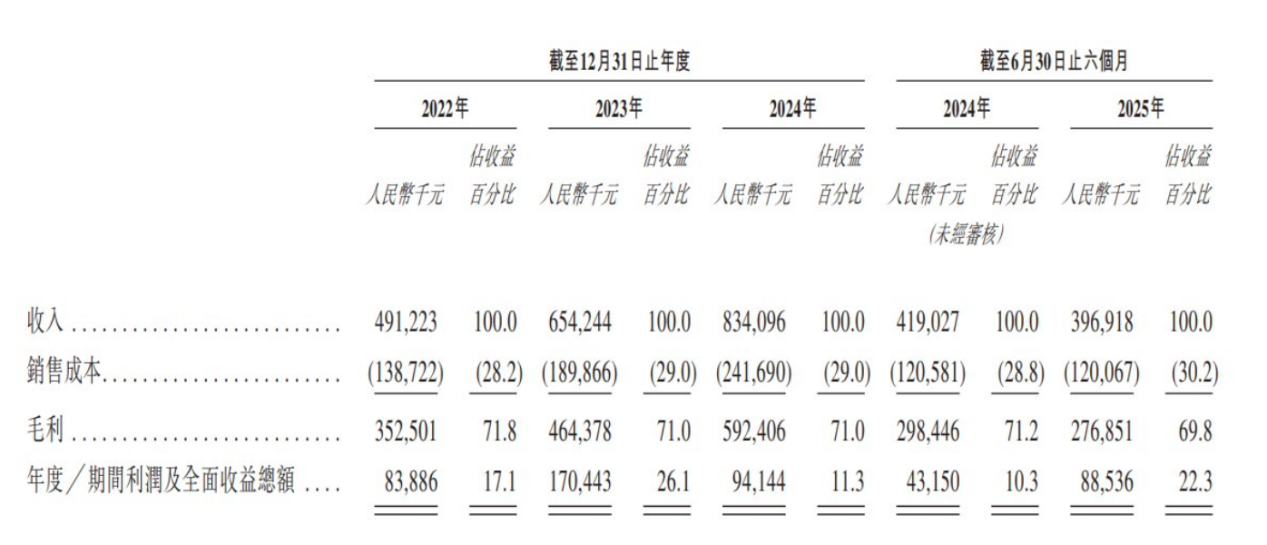
Specifically, the company's revenue rapidly expanded from 491 million yuan in 2022 to 834 million yuan in 2024, with a compound annual growth rate of 30.4%. This level of growth significantly exceeds the average growth rate of China's healthcare industry, indicating that the company is on a segmented circuit with high growth characteristics. The company's gross margin remained high at around 70% for a long time (2022 - 2024:71.8%, 71.0%, 71.0%), and fell slightly to 69.8% in 2025H1. This level is comparable to innovative pharmaceutical companies and high-end software companies, and is their core competitive advantage.
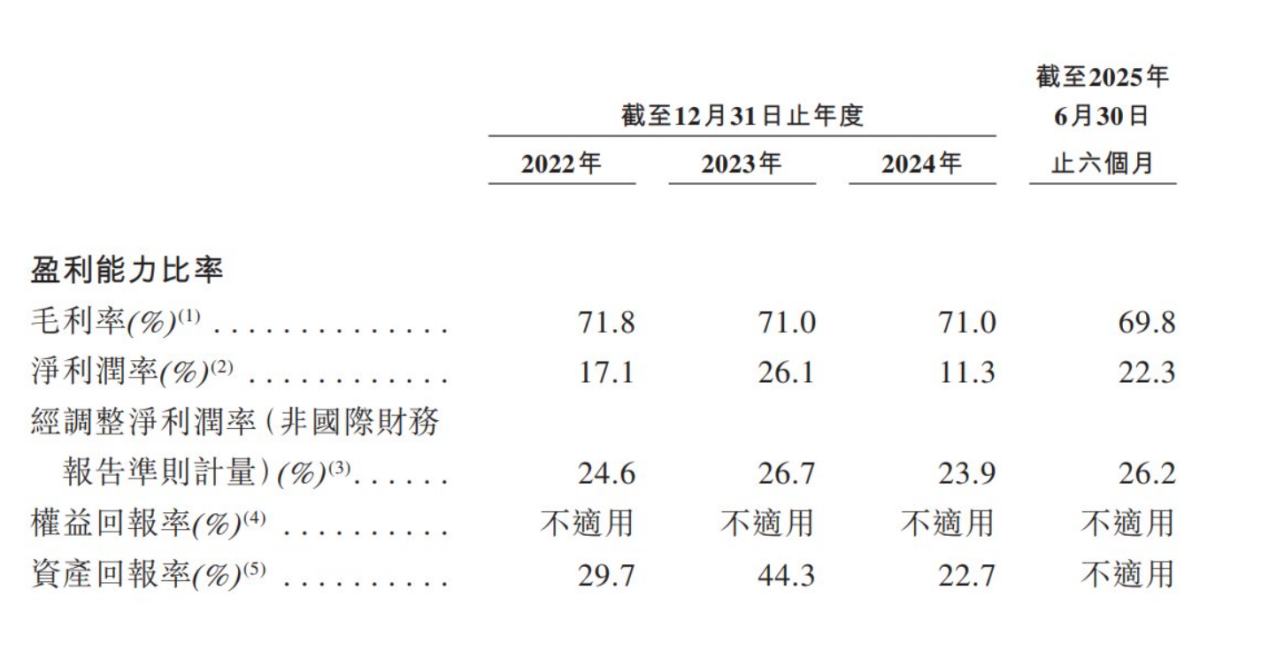
69.8% was a low of nearly three and a half years. Even if it falls by only 1-2 percentage points, the impact on net profit amplification may reach 5-10 percentage points under the influence of financial leverage. We need to be wary of whether this is the beginning of a trend decline. The driving factors may be raw material cost inflation, strategic price cuts to seize the market, or a structural increase in the share of sales in low-margin categories.
Special medicine nutrition “makes a fortune without making a noise”
While the expertise of synthetic biology companies is leading the advanced development of the nutrition and health industry, domestic specialty nutrition is also running in a low-key manner.
As the nutritional demand for specialty medicine increases, the domestic specialty food market is developing rapidly. Research reports show that the compound annual growth rate of China's specialty food market is expected to be 27.8% in 2020-2025, but at the same time, due to the late start — the revised “Food Safety Law” issued by China in 2015 only officially included specialty food in the scope of legal supervision, and specialty food requires high R&D capacity and investment. Domestic products account for far less than imported products. Foreign brands such as Nestle and Abbott are active on the front line of the market, accounting for more than half of the infant specialty nutrition market.
However, with the introduction of favorable policies and the increase in the number of related companies, this gap is gradually narrowing. Since 2024, the approval rate for domestic specialty foods has accelerated markedly. In March of this year, the National Health and Health Commission and the State Administration of Market Supervision issued the “National Food Safety Standard General Rules for Infant Formulas for Special Medical Purposes”. The new national standard has expanded the variety of products, optimized nutritional content, technical indicators, etc., and will be implemented in March 2027.
Today, financing for specialty nutrition companies is showing a concentrated explosion: in the first quarter of this year, three consecutive Chinese specialty nutrition companies received financing, totaling nearly 700 million yuan. Among them, “Shengtong Medical” received more than 400 million yuan in B+ round financing, which is the largest amount of financing in this field in recent years. In addition, “Mars Sarah” received 200 million yuan in Series B financing, and Hong Kong's “Meiyat Medical” received tens of millions of yuan in strategic financing.
According to Insight Consulting data, the penetration rate of specialty foods in China in 2024 is about 3%, far below the level of over 40% in mature markets such as the US. The size of China's specialty food market is expected to grow at a compound annual growth rate of 18.0% to 53.1 billion yuan in 2029. Among them, infant specialty food products account for the largest share of the Chinese specialty food market and are expected to increase to 27.4 billion yuan in 2029 at a compound annual growth rate of 15.1%. Non-infant specialty food products are becoming a new growth engine, and are expected to increase to 25.8 billion yuan in 2029 at a compound annual growth rate of 21.5%.
Among them, Shengtong Specialty Medicine's revenue growth rate exceeds the market — from 2022 to 2024, the compound annual growth rate of China's specialty food market was 26.4% in terms of retail sales, and the average compound annual revenue growth rate of the five major market participants was about 20% during the same period. Thanks to its rapid growth, Shengtong Medical has received investment from well-known institutions such as Honghui Fund, Telford Capital, Innovation Factory, Gao Lin Venture Capital, Hengxu Capital, Caitong Venture Capital, Forebright Global, and CICC Capital.
As the specialty food market grows in the future, the growth momentum of Shengtong Specialty Medicine is still worth looking forward to. However, at present, the company is clearly insolvent, and fluctuations on the profit side are still worth paying attention to.