
- LIVE QUOTES
- LEARN
- HELP
 Nasdaq
 Wall Street Journal
EN
United Maritime Corporation (NASDAQ:USEA) Held Back By Insufficient Growth Even After Shares Climb 28%
United Maritime Corporation (NASDAQ:USEA) shareholders would be excited to see that the share price has had a great month, posting a 28% gain and recovering from prior weakness. While recent buyers may be laughing, long-term holders might not be as pleased since the recent gain only brings the stock back to where it started a year ago.
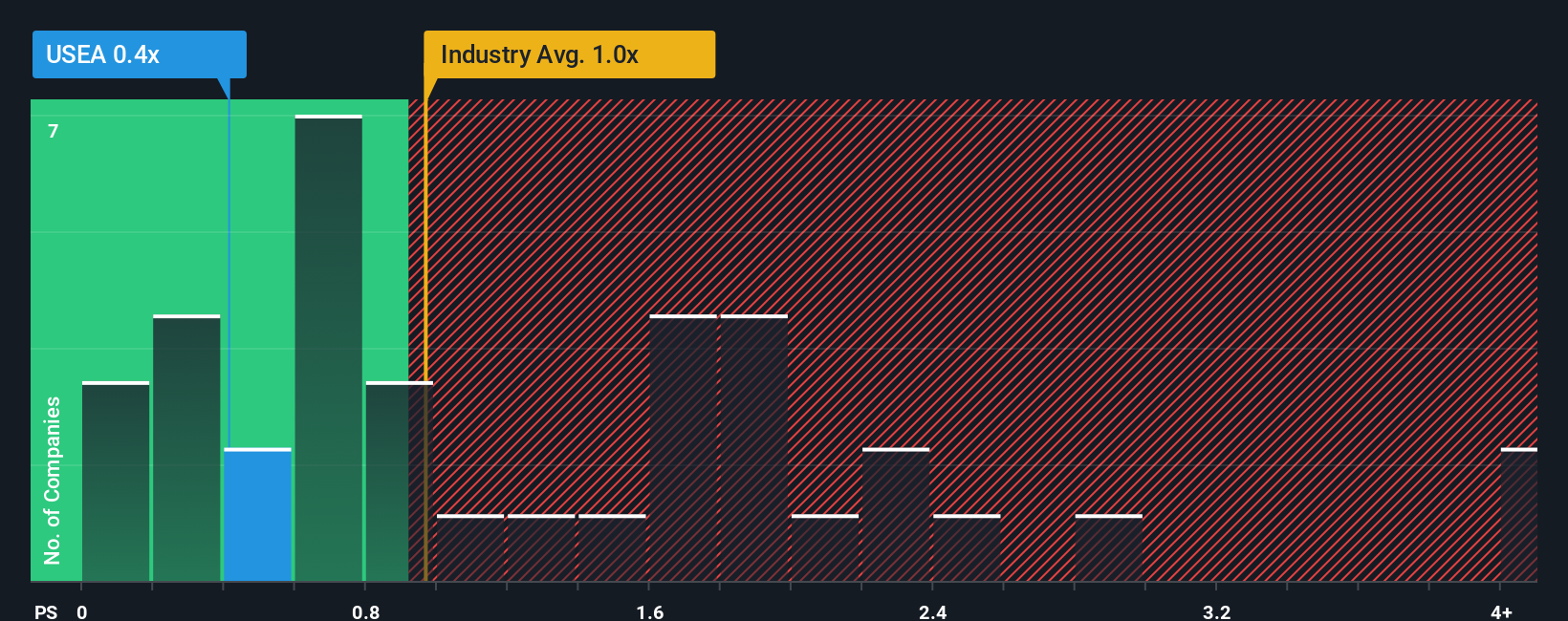
Even after such a large jump in price, when close to half the companies operating in the United States' Shipping industry have price-to-sales ratios (or "P/S") above 1x, you may still consider United Maritime as an enticing stock to check out with its 0.4x P/S ratio. Although, it's not wise to just take the P/S at face value as there may be an explanation why it's limited.
Check out our latest analysis for United Maritime
What Does United Maritime's P/S Mean For Shareholders?
United Maritime hasn't been tracking well recently as its declining revenue compares poorly to other companies, which have seen some growth in their revenues on average. It seems that many are expecting the poor revenue performance to persist, which has repressed the P/S ratio. If this is the case, then existing shareholders will probably struggle to get excited about the future direction of the share price.
If you'd like to see what analysts are forecasting going forward, you should check out our free report on United Maritime.What Are Revenue Growth Metrics Telling Us About The Low P/S?
In order to justify its P/S ratio, United Maritime would need to produce sluggish growth that's trailing the industry.
In reviewing the last year of financials, we were disheartened to see the company's revenues fell to the tune of 9.0%. Still, the latest three year period has seen an excellent 69% overall rise in revenue, in spite of its unsatisfying short-term performance. So we can start by confirming that the company has generally done a very good job of growing revenue over that time, even though it had some hiccups along the way.
Shifting to the future, estimates from the lone analyst covering the company are not good at all, suggesting revenue should decline by 19% over the next year. The industry is also set to see revenue decline 5.6% but the stock is shaping up to perform materially worse.
With this information, it's not too hard to see why United Maritime is trading at a lower P/S in comparison. However, when revenue shrink rapidly the P/S often shrinks too, which could set up shareholders for future disappointment. There's potential for the P/S to fall to even lower levels if the company doesn't improve its top-line growth.
What Does United Maritime's P/S Mean For Investors?
The latest share price surge wasn't enough to lift United Maritime's P/S close to the industry median. It's argued the price-to-sales ratio is an inferior measure of value within certain industries, but it can be a powerful business sentiment indicator.
As expected, our analysis of United Maritime's analyst forecasts confirms that the company's even more precarious outlook against the industry is a major contributor to its low P/S. Right now shareholders are accepting the low P/S as they concede future revenue probably won't provide any pleasant surprises. However, we're still cautious about the company's ability to resist even greater pain to its business from the broader industry turmoil. In the meantime, unless the company's prospects improve they will continue to form a barrier for the share price around these levels.
Before you take the next step, you should know about the 4 warning signs for United Maritime (3 make us uncomfortable!) that we have uncovered.
If you're unsure about the strength of United Maritime's business, why not explore our interactive list of stocks with solid business fundamentals for some other companies you may have missed.
Have feedback on this article? Concerned about the content? Get in touch with us directly. Alternatively, email editorial-team (at) simplywallst.com.
This article by Simply Wall St is general in nature. We provide commentary based on historical data and analyst forecasts only using an unbiased methodology and our articles are not intended to be financial advice. It does not constitute a recommendation to buy or sell any stock, and does not take account of your objectives, or your financial situation. We aim to bring you long-term focused analysis driven by fundamental data. Note that our analysis may not factor in the latest price-sensitive company announcements or qualitative material. Simply Wall St has no position in any stocks mentioned.