
- LIVE QUOTES
- LEARN
- HELP
 Nasdaq
 Wall Street Journal
EN
Is Weakness In Hikari Food Service Co., Ltd. (TSE:138A) Stock A Sign That The Market Could be Wrong Given Its Strong Financial Prospects?
With its stock down 14% over the past month, it is easy to disregard Hikari Food Service (TSE:138A). However, a closer look at its sound financials might cause you to think again. Given that fundamentals usually drive long-term market outcomes, the company is worth looking at. In this article, we decided to focus on Hikari Food Service's ROE.
ROE or return on equity is a useful tool to assess how effectively a company can generate returns on the investment it received from its shareholders. Put another way, it reveals the company's success at turning shareholder investments into profits.
How To Calculate Return On Equity?
Return on equity can be calculated by using the formula:
Return on Equity = Net Profit (from continuing operations) ÷ Shareholders' Equity
So, based on the above formula, the ROE for Hikari Food Service is:
9.7% = JP¥128m ÷ JP¥1.3b (Based on the trailing twelve months to August 2025).
The 'return' is the amount earned after tax over the last twelve months. Another way to think of that is that for every ¥1 worth of equity, the company was able to earn ¥0.10 in profit.
View our latest analysis for Hikari Food Service
Why Is ROE Important For Earnings Growth?
Thus far, we have learned that ROE measures how efficiently a company is generating its profits. Based on how much of its profits the company chooses to reinvest or "retain", we are then able to evaluate a company's future ability to generate profits. Assuming all else is equal, companies that have both a higher return on equity and higher profit retention are usually the ones that have a higher growth rate when compared to companies that don't have the same features.
Hikari Food Service's Earnings Growth And 9.7% ROE
To start with, Hikari Food Service's ROE looks acceptable. And on comparing with the industry, we found that the the average industry ROE is similar at 12%. Consequently, this likely laid the ground for the decent growth of 17% seen over the past five years by Hikari Food Service.
As a next step, we compared Hikari Food Service's net income growth with the industry and were disappointed to see that the company's growth is lower than the industry average growth of 48% in the same period.
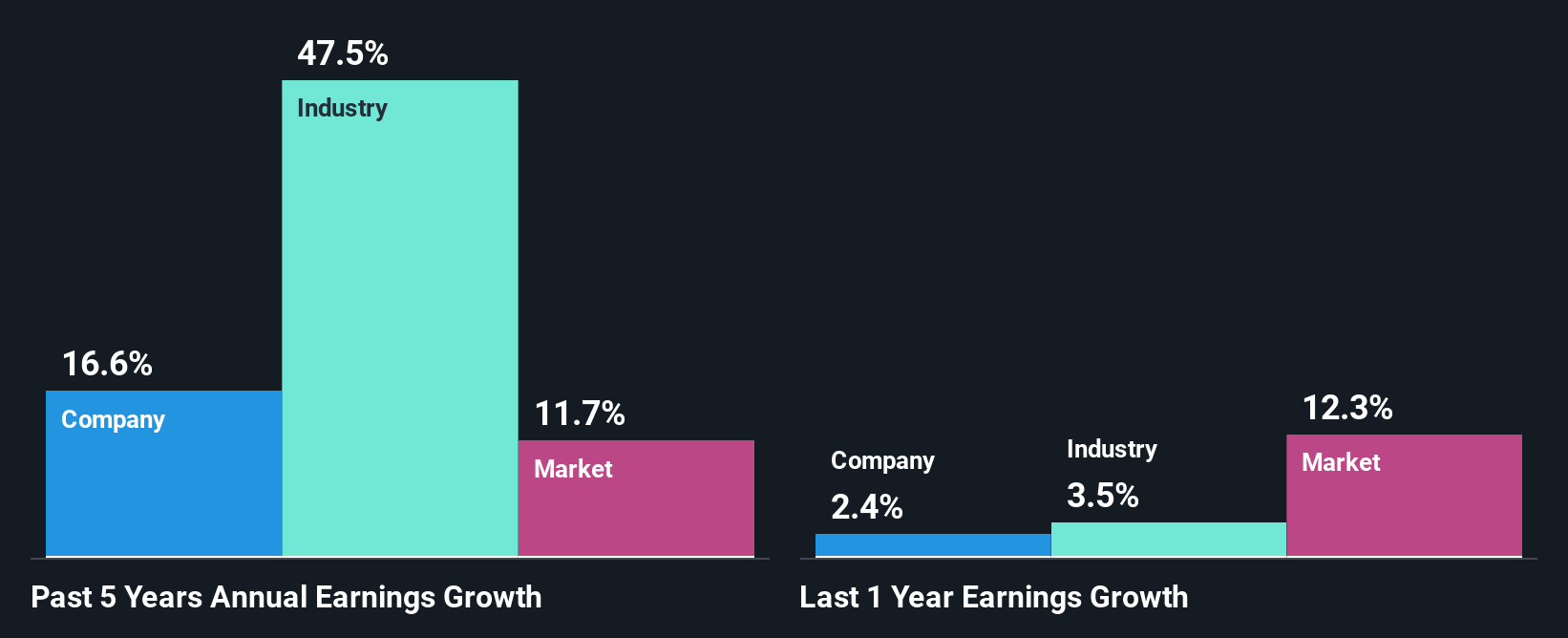
The basis for attaching value to a company is, to a great extent, tied to its earnings growth. It’s important for an investor to know whether the market has priced in the company's expected earnings growth (or decline). By doing so, they will have an idea if the stock is headed into clear blue waters or if swampy waters await. If you're wondering about Hikari Food Service's's valuation, check out this gauge of its price-to-earnings ratio, as compared to its industry.
Is Hikari Food Service Efficiently Re-investing Its Profits?
In Hikari Food Service's case, its respectable earnings growth can probably be explained by its low three-year median payout ratio of 18% (or a retention ratio of 82%), which suggests that the company is investing most of its profits to grow its business.
Along with seeing a growth in earnings, Hikari Food Service only recently started paying dividends. Its quite possible that the company was looking to impress its shareholders.
Conclusion
In total, we are pretty happy with Hikari Food Service's performance. In particular, it's great to see that the company is investing heavily into its business and along with a high rate of return, that has resulted in a respectable growth in its earnings. If the company continues to grow its earnings the way it has, that could have a positive impact on its share price given how earnings per share influence long-term share prices. Not to forget, share price outcomes are also dependent on the potential risks a company may face. So it is important for investors to be aware of the risks involved in the business. To know the 2 risks we have identified for Hikari Food Service visit our risks dashboard for free.
Have feedback on this article? Concerned about the content? Get in touch with us directly. Alternatively, email editorial-team (at) simplywallst.com.
This article by Simply Wall St is general in nature. We provide commentary based on historical data and analyst forecasts only using an unbiased methodology and our articles are not intended to be financial advice. It does not constitute a recommendation to buy or sell any stock, and does not take account of your objectives, or your financial situation. We aim to bring you long-term focused analysis driven by fundamental data. Note that our analysis may not factor in the latest price-sensitive company announcements or qualitative material. Simply Wall St has no position in any stocks mentioned.