
- PRICING
- LIVE QUOTES
- LEARN
- HELP


EN
China Chamber of Commerce for Import and Export of Medicines and Health Products: China's total import and export volume of medical devices reached US$41.09 billion in the first half of the year, up 1.1% year-on-year
The Zhitong Finance App learned that according to statistics from the China Chamber of Commerce for Import and Export of Medicines and Health Products, in the first half of 2025, China's total import and export volume of medical devices reached 41.09 billion US dollars, an increase of 1.1% year on year; of these, the export value was 24.10 billion US dollars, up 5.0% year on year; import value was 16.99 billion US dollars, down 3.9% year on year. A trade surplus of US$7.11 billion was achieved in the first half of the year.
1. Exports continue to grow, and external demand is rising steadily
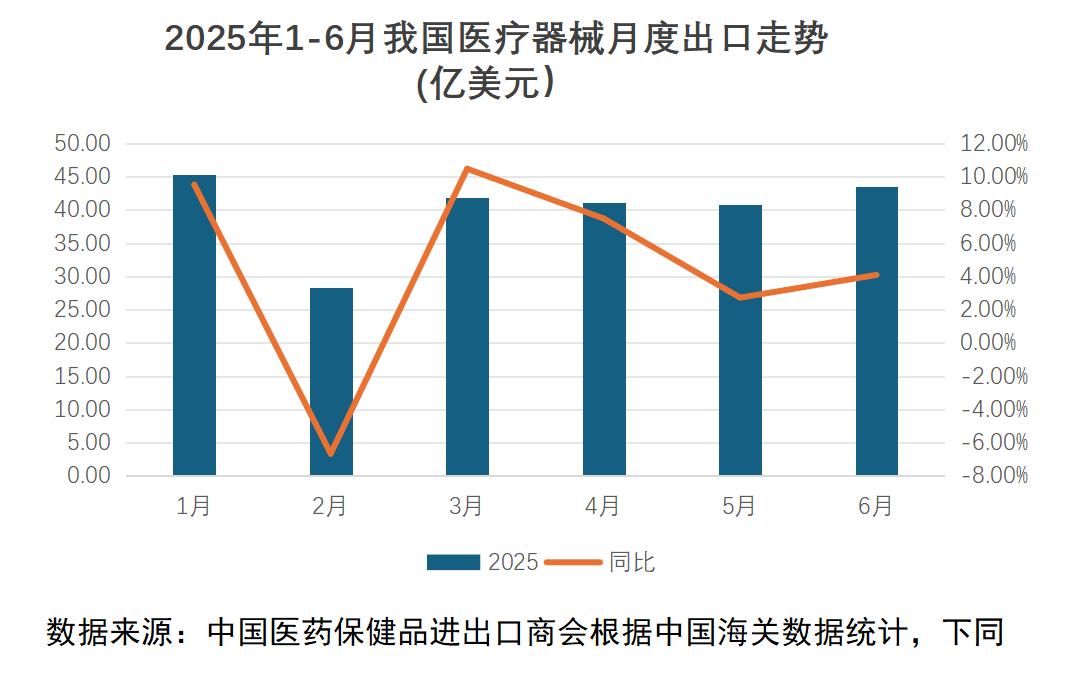
Judging from monthly export data, in the first half of 2025, China's medical device exports maintained a growth trend during the rest of the month, with the exception of February, which was significantly affected by holiday factors. This operating curve shows that the industry's external demand base is generally stable. It is worth noting that the imposition of tariffs by the US continues to disrupt the global supply chain. Our exports to the US all showed negative year-on-year growth in April, May, and June. In particular, the decline was significant in April and May. Although exports to the US rebounded month-on-month in June after the tariff policy was suspended in May, exports to the US were 5.167 billion US dollars in the first half of the year, down 4.41% year on year. In stark contrast to this, demand is generally strong in non-US markets.
II. Continued optimization and upgrading of the export structure
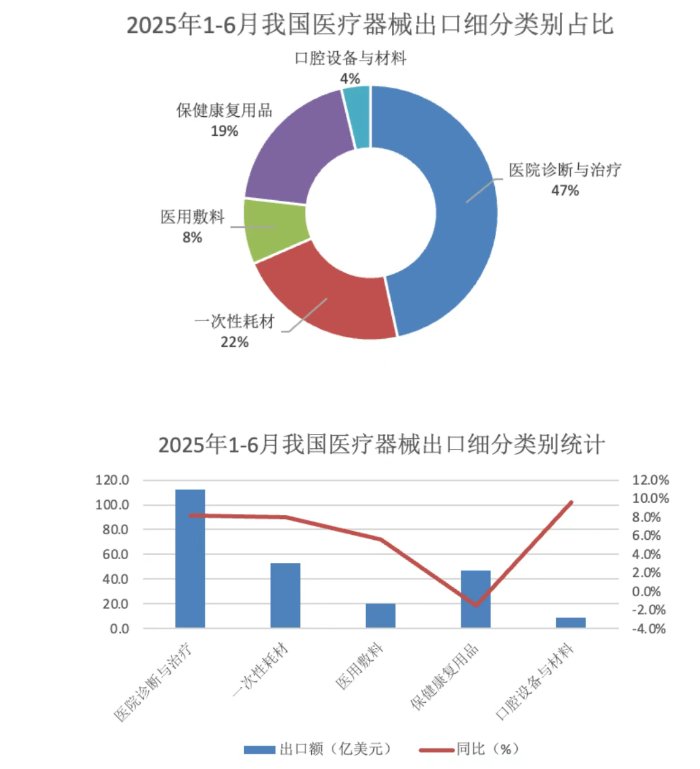
Looking at the main subcategories, in the first half of 2025, with the exception of exports of health insurance compound products, which fell slightly year-on-year, exports of the remaining four major categories all achieved significant increases.
In the first half of the year, the export value of hospital diagnostic and treatment products reached US$11.23 billion, an increase of 8.2% over the previous year. Among them, exports of high-tech products such as therapeutic respirators, endoscopes, artificial joints, magnetic resonance imaging devices, scintillation imaging devices, artificial kidneys, invasive ventilators, other artificial human implants, and surgical robots have increased dramatically. Overall, with the improvement of China's medical technology and manufacturing capacity, products continue to penetrate the global market with their excellent cost performance ratio and continue to transform to technology-intensive, thus enhancing the international competitiveness of the industry.
The export value of disposable consumables reached US$5.27 billion, an increase of 8.0% over the previous year. Among them, products such as rubber gloves, vascular stents, and other human stents have increased significantly.
In the first half of the year, the export volume of recycled health products increased 9.7% year on year, but the average export price fell 10.2% year on year. Under this influence, the export value was 4.68 billion US dollars, down 1.5% year on year. Among them, massage devices, as non-medical products, were greatly affected by the additional tariffs imposed by the US. Companies were forced to adopt a price-for-volume export strategy. The export price fell 6.0% year on year, the export volume fell slightly by 0.2%, and the export value was 2.11 billion US dollars, down 6.2% year on year, making it the biggest segment that dragged down exports of health care products.
The export value of medical dressing products reached US$2.02 billion, an increase of 5.6% over the previous year. In particular, exports of high-end medical dressings and compression hosiery products are growing strongly, and exports to the European and American markets continue to grow at a high rate.
In the first half of the year, dental equipment and materials continued to grow significantly, with exports reaching US$90 million, an increase of 9.6% year on year (due to the adjustment of the HS coding range, the year-on-year data is based on the 2025 new coding range statistics). Judging from the volume-price relationship, export volume increased 8.9% year on year, and the average export price rose 0.7% year on year, achieving both volume and price increases. Among them, products such as dental instruments, dentures, and dental X-ray application equipment achieved a significant increase in export value.
3. Diversified market layout and accelerated construction of product value barriers
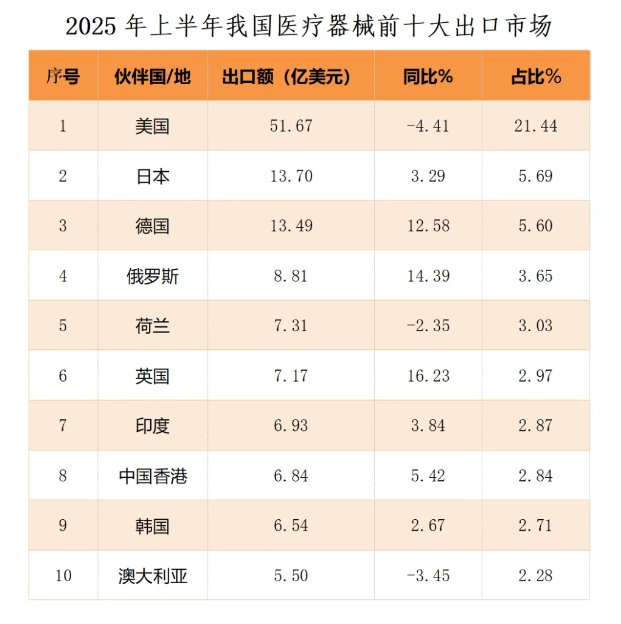
In the first half of 2025, China's medical device exports continued to be dominated by Europe, America, and Japan, and exports to the top ten partner countries accounted for more than 50% of total global trade. Among them, the US ranked first with US$5.167 billion (21.44% of total exports), but due to the intensification of trade frictions between China and the US, exports to the US fell 4.41% year on year, and its market share shrank 2.26 percentage points from the same period in 2024. At the same time, technology-intensive categories bucked the trend: with the support of independent domestic innovation, exports of high-value-added products such as precision surgical instruments, next-generation catheters, and high-end dressings to the US increased significantly. Similar products are also expanding simultaneously in developed markets such as Germany and the United Kingdom, where certification barriers are strict, marking that domestic devices are substantially breaking through developed country technology entry barriers. Combined with the steady growth of emerging markets, “technological breakthroughs and market diversification” have become the core driving force for Chinese medical devices to go overseas.
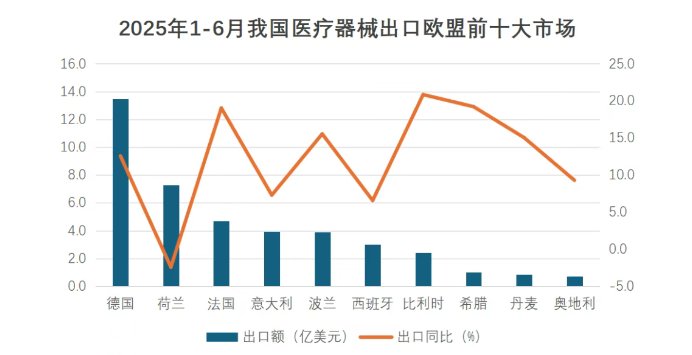
In the first half of 2025, China's medical device exports to the EU reached 4.71 billion US dollars, an increase of 11.2% over the previous year. The growth rate was significantly higher than the overall medical device export level. Among the top ten trading partners of the EU, China's exports to nine countries other than the Netherlands all achieved positive growth. Markets such as Germany, France, Poland, Belgium, Greece, and Denmark grew by more than 10% year on year, highlighting the good recovery of EU demand and continued deepening market penetration. It is worth noting that high-end medical equipment has become a new driving force for growth. Exports of scintillation devices, including PET equipment, to the EU have increased 15 times, and exports of other mass spectrometers and surgical robots to the EU have also doubled. Technological upgrades are driving Chinese devices to continue to break through in the high-end European market.
While traditional markets other than the US are growing steadily, China's medical device industry is speeding up the deployment of emerging regions. Benefiting from the upgrading of medical demand in emerging markets and deepening cooperation among the “Belt and Road” countries, the penetration rate of domestic medical devices in ASEAN, Latin America, the Middle East, Central Asia and other markets continues to increase, and export markets are becoming more diversified.
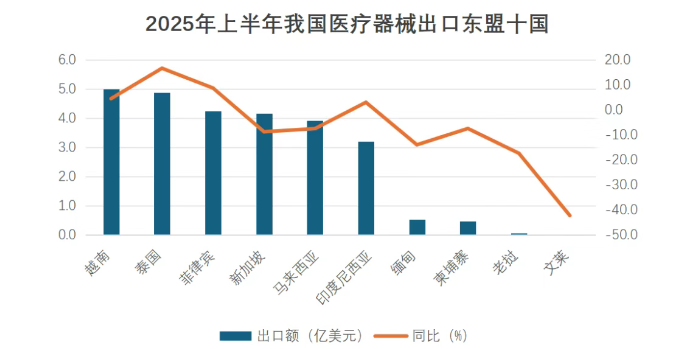
In the first half of 2025, China's medical device exports to the 10 ASEAN countries were US$2.60 billion, an increase of 1.8% over the previous year. Among them, exports to Vietnam were US$50 billion, up 4.5% year on year; exports to Thailand were US$490 million, up 16.6% year on year; exports to the Philippines were US$420 million, up 8.7% year on year; exports to Singapore were US$420 million, down 8.8% year on year; exports to Malaysia were US$390 million, down 7.5% year on year; and exports to Indonesia were US$320 million, up 3.0% year on year.
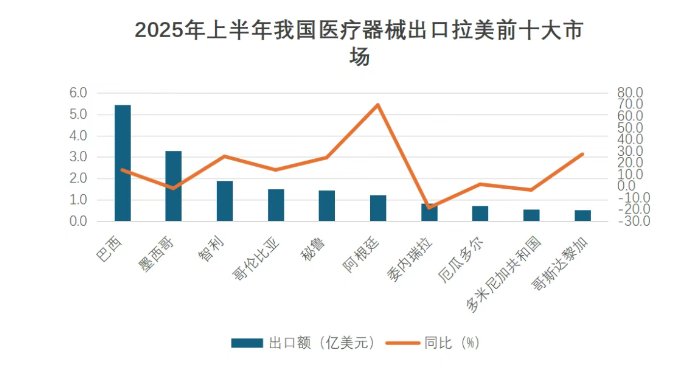
In the first half of 2025, China exported 2.02 billion US dollars of medical devices to Latin America, an increase of 13.8% over the previous year. Among them, exports to Brazil reached 540 million US dollars, up 13.9% year on year; exports to Mexico reached 330 million US dollars, down 1.8% year on year; exports to Chile, Colombia, Peru, and Argentina all achieved double-digit increases.
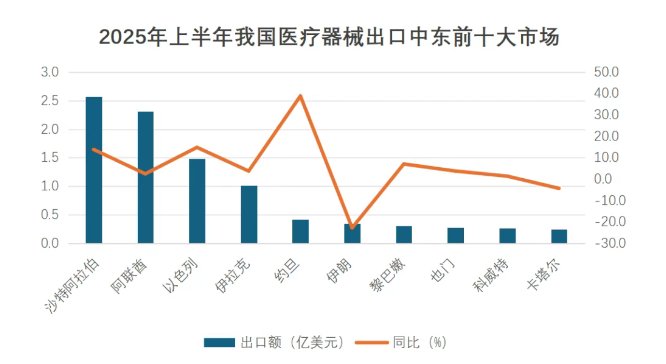
In the first half of 2025, China's exports of medical devices to the Middle East were 950 million US dollars, an increase of 7.3% over the previous year. Among them, exports to Saudi Arabia were US$260 million, up 13.9% year on year; exports to the UAE were US$230 million, up 2.4% year on year; exports to Israel, Jordan, and Oman all increased by more than double digits.
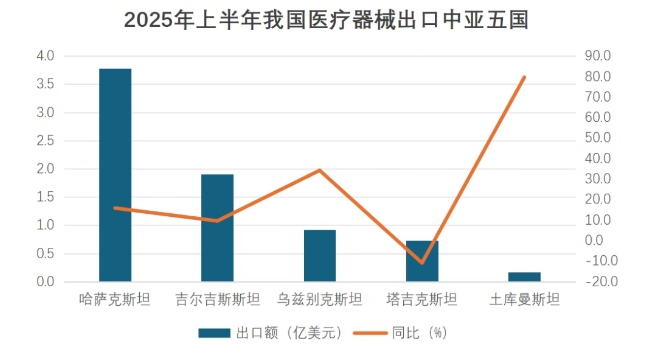
In the first half of 2025, China's medical device exports to the five Central Asian countries were US$380 million, an increase of 16.4% over the previous year. Among them, exports to Kazakhstan were US$190 million, up 15.9% year on year; exports to Kyrgyzstan reached US$90 million, up 9.6% year on year.
4. The trend of domestic substitution continues, and independent innovation deepens and restructures the import pattern
In the first half of 2025, China's medical device imports continued the downward trend, totaling US$16.99 billion, down 5.7% year on year, maintaining a negative growth trend for three consecutive years. Driven by both technological upgrading and policy guidance, the domestic substitution pattern accelerated the transition from low-end consumables to high-end equipment: in vitro diagnostic reagents (customs code: 38221900) were the largest imported category, and the import value fell -19.4% year on year, mainly due to increased IVD localization rate and preferential collection policies; medical imaging equipment replacement was particularly significant. The import value of color ultrasound diagnostic equipment fell 5.7% year on year. The import value of X-ray application equipment plummeted by 30.6% year on year, reflecting the squeezing effect of technological breakthroughs in domestic equipment; high-value consumables (such as artificial joints, etc.) vascular stents, etc.) due to With volume procurement requirements and local cost advantages, the decline in import value is also quite obvious. As can be seen, the main battleground for domestic replacement is gradually shifting to cutting-edge fields of medical devices, such as high-end imaging systems and other high value-added products. However, in the short term, domestic devices still need to deepen international collaborative breakthroughs in the fields of high-end sensors, precision components, etc.
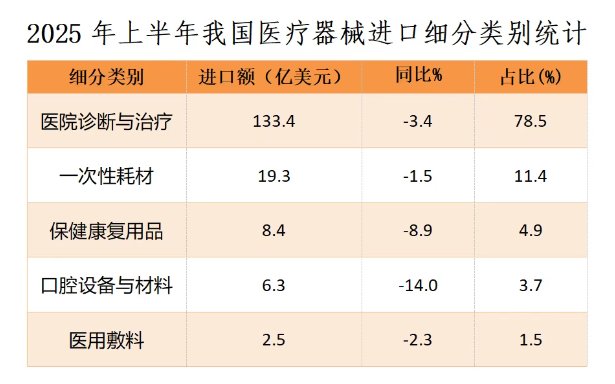
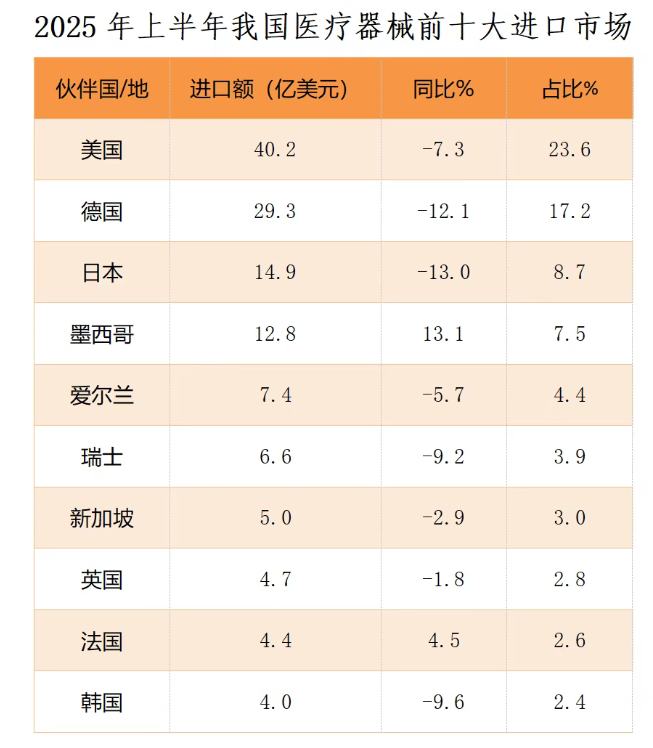
In the first half of 2025, the United States, Germany, and Japan were still the top three importers of medical devices in China, accounting for a total share of 49.6%, down 2.4 percentage points from the same period last year. While import market concentration continued to decline, imports from the US, Germany, and Japan all declined year on year, and the decline was higher than the overall average.
Among the top ten countries/regions by import value, China's medical device imports from Mexico and France increased year-on-year, while the rest of the markets experienced varying degrees of decline. It is worth noting that in the first half of the year, imports of our medical devices from Southeast Asia and South America grew significantly. On the one hand, it stemmed from Mexico's short-term growth highlights due to tax avoidance and localized production by US companies, but the deeper impetus came from the multi-polarized restructuring of the global industrial chain — including the dividends of Southeast Asia RCEP regional integration, policy-driven infrastructure investment in South America, and the active capacity layout and technology export of Chinese companies.
5. The international environment is changing and intertwined, and the dual drive of “innovation+globalization” is determined
Currently, the international situation and foreign trade environment are changing and intertwined, international tariff policies are erratic, and all kinds of challenges are pouring in. Trade restrictions and unfair competition practices are constantly emerging, leading to a significant increase in uncertainty about global economic growth. In the current complex environment of escalating international trade frictions and heightened geopolitical risks, China's medical device industry has always adhered to the dual drive of technological innovation and globalization strategy.
According to the latest statistics from the State Drug Administration, 45 innovative medical devices have been approved for marketing in the first half of 2025, with products made in China accounting for 83.3%. Domestic enterprises have achieved a comprehensive breakthrough in the field of traditional foreign investment advantages — in the field of cardiac electrophysiology, domestic PFA equipment competes simultaneously with international giants; in terms of neurological intervention, the performance of domestic dense mesh stents is comparable to top international products. At the same time, leading companies have successively conquered “stuck neck” technology in the high-end field, and Lianying Medical launched the world's first 5.0T human full-body magnetic resonance, marking that China has broken the long-term monopoly of European and American companies in the field of ultra-high field magnetic resonance equipment and has passed FDA and CE certification; Hengrui Medical overcame the ECMO membrane lung material PMP membrane wire process to achieve domestic replacement in the entire industry chain...
In the face of abnormal competition methods such as the imposition of tariffs and technical blockades by the United States, Chinese companies are reconstructing the competitive order with a “technology echelon plus global layout.” Lianying Medical has built a global service network of “7 regional spare parts hubs and 32 national banks” around the world, covering the global market through strategic spare parts centers such as the United States, the Netherlands, the United Arab Emirates, and Malaysia; minimally invasive surgical robots have entered Europe, America and the “Belt and Road” 30 countries to export “China's solutions” through 5G remote surgery technology; Mindray Healthcare is advancing a global strategy in digitalization and intelligence, bringing remote monitoring and data transmission between devices to hospitals in Africa and Southeast Asia through IoT technology. More and more domestic medical devices are building their own brands “overseas” through internationalization of marketing and service localization; at the same time, more companies are exploring the deployment of supply chains and manufacturing overseas to build a “R&D-production-service” global collaborative ecosystem. Breaking through barriers with technological sovereignty and penetrating change through ecological collaboration, Chinese medical devices are reshaping the voice of the industry in a new situation of international competition with a two-wheel drive of “technological innovation+globalization”.