
- LIVE QUOTES
- LEARN
- HELP


EN
The AI application section “Bull Market Narrative” has been strengthened again! “AI+ Digital Advertising” leader Applovin (APP.US)'s performance exceeded expectations, and net profit soared 164%
The Zhitong Finance App learned that AppLovin (APP.US), an AI application leader focusing on “AI+ digital advertising,” announced financial results for the second quarter of fiscal year 2025 after the US stock market on Wednesday EST. Under the strong impetus of the AI advertising engine model AXON, the actual results announced by the company and revenue outlook for the third quarter easily exceeded the average expectations of Wall Street analysts. As global capital continues to pour into the AI computing power infrastructure and AI application software sector since this year, AppLovin's stock price rose by up to 20% during the year and surpassed the S&P 500 index. This was not only due to the increase in valuation brought about by investors betting on the accelerated penetration of AI applications into all walks of life, but also by Applovin's strong performance growth rate.
Prior to AppLovin's latest performance report, Facebook and Instagram parent company Meta (META.US) had achieved strong performance growth that far exceeded expectations, driven by the new advertising engine called “AI+ Digital Advertising,” and Meta raised the lower capital expenditure limit for the full year of 2025 from US$64 billion to US$66 billion. Currently, the annual expenditure for 2025 is expected to be between US$66 billion and US$72 billion, which can be described as completely highlighting the social media giant based on the “AI+ digital advertising” model The strong growth rate of the advertising business is sufficient to support its aggressive investment in AI infrastructure.
AppLovin's overall performance exceeded expectations, but the market is not buying it?
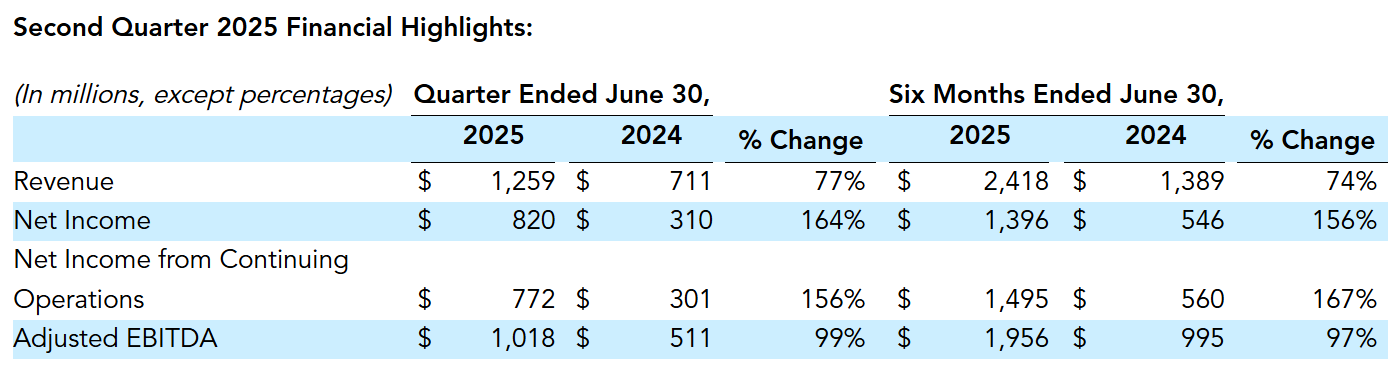
According to AppLovin's performance data, for the quarter ending June 30, AppLovin, a digital advertising and marketing platform focused on app marketing software, reported adjusted earnings per share of $2.39, while Wall Street analysts expected an average of about $2.32. Earnings per share in US GAAP (GAAP) were $2.28, which was also above the Wall Street average estimate of $1.98. Under GAAP guidelines, Applovin's net profit for the second quarter reached US$820 million, a sharp increase of 164%.
More importantly, AppLovin's second-quarter revenue totaled $1.26 billion, surpassing Wall Street's average forecast of about $1.22 billion, and achieving a 17% year-on-year increase. Excluding the company's already sold game business, AppLovin achieved a sharp 77% year-on-year increase in overall sales in the second quarter due to its strong advertising business. The company achieved Q2 adjusted EBITDA of US$1,018 million, a significant increase of 99% year over year.
Looking ahead, AppLovin expects third-quarter revenue to be between $1.32 billion and $1.34 billion, and the median range given by the company's management is higher than Wall Street's average estimate of about $1.31 billion.
At the end of the second quarter, the company also sold its mobile gaming business to Tripledot Studios for an overall value of $400 million.
“The completion of this transaction allows us to focus our business more on core areas and allows us to focus fully on the exciting and significant opportunities that will shape and define the future of the company.” AppLovin CEO and co-founder Adam Foroughi said in a performance statement. Management said during the performance conference call that it is focusing growth on “AI-driven global expansion of enterprises.”
Earlier, on July 1, AppLovin announced that it had completed the sale of its mobile game business to TripleDot Studios. Following the completion of this significant transaction, AppLovin received $400 million in cash flow and 20% of TripleDot's shares. AppLovin has divested its mobile gaming business, which includes 10 game studios and their mobile game franchises, to focus on its core “AI+ digital advertising” professional marketing platform business.
Although AppLovin announced strong performance reports and performance forecasts, investors clearly didn't buy it. As of press time, the company's stock price fell more than 6% after the US stock market. There are opinions that after Meta announced strong results, AppLovin's stock price followed Meta's strong performance and rose nearly 8% in a single day. If AppLovin's performance and performance outlook — especially the outlook — did not far exceed the general expectations of the market, it may not be a satisfactory performance answer in the market's opinion.
AppLovin has successfully embedded generative AI and deep machine learning into the core of each ad technology. AppLovin used the AXON 2.0 engine plus MAX/AppDiscovery to create a “buy-to-monetize” closed loop, thus driving ad type revenue to soar 71% year-on-year in Q1 2025, accounting for 78% of total revenue. AppLovin forms a data network effect + economies of scale on the “AI+ digital advertising” circuit, which not only boosts eCPM and ROI, but also rapidly exponentially expands EBITDA.
The Axon 2.0 engine created by AppLovin based on a large artificial intelligence model uses real-time bidding based on deep learning and reinforcement learning, and continuous closed-loop optimization. It can transform a large number of first-party/third-party signals into accurate delivery capabilities, which is a direct driving force for the rapid expansion of the company's revenue and profit. At microsecond speeds, AXON combines billions of users and contextual signals to match the highest ROI bidders for every ad display. AXON AI initially focused only on mobile game customer acquisition, and now covers high-growth vertices such as e-commerce, fintech, and CTV.
Therefore, there is no doubt that AppLovin provides efficient programmatic advertising in the mobile and CTV fields through the self-developed AXON AI algorithm platform, and has become one of the leaders in the “AI+ digital advertising” sector.
The “super bull market” belonging to the AI application sector is far from over
Before AppLovin announced its results, the international bank UBS (UBS) released a research report stating that in an environment where the market is high and AI concept hype is divided, AppLovin has extremely scarce performance delivery AI attributes in the broad sense of the AI concept sector, which is worthy of “additional allocation” for investors. Therefore, the stock was listed as the first choice for the US stock earnings season, and the rating was “bought.”
UBS's latest SMID-Cap internet preview report lists “AI+ digital advertising” as the most definitive supertrack in the stock market. The agency's latest Internet stock report has an overall tone of “neutral and slightly positive,” and focuses on AppLovin and The Trade Desk as the “dual core” worth adding before and after the earnings season. The core reason UBS is optimistic about these two leading AI application software companies is that they are already taking the lead in redeeming AI operating efficiency dividends with next-generation advertising algorithms and generative AI ideas based on cutting-edge AI models, with both room for profit improvement and room for upward valuation.
Since ChatGPT became popular around the world in 2023, the accelerated integration of artificial intelligence in the field of digital advertising has become a trend that cannot be ignored. The two major digital advertising industry giants, Google and Meta, are rapidly introducing generative AI technology into advertising systems, innovating everything from ad placement optimization to content presentation. On the side of Google, in addition to AI search summaries and Performance Max, it also embeds machine learning algorithms in its ad networks and cloud services to improve delivery efficiency; Meta uses AI to improve ad delivery returns (such as using machine learning to improve ad rankings and actual efficiency conversion optimization), and explores generative AI to create content to enhance user engagement and advertising diversity.
UBS emphasized that the structural impact of AI integration is already showing: on the one hand, AI can help improve the targeting accuracy and conversion effect of digital advertising, and drive advertisers to obtain higher ROI (this can be seen from the rapid popularity of products such as Performance Max); on the other hand, AI-generated content and answers may divert part of the traffic, causing the value of traditional advertising inventory to face re-evaluation (such as increasing the frequency of ad display and falling click rates based on the Google search model).
Since this year, benefiting from the accelerated expansion of market demand for artificial intelligence application software, enterprise-level AI application software provider C3.ai (AI.US), and advertising and marketing service provider AppLovin (APP.US), which focuses on the “AI+ digital advertising” field, and Palantir (PLTR.US), a leader focusing on “AI+ data analysis”, have published extremely strong performance data and future performance prospects this year. This means that not only is demand for AI computing power infrastructure represented by Nvidia's AI GPUs extremely strong, but demand for AI software applications, especially enterprise-level AI application software that can comprehensively improve operational efficiency, is also strong, and it is rapidly penetrating all walks of life.
As the focus of the global technology stock investment wave covers both the AI computing power infrastructure side and the AI application software side, it continues to provide significant support to the valuation of AI application companies such as AppLovin, Trade Desk, Duolingo, and Palantir. Killer generative AI applications in various industries covering the B-side or C-side in the future, and “AI agents” that are likely to greatly boost human social productivity are likely to explode. This is also why global capital has recently poured into software stocks.
Judging from the current technological trajectory, the development direction of AI application software is focused on “generative AI application software” (such as DeepSeek, ChatGPT, Sora, and Claude launched by Anthropic), and on the basis of generative AI, AI functions are shifting from chatbox-style question-and-answer to “AI agents that independently perform various complicated and complex tasks.” Among them, AI agents are most likely a major trend in AI applications before 2030. The emergence of AI agents means that artificial intelligence is beginning to evolve from an information support tool to a highly intelligent productivity tool.
The urgent need for companies to improve efficiency and reduce operating costs can be described as vigorously promoting the two core categories of AI application software — generative AI applications and the widespread application of AI agents. In particular, AI agents such as OpenAI Deep Research and Manus can automate repetitive tasks, analyze and summarize big data based on extremely powerful AI models, provide real-time monitoring and insight reports, and make appropriate decisions in extremely complex situations in a very short time, thereby improving business efficiency. For personal learning and work efficiency, it is also basically the same logic of increasing efficiency. AI agents can also efficiently participate in all stages of large-scale projects in various fields around the world from blueprint planning to implementation, greatly speeding up project progress.