
- PRICING
- LIVE QUOTES
- LEARN
- HELP


EN
Japan's Agriculture and Forestry Central Bank bets on a huge loss of 12.6 billion US dollars in US debt and warns to invest carefully in Japanese treasury bonds
The Zhitong Finance App learned that Japan's Agriculture and Forestry Central Bank (Norinchukin Bank), which suffered huge losses due to investing in US treasury bonds, said on Thursday that it would be “extremely cautious” in purchasing Japanese treasury bonds.
Masaki Nagano, the company's chief financial officer, said at a briefing that Japan is expected to raise interest rates further. This statement comes at a time when Japan's 7.8 trillion dollar treasury bond market experienced severe shocks this week.
The Agriculture and Forestry Central Bank's position coincides with other investors — investors who are closely monitoring the financial health of countries from the US to Japan. US Treasury yields continued to soar as US lawmakers debated tax cuts; while Japanese long-term bonds were sold off as the central bank reduced its holdings at a time of rising inflation.
The briefing document shows that the Agriculture and Forestry Central Treasury has sold so-called low-yield assets worth 17.3 trillion yen, including European and American government bonds and investment-grade corporate bonds. By the end of March, the bank's unrealized loss on bonds was 1.24 trillion yen, which is narrower than 2.2 trillion yen in the same period last year.
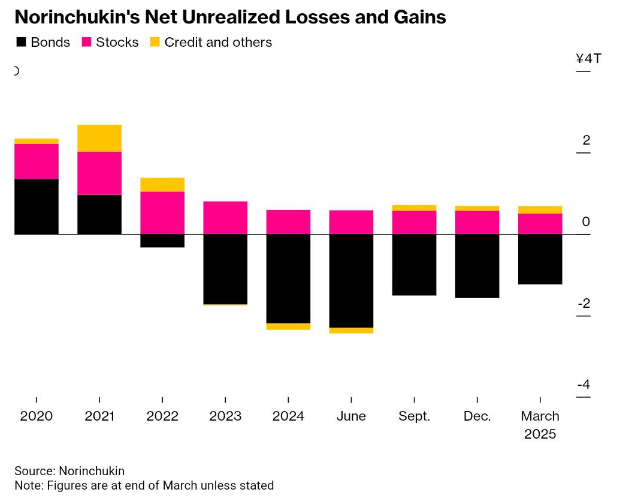
Due to the large-scale sale of foreign bonds such as US Treasury bonds, the agricultural financial institution reported a loss of 1.8 trillion yen (about 12.6 billion US dollars) in the fiscal year ending March, compared with a profit of 63.6 billion yen for the same period last year. According to the briefing document, the Agriculture and Forestry Central Treasury maintains previous forecasts and is expected to achieve profits of 30 billion to 70 billion yen this fiscal year.
As one of the typical victims of soaring US interest rates, the Tokyo-based bank's foreign bond holdings shrank in value as interest rates rose, while dollar financing costs surged more than securities earnings, and eventually suffered huge losses. Its huge losses are a profound warning. Under macroeconomic pressure, even traditional safe-haven assets such as US Treasury bonds conceal risks.
After former CEO Kazuto Oku resigned due to losses in the previous fiscal year, new CEO Taro Kitabayashi took office in April and is in the process of rebuilding his 40.3 trillion yen securities portfolio. Kitabayashi joined the bank in 1994 and held the position of chief financial officer until the end of March.
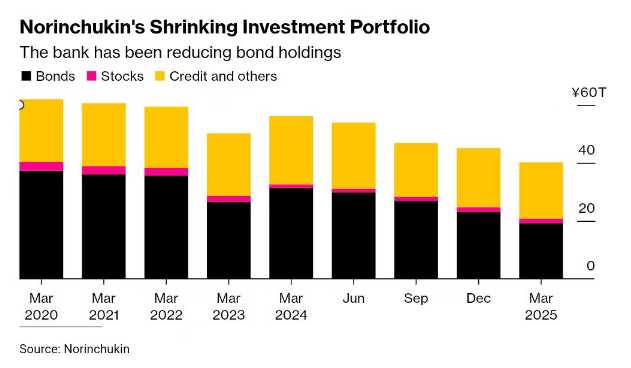
Kitabayashi is looking extensively at other investment asset classes in an effort to include non-interest sensitive assets in the portfolio. Chief Financial Officer Nagano said at the briefing that the company is investing in the fields of bonds, credit and alternative assets.
According to the bank's disclosure documents, due to new investment and exchange rate factors, as of the end of March, the size of mortgage-backed securities held by the bank increased from 8.2 trillion yen three months ago to 8.3 trillion yen, accounting for 20% of the investment portfolio.