
- LIVE QUOTES
- LEARN
- HELP


EN
retail investors who own 36% along with institutions invested in Scandinavian Tobacco Group A/S (CPH:STG) saw increase in their holdings value last week
Key Insights
- Scandinavian Tobacco Group's significant retail investors ownership suggests that the key decisions are influenced by shareholders from the larger public
- A total of 6 investors have a majority stake in the company with 52% ownership
- Insiders have bought recently
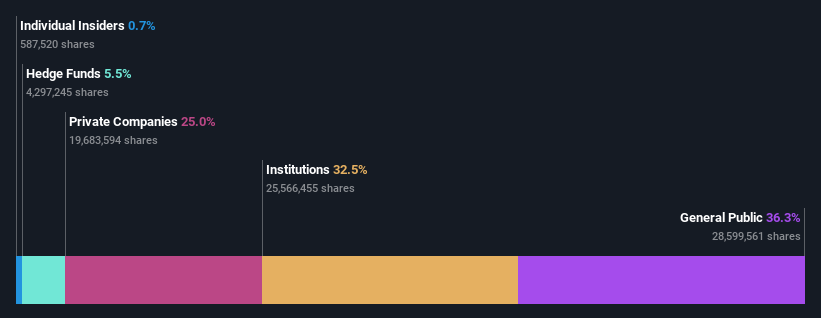
A look at the shareholders of Scandinavian Tobacco Group A/S (CPH:STG) can tell us which group is most powerful. We can see that retail investors own the lion's share in the company with 36% ownership. Put another way, the group faces the maximum upside potential (or downside risk).
Retail investors gained the most after market cap touched kr.7.4b last week, while institutions who own 32% also benefitted.
Let's take a closer look to see what the different types of shareholders can tell us about Scandinavian Tobacco Group.
View our latest analysis for Scandinavian Tobacco Group
What Does The Institutional Ownership Tell Us About Scandinavian Tobacco Group?
Many institutions measure their performance against an index that approximates the local market. So they usually pay more attention to companies that are included in major indices.
Scandinavian Tobacco Group already has institutions on the share registry. Indeed, they own a respectable stake in the company. This implies the analysts working for those institutions have looked at the stock and they like it. But just like anyone else, they could be wrong. It is not uncommon to see a big share price drop if two large institutional investors try to sell out of a stock at the same time. So it is worth checking the past earnings trajectory of Scandinavian Tobacco Group, (below). Of course, keep in mind that there are other factors to consider, too.

It looks like hedge funds own 5.5% of Scandinavian Tobacco Group shares. That's interesting, because hedge funds can be quite active and activist. Many look for medium term catalysts that will drive the share price higher. Chr. Augustinus Fabrikker Aktieselskab is currently the company's largest shareholder with 25% of shares outstanding. C.W. Obel A/S is the second largest shareholder owning 11% of common stock, and Parvus Asset Management Europe Limited holds about 5.5% of the company stock.
On further inspection, we found that more than half the company's shares are owned by the top 6 shareholders, suggesting that the interests of the larger shareholders are balanced out to an extent by the smaller ones.
While it makes sense to study institutional ownership data for a company, it also makes sense to study analyst sentiments to know which way the wind is blowing. Quite a few analysts cover the stock, so you could look into forecast growth quite easily.
Insider Ownership Of Scandinavian Tobacco Group
The definition of company insiders can be subjective and does vary between jurisdictions. Our data reflects individual insiders, capturing board members at the very least. Company management run the business, but the CEO will answer to the board, even if he or she is a member of it.
I generally consider insider ownership to be a good thing. However, on some occasions it makes it more difficult for other shareholders to hold the board accountable for decisions.
Our information suggests that Scandinavian Tobacco Group A/S insiders own under 1% of the company. But they may have an indirect interest through a corporate structure that we haven't picked up on. It's a big company, so even a small proportional interest can create alignment between the board and shareholders. In this case insiders own kr.55m worth of shares. It is good to see board members owning shares, but it might be worth checking if those insiders have been buying.
General Public Ownership
The general public-- including retail investors -- own 36% stake in the company, and hence can't easily be ignored. While this size of ownership may not be enough to sway a policy decision in their favour, they can still make a collective impact on company policies.
Private Company Ownership
Our data indicates that Private Companies hold 25%, of the company's shares. Private companies may be related parties. Sometimes insiders have an interest in a public company through a holding in a private company, rather than in their own capacity as an individual. While it's hard to draw any broad stroke conclusions, it is worth noting as an area for further research.
Next Steps:
While it is well worth considering the different groups that own a company, there are other factors that are even more important. Consider for instance, the ever-present spectre of investment risk. We've identified 1 warning sign with Scandinavian Tobacco Group , and understanding them should be part of your investment process.
If you are like me, you may want to think about whether this company will grow or shrink. Luckily, you can check this free report showing analyst forecasts for its future.
NB: Figures in this article are calculated using data from the last twelve months, which refer to the 12-month period ending on the last date of the month the financial statement is dated. This may not be consistent with full year annual report figures.
Have feedback on this article? Concerned about the content? Get in touch with us directly. Alternatively, email editorial-team (at) simplywallst.com.
This article by Simply Wall St is general in nature. We provide commentary based on historical data and analyst forecasts only using an unbiased methodology and our articles are not intended to be financial advice. It does not constitute a recommendation to buy or sell any stock, and does not take account of your objectives, or your financial situation. We aim to bring you long-term focused analysis driven by fundamental data. Note that our analysis may not factor in the latest price-sensitive company announcements or qualitative material. Simply Wall St has no position in any stocks mentioned.