


What Investors Got Wrong About Jubilant FoodWorks Before The Drop
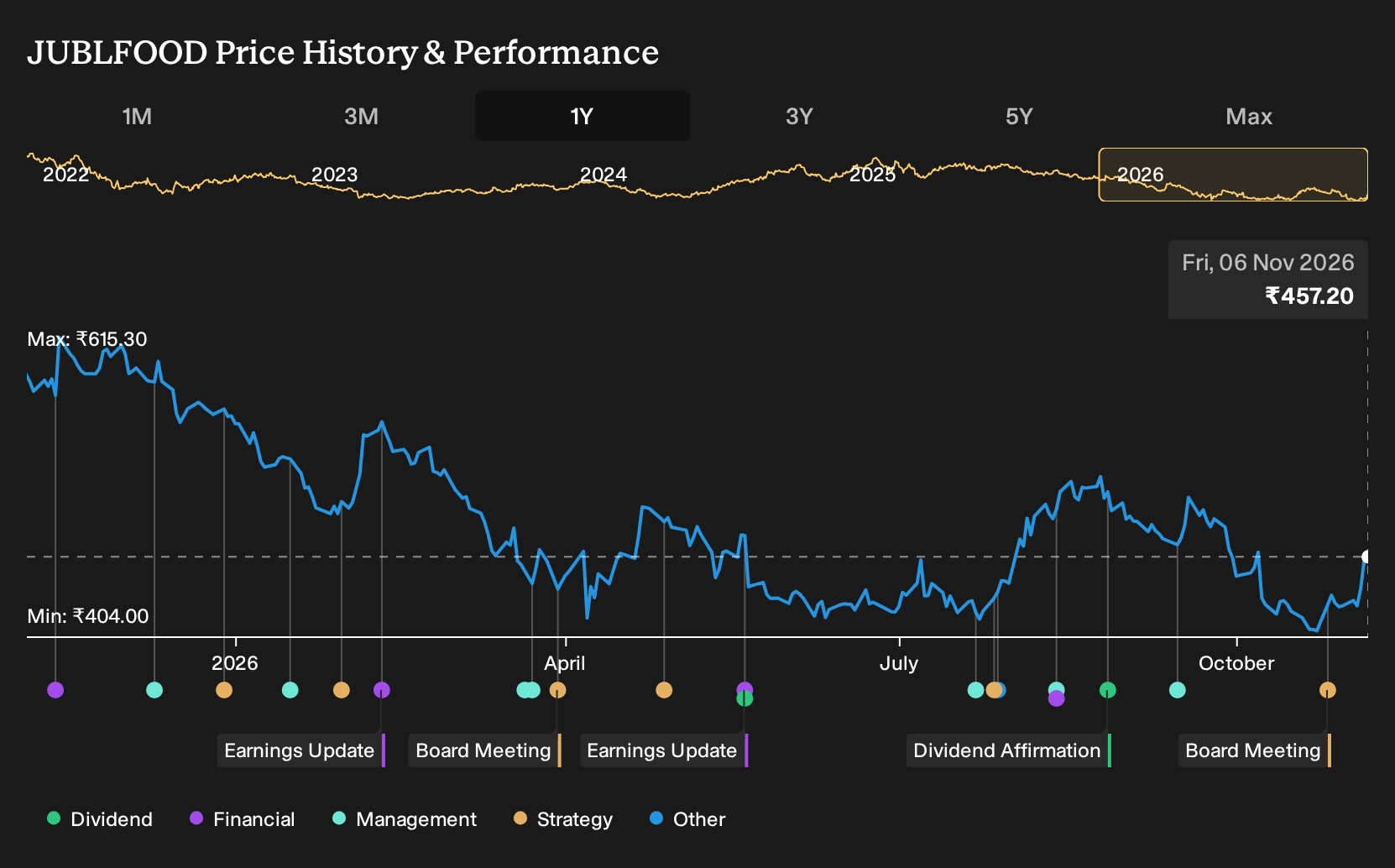
Jubilant FoodWorks just reported Q1 2027 revenue of ₹25,696.54m and net income of ₹1,004.07m, yet its net margin slipped to 3.9% from 4.2%. Investors who held Jubilant FoodWorks over the past year are down 20.5%, including dividends. If you had been weighing a purchase a year ago, that gap between growing sales and a weaker margin is exactly what needs unpacking. Did the early store expansion and digital push justify that risk?
A Narrative on Simply Wall St is one investor's written case for a company, with its growth, margin and multiple assumptions spelled out. Those assumptions imply an estimated Fair Value.
Jubilant FoodWorks has already moved. See which of 227 high quality undervalued stocks still trade below our estimates.
The Two Jubilant FoodWorks Stories Investors Had To Choose Between
The shares cost ₹583 at the start of the period, and anyone looking at Jubilant FoodWorks then had to decide which story felt more realistic.
On the optimistic side, the bull Narrative put Fair Value at ₹718. That case leaned on continued store expansion into underpenetrated cities and heavier use of digital ordering, with revenue growth assumptions of 13.3% and profit margins reaching 6.4% over three years.
The cautious view set Fair Value at ₹516. That bearish Narrative focused on rising health consciousness and tighter regulation as key risks, along with margin pressure from food delivery aggregators and intense QSR competition.
What The Jubilant FoodWorks Results Actually Tested
Q1 2027 showed Jubilant FoodWorks lifting revenue to ₹25,696.54m and net income to ₹1,004.07m, which supported the growth side of the bullish case. The catch was profitability. Net margin slipped from 4.2% to 3.9%, so the stronger profit assumptions in both Narratives stayed unproven. The evidence cut both ways.
The key lesson is clear. When a thesis leans on margin recovery, you need to track the actual net margin line in each result and test it against the story, not just the revenue print.
What A Buyer Of Jubilant FoodWorks Is Really Paying For Now
Jubilant FoodWorks trades at ₹457 today after the share price fell 20.5% over the past year. The selected bullish Narrative places its Fair Value above the current price, built around a multi brand QSR platform rather than a single Domino’s story.
The argument leans on store rollout, digital ordering and brands like Popeyes to support margins. For the fall to look like an opportunity rather than a warning, a buyer must believe that this two engine model can absorb cost pressure while lifting store level profitability.
"The main factor that has to go right is that Jubilant FoodWorks converts its two engine model, with Domino’s and a rapidly scaling Popeyes network, into sustained like for like growth and higher store level profitability despite cost and competitive pressure."
Not everyone reads the same price the same way. → See the higher figure this Narrative lands on, and how it gets there
Looking Beyond Jubilant FoodWorks
Watching Jubilant FoodWorks, you are really watching how people eat. There is another piece of the puzzle in how that food arrives, powered and online.
Behind every always on kitchen and delivery app sits hungry hardware. Data centers and electronics need efficient power and cooling so digital orders even reach a store.
One specialist outfits those systems so they run cooler and waste less energy. It sells complete power and thermal setups that help operators pack in more computing.
As more ordering, routing and payments rely on heavy computing, that kind of gear can quietly gain importance. The business problem looks different, but the dependence on reliable power is just as real.
Could this be another way into the opportunity? → Explore the robotics opportunity and its 56% discount to one Narrative's Fair Value
Have feedback on this article? Concerned about the content? Get in touch with us directly. Alternatively, email editorial-team@simplywallst.com