


Paymentus (NYSE:PAY) delivers impressive Q3 2026, full-year outlook slightly exceeds expectations

Digital payment platform Paymentus (NYSE:PAY) beat Wall Street’s revenue expectations in Q3 2026, with revenue rising 19.8% year on year to $372.2 million. The company expects next quarter’s revenue to be around $375.5 million, close to analysts’ consensus estimates. Its non-GAAP profit of $0.25 per share was 18.6% above analysts’ consensus estimates.
For more on Paymentus, read our free full research report.
Paymentus (PAY) Q3 2026 highlights:
- Revenue $372.2 million vs S&P analysts’ consensus estimates of $358.9 million (19.8% year-on-year growth, 3.7% beat)
- Pre-tax profit $36.83 million (9.9% margin)
- Adjusted EPS $0.25 vs S&P analysts’ consensus estimates of $0.21 (18.6% beat)
- Revenue guidance $375.5 million at the midpoint for Q4 2026, roughly in line with what analysts were expecting
- Market capitalization $4.13 billion
“Paymentus delivered another strong quarter, with 19.8% year-over-year revenue growth. This revenue performance drove growth in contribution profit and adjusted EBITDA of 20.6% and 38.6%, respectively. Our year-to-date results, combined with strong bookings and a sizable backlog, reinforce our confidence in achieving our 2026 financial targets as well as our outlook for 2027,” said Dushyant Sharma, Founder and CEO.
Revenue growth
A company’s long-term revenue performance is one signal of its overall quality. Even a weak business can perform well for one or two quarters, but a top-tier one grows for years. Paymentus’s revenue grew at a strong 30.9% compounded annual growth rate over the last five years. Its growth surpassed the average financials company and shows its offerings resonate with customers.
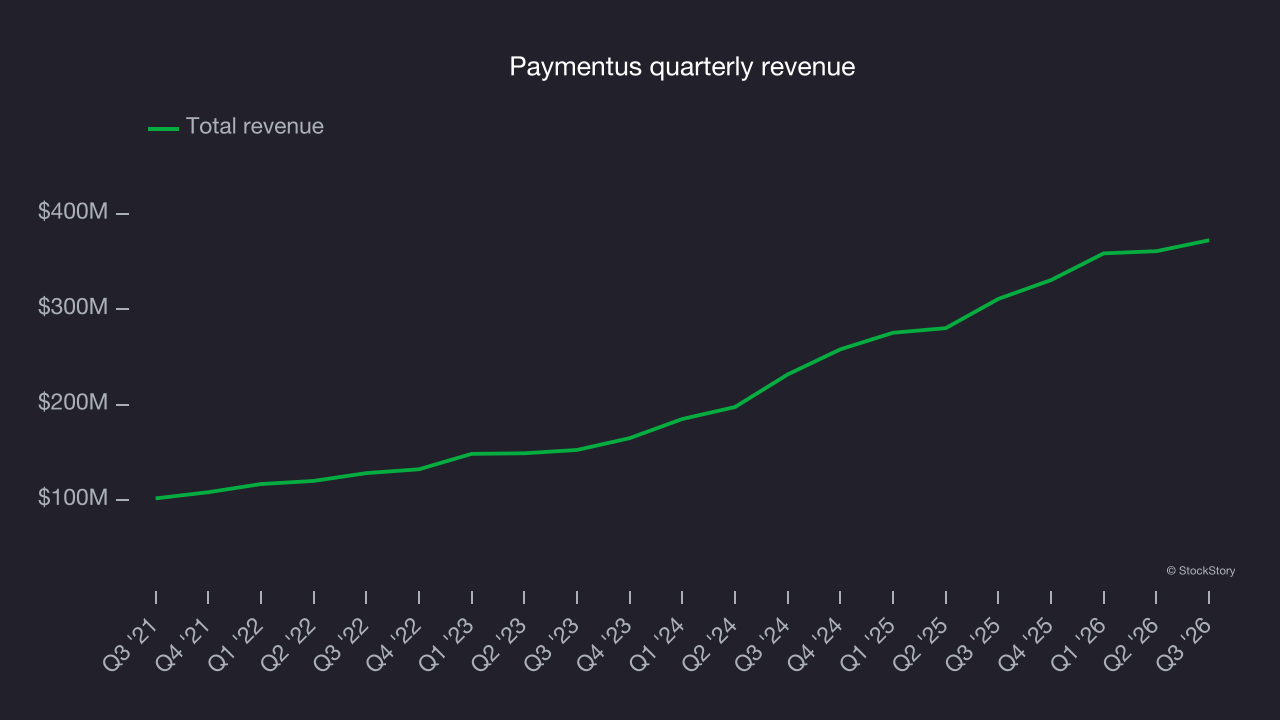
Long-term growth matters most, but within financials, a half-decade historical view may miss recent interest rate changes, market returns and industry trends. Paymentus’s annualized revenue growth of 35.1% over the last two years is above its five-year trend, suggesting its demand was strong and recently accelerated. 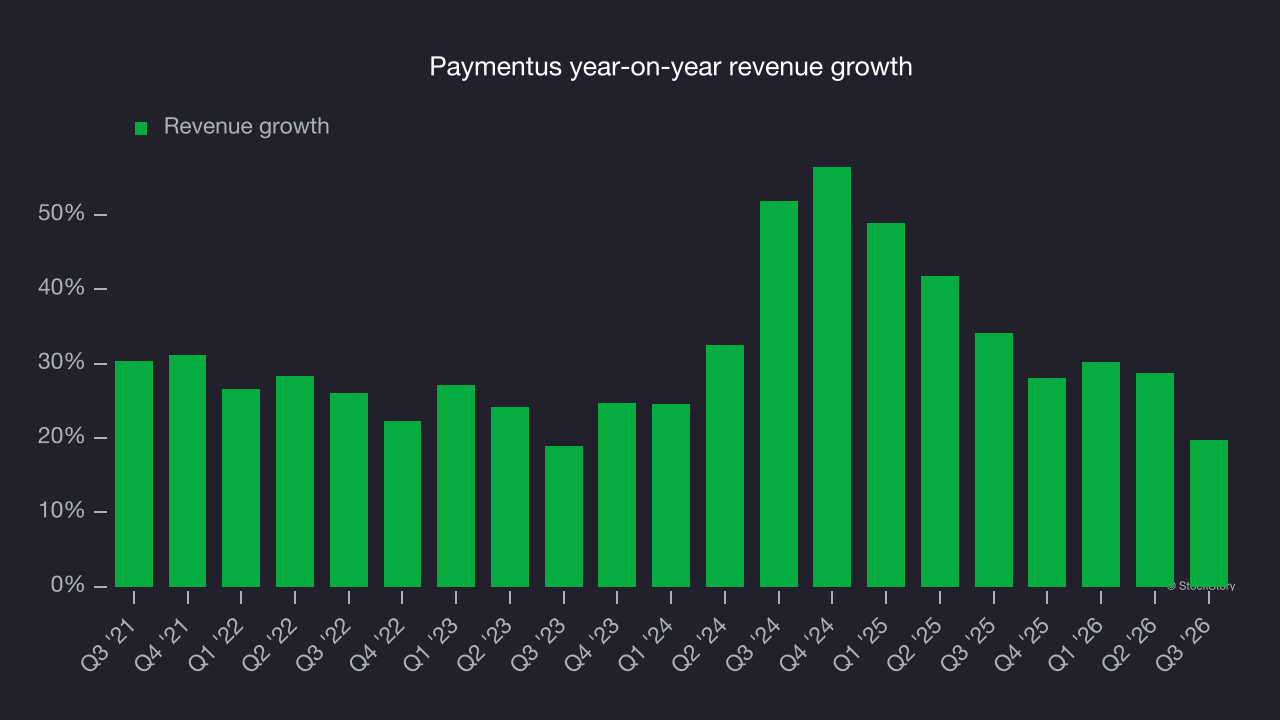
This quarter, Paymentus reported year-on-year revenue growth of 19.8%, and its $372.2 million of revenue exceeded Wall Street’s consensus estimates by 3.7%. Management is guiding for a 13.6% year-on-year increase in revenue next quarter.
Key takeaways from Paymentus’s Q3 results
A substantial beat against analysts’ consensus EBITDA estimates helped make this a good quarter for Paymentus, and EPS also topped Wall Street’s consensus estimates. Shares remained flat at $35.07 immediately after the release.
Paymentus had a solid quarterly earnings result, but assessing the stock requires more context. The latest quarter matters, but not as much as longer-term business quality and valuation when deciding whether to invest. For more on Paymentus, read our full research report here (it’s free).