


Rate Cuts Put ARMOUR Residential REIT Stock And Other Income Plays In Focus
Rate cuts, missing data and a Fed flying partly blind have pushed short term cash and floating rate income ideas into the spotlight. When markets lean so heavily toward one outcome, even small surprises can move money quickly. This creates both openings and traps for anyone parking cash or hunting yield. This article explains that setup and reviews 3 stocks affected by this news shock so you can evaluate the risk and reward for yourself.
The three stocks below are a starting sample. The full screen surfaced 10 more U.S. Short Term Cash and Floating Rate Income Providers with equally compelling stories that are not covered here. To go deeper and identify which tickers best fit your own cash and income plan, analyze the U.S. Short‑Term Cash & Floating‑Rate Income Providers screener.
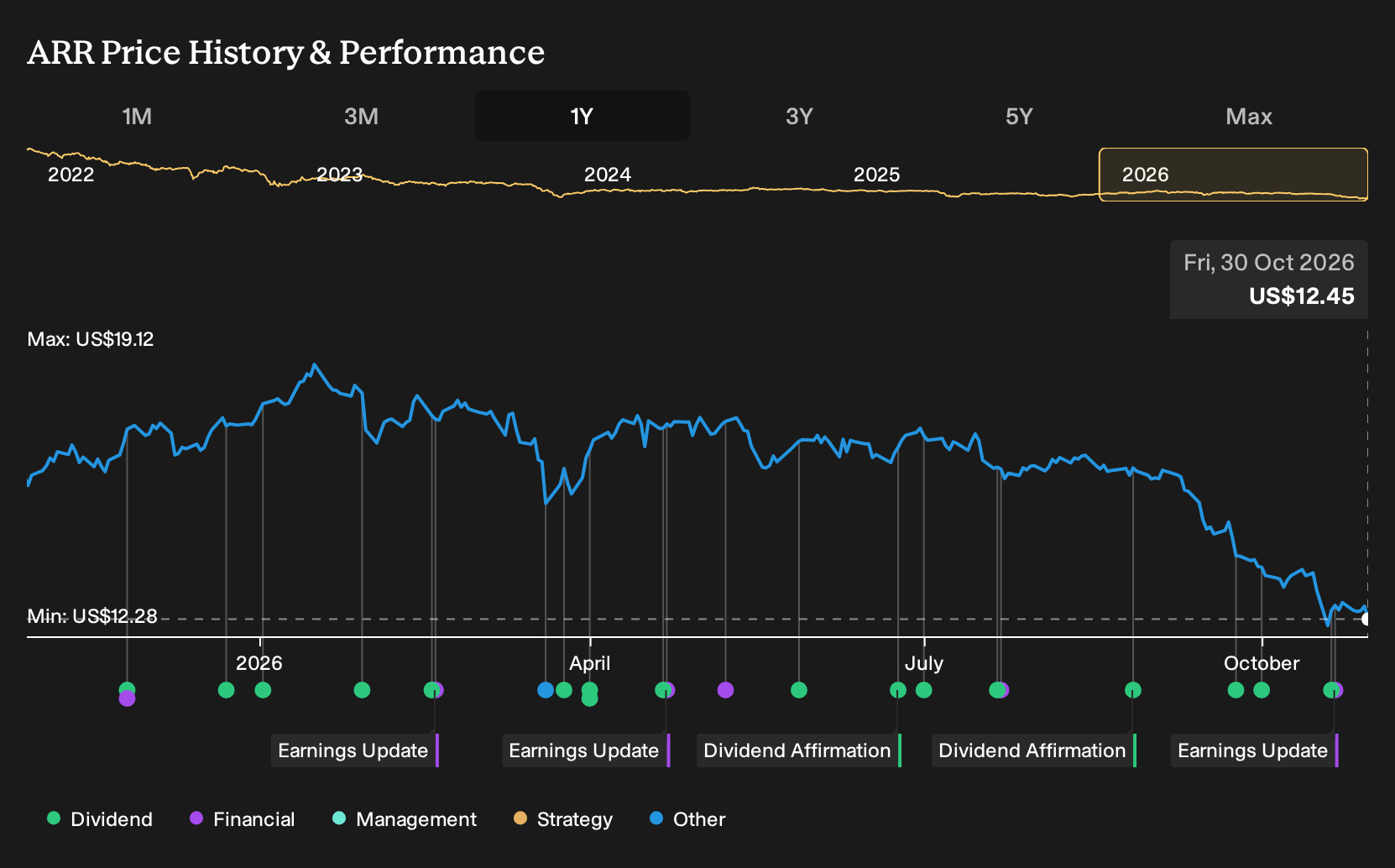
ARMOUR Residential REIT (ARR)
ARMOUR Residential REIT plugs into this cash and income screen through its focus on Agency mortgage backed securities, giving you rate sensitive income exposure that behaves very differently from a simple money market fund or floating rate loan portfolio.
ARMOUR Residential REIT invests in Agency residential mortgage backed securities and related fixed income, generating about $11 million from its REIT mortgage activity in the United States, and the business has a market value of roughly $1.8b.
Federal Reserve easing and a potential shift toward using SOFR or similar repo based measures as a policy benchmark are expected to lower funding costs and reduce rate volatility, supporting wider economic net interest margins and more stable distributable earnings.
What happens to those earnings if a single pressure point in that funding mix moves the wrong way will matter a great deal.
If that pressure starts to move, the full narrative for ARMOUR Residential REIT shows how ARMOUR Residential REIT could either accelerate income or see risks that the headline yield is masking.
BrightSpire Capital (BRSP)
BrightSpire Capital fits this short term cash and floating rate income screen as a higher yield real estate credit option, using commercial property loans instead of pure money market instruments to turn interest rate moves into distributable income.
BrightSpire Capital is a commercial real estate credit REIT that earns about $207 million from senior and mezzanine loans and preferred equity, $127 million from net leased and other real estate, and $5 million from corporate and other activity, with a market value of roughly $426 million.
For this screen, what really matters is that BrightSpire Capital focuses on lending against income producing properties, often on floating rate terms, which can pull it closer to the cash and short duration theme even though the underlying collateral is longer term bricks and mortar.
Rising interest rates as a persistent macroeconomic headwind are likely to raise borrowing costs for both BrightSpire and their property-level borrowers, which may lead to decreased loan demand, declining asset values, and compressed net interest margins. This could put sustained pressure on earnings and profitability.
What happens if one key source of refinancing liquidity tightens just as those loans roll over will be central to how that income story plays out.
As that refinancing risk builds, the full narrative for BrightSpire Capital maps where BrightSpire Capital’s income engine could be accelerating, stalling, or quietly masking opportunity.

Alerus Financial (ALRS)
Alerus Financial connects to the U.S. Short Term Cash and Floating Rate Income theme through its mix of deposits, short term lending, and cash management services, while its retirement and wealth platforms add another layer of income that does not solely rely on interest spreads.
Alerus Financial runs a full service banking, retirement, benefit services, and wealth platform for U.S. clients, generating about $248 million in revenue from the United States and carrying a market value near $821 million.
Alerus Financial gives this screen a different flavor, pairing traditional cash management and lending with fee driven retirement and wealth businesses that can behave more like a steady income line than a pure rate trade.
Continued build out of retirement and benefit services, where fee income represented more than 40% of total revenue in recent quarters and is supported by assets under administration and low cost deposits such as HSA balances, is expected to provide a recurring, capital light revenue base that can smooth earnings through different rate cycles.
What really moves the story from here is how one key shift in the loan and deposit mix filters through to margins when policy rates surprise.
That rate mix inflection point is exactly where the full narrative for Alerus Financial shows how Alerus Financial’s fee engines, funding costs, and credit risks could be quietly decoupling.

Seeking Alternatives Before Momentum Flies
Fresh ideas move first. Breakout trends gain momentum while data is still under the radar for now and pricing has not fully caught up. Consider researching opportunities early in the process.
- Target resilient payers with steady cash engines by scanning the 5 dividend fortresses that focuses on companies aiming to keep income flowing even when sentiment drops.
- Explore real business momentum instead of hype by filtering for the 41 profitable AI stocks that aren't just burning cash where AI exposure comes with earnings, not just story driven excitement.
- Look for potential opportunities in real assets by checking the 34 elite gold producer stocks while some producers may still be under the crowd's radar and reflecting older assumptions in their pricing.
Have feedback on this article? Concerned about the content? Get in touch with us directly. Alternatively, email editorial-team@simplywallst.com