


Credit Acceptance (CACC) Dropped, What Is Behind The Move?
Credit Acceptance (CACC) came into focus after reporting a third-quarter net loss tied to lower forecast collection rates on loans from 2022 through 2026, following a revised forecasting approach.
The market reaction has been sharp. Credit Acceptance’s share price fell about 19% on the day and is down roughly 19% over the past three months. Year to date, the share price return is slightly positive, and the 1 year total shareholder return is just under 4%. This suggests short term momentum has faded even as longer term holders have seen only modest gains.
Scan how Credit Acceptance's setback compares with other lenders facing credit quality questions by reviewing a hand picked group of 29 resilient stocks with low risk scores.
Credit Acceptance still runs a sizeable auto finance franchise, even after this forecast shock. The real crux now is simpler: Are you looking at a resilient business temporarily repriced, or a stock that still overestimates future cash flows?
Preferred P/E of 14x: Is it justified for Credit Acceptance?
Valuation on Credit Acceptance right now is built around earnings. The stock closed at $464.89 and is trading on a P/E of 14x, which puts a clear question in front of you about how generous that is given the recent earnings trend.
The P/E ratio compares the share price with annual profit per share. For a lender like Credit Acceptance, it is a quick way of seeing how much investors are paying for each dollar of current earnings, especially when profit is under pressure and forecasts matter more.
Here, the picture is mixed. Revenue is forecast to grow 27.3% per year, yet earnings are expected to decline an average of 6.6% per year over the next 3 years and have already fallen 21.2% per year over the past 5 years, with net profit margins slipping from 36.8% to 31.6%. Against that backdrop, a 14x P/E is described as expensive versus the estimated fair P/E of 10.1x. This is a level the market could move towards if expectations around profitability keep resetting.
The gap gets even starker when stacked against peers. The same 14x P/E is flagged as rich compared to both the US Consumer Finance industry average of 8.5x and a peer average of 13.3x, which suggests the stock carries a premium despite weaker profit trends.
Explore the SWS fair ratio for Credit Acceptance.
Result: Price-to-earnings of 14x (OVERVALUED)
Still, the narrative can crack if forecast collection rates weaken again or if Credit Acceptance faces tighter funding conditions that further pressure earnings.
Find out about the key risks to this Credit Acceptance narrative.
Another View on Credit Acceptance’s Valuation
The first check on Credit Acceptance focused on that 14x P/E. A second lens tells a similar story. The SWS DCF model estimates future cash flows support a value of $324.13 per share, which is well below the current $464.89 price. On this measure the stock screens as overvalued.
That gap points to clear valuation risk. You are paying well above the modeled cash flow value, which leaves less room for forecast slips or further cuts to collection assumptions. The key question is whether you place more weight on the earnings-based multiple or on the cash flow model when the cycle turns.
Look into how the SWS DCF model arrives at its fair value.
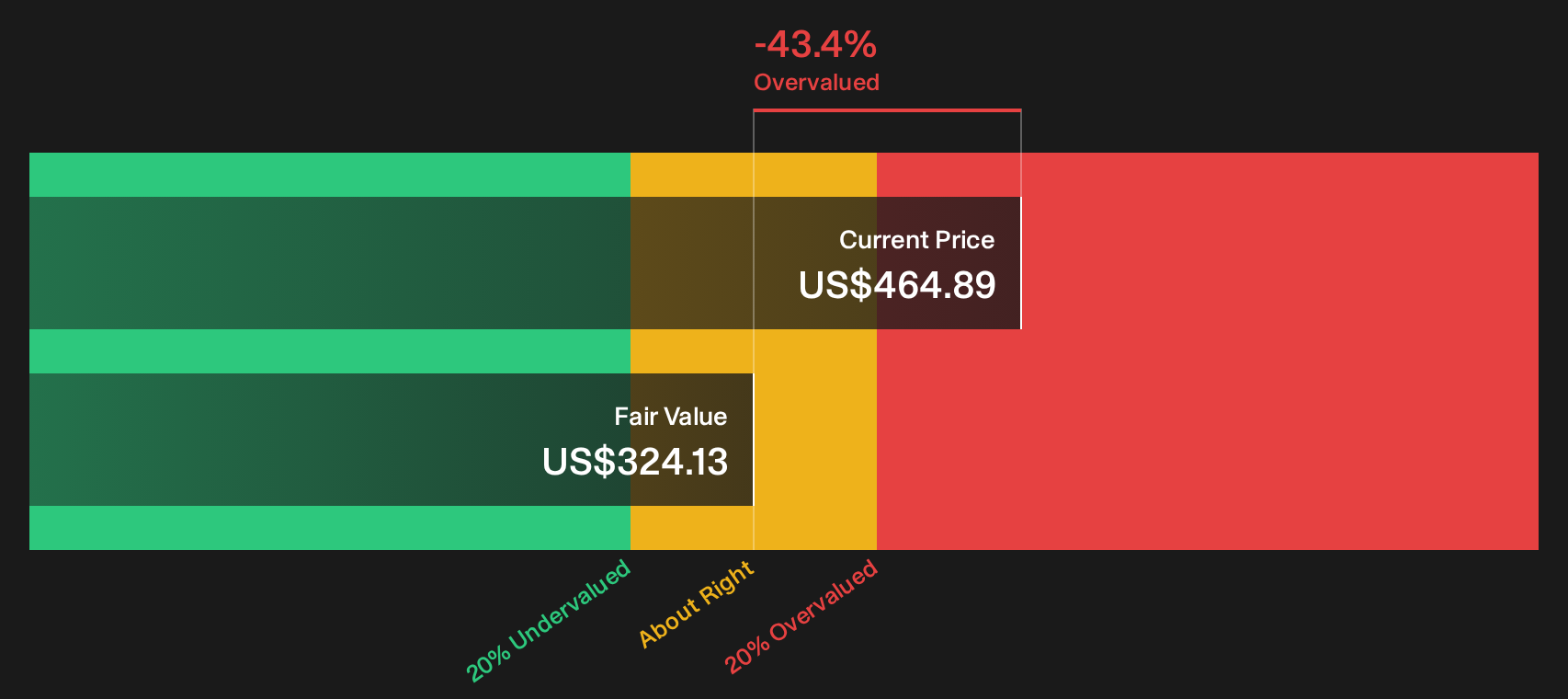
Simply Wall St performs a discounted cash flow (DCF) on every stock in the world every day (check out Credit Acceptance for example). We show the entire calculation in full. You can track the result in your watchlist or portfolio and be alerted when this changes, or use our stock screener to discover 33 high quality undervalued stocks. If you save a screener we even alert you when new companies match - so you never miss a potential opportunity.
Next Steps
Mixed signals on Credit Acceptance can feel confusing. Move quickly, pull up the data that matters, and weigh both sides by focusing on 2 key rewards and 2 important warning signs.
Looking for more investment ideas beyond Credit Acceptance?
If Credit Acceptance has you reassessing risk and reward, do not stop here. Broaden your opportunity set by scanning other ideas built from focused, data driven screeners.
- Target rock solid balance sheets and steady fundamentals by reviewing a curated list of solid balance sheet and fundamentals (24 results) that keeps financial resilience front and center.
- Hunt for potential value opportunities by scanning a hand picked 33 high quality undervalued stocks where quality and price are weighed side by side.
- Prioritize cash returns by sorting through a focused 5 dividend fortresses designed for investors who want income with structure and discipline.
Have feedback on this article? Concerned about the content? Get in touch with us directly. Alternatively, email editorial-team@simplywallst.com