


Should Higher Dividend Payout Require Action From Hamilton Lane (HLNE) Investors?
- Hamilton Lane recently confirmed a quarterly dividend of $0.60 per share, implying a 2.8% yield and an 11.1% increase in the annualized payout compared with last year, supported by a payout ratio of 37%.
- The combination of a higher annualized dividend and an earnings outlook that points to 26.61% growth for fiscal 2026 underscores management’s confidence in Hamilton Lane’s current fee base and pipeline rather than short term market conditions.
- We will now look at how Hamilton Lane’s higher dividend and 37% payout ratio could reshape the broader investment narrative.
Scan for other income ideas with similar traits by comparing Hamilton Lane’s profile against hand-picked 5 dividend fortresses that combine yield with disciplined payout ratios.
Hamilton Lane Investment Narrative Recap
For a shareholder in Hamilton Lane, the core belief is that private markets will keep attracting capital and that this platform can keep building fee earning assets and performance fees on top of that. The higher dividend, paired with a 37% payout ratio, signals that management sees current earnings power as durable. The key near term swing factor remains whether fundraising and evergreen inflows stay healthy enough to support that earnings outlook.
The biggest operational risk is that higher compliance costs, fee pressure and tougher competition erode margins faster than new products and technology initiatives can offset. The latest dividend move does not fundamentally change that risk reward balance. It simply raises the bar for consistent execution on costs, product performance and client retention.
The most relevant piece of context around this dividend decision is the earnings outlook that points to 26.61% growth for fiscal 2026. That projection, on top of recent 15.9% annual earnings growth over five years and higher net margins, is what makes a higher regular payout feel workable rather than stretched. The story still leans heavily on profitable fee related revenue.
For you as an investor, the link to catalysts is direct. If evergreen funds, separate accounts and global distribution continue to pull in assets, Hamilton Lane has more room to fund both the dividend and reinvestment in technology and data offerings that support client stickiness. If regulatory complexity, fee compression or one off items hit earnings, the higher fixed dividend could make any stumble in execution more visible, even with a 37% payout ratio.
Hamilton Lane Growth Assumptions Behind The Dividend Story
For investors watching Hamilton Lane pair a richer dividend with a 37% payout ratio, the analyst model in the background matters as much as the headline yield. The dividend is being framed on top of a forecast that earnings could reach US$478.8 million by 2029 and that profit margins widen from 32.1% today to 39.1% over the next three years. That backdrop helps explain why management might feel comfortable setting a higher recurring cash return while still keeping room to reinvest in the private markets platform.
Revenue expectations in the current research are punchy but specific. Analysts are working off an assumption that Hamilton Lane grows its top line by 12.5% a year over the next three years, supported by a higher margin profile and a modest decline in share count of 2.58% annually. Higher fee related income combined with a lower share base can support earnings per share even if market conditions stay choppy. This ties back to why a 37% payout ratio can be framed as measured rather than aggressive.
Valuation work in the consensus models then links those operating targets to a P/E multiple. To line up with the broader analyst view, you would need to accept that by 2029 Hamilton Lane could be generating US$1.2b in revenue and US$478.8 million in earnings, and that investors would pay about 12.8x those earnings. That assumed multiple sits below the current 38.0x P/E cited for the US capital markets peer group, which effectively bakes in some relative discount even if the firm hits its margin and growth targets.
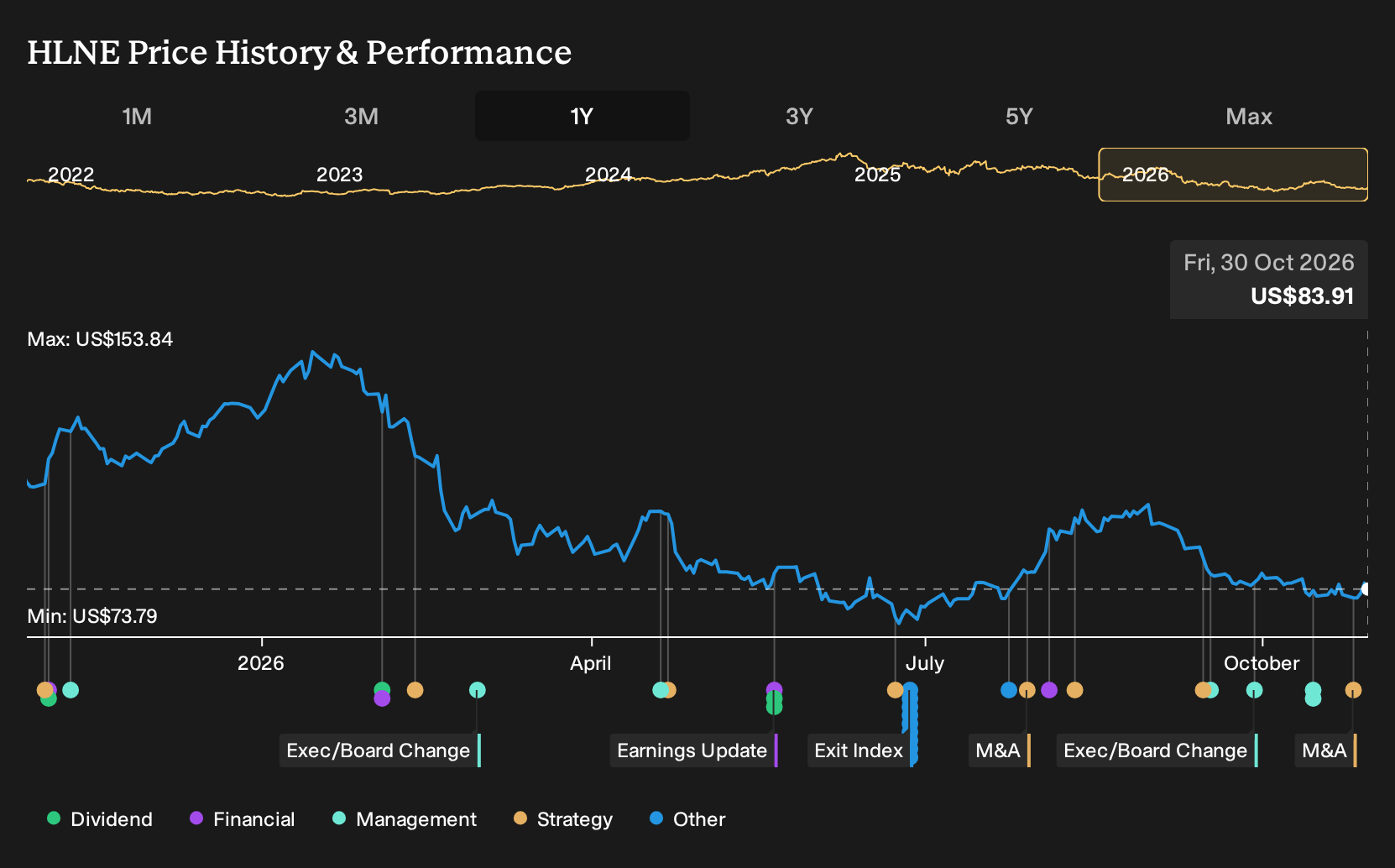
The wide range of price targets highlights how uncertain that path can be. With the most optimistic analyst at US$171.0 and the most cautious at US$95.0, there is clear disagreement over how durable fee revenue, carried interest and margin expansion might prove. The midpoint consensus of US$123.12 versus a share price of US$81.32 implies upside according to that framework. However, the higher fixed dividend means any gap between these projections and actual earnings will show up more quickly in payout sustainability debates.
Hamilton Lane's narrative projects US$1.2b revenue and US$478.8 million earnings by 2029. This builds on analysts assuming 12.5% yearly revenue growth and an earnings increase of about US$202.9 million from US$275.9 million today.
Uncover why Hamilton Lane's fair value indicates a 47% potential upside to its current price that could narrow quickly.
Exploring Other Perspectives
One alternate view you might weigh focuses on the Evergreen platform as the key swing factor for Hamilton Lane. The most optimistic analysts were already penciling in about US$1.4b of revenue and US$485.2 million of earnings by 2029, well above consensus assumptions. Those projections reflect a much stronger narrative that could shift as this richer dividend sinks in.
Explore 8 other Hamilton Lane fair value estimates, including one that suggests potential upside of up to 189% from the current price.
Reach Your Own Conclusion
Don't just follow the ticker. Dig into the data and build a conviction that's truly your own.
- A great starting point for your Hamilton Lane research is our analysis highlighting 4 key rewards and 1 important warning sign that could impact your investment decision.
- See our latest analysis for Hamilton Lane. The report includes a comprehensive fundamental analysis summarized in a single visual, the Snowflake, making it easy to evaluate Hamilton Lane's overall financial health at a glance.
Looking For More Investment Ideas Beyond Hamilton Lane?
If the Hamilton Lane story has sharpened your thinking on income, growth and risk, broaden the search and compare it with other listed businesses that share similar traits. The Simply Wall St Screener can help you quickly sort through the market so you spend more time weighing the narrative and less time trawling through raw data.
- If capital protection sits high on your list, scan a group of companies that score well on resilience and stability with the 29 resilient stocks with low risk scores.
- If you want to focus on value opportunities backed by solid fundamentals, line up Hamilton Lane against a curated 19 high quality undiscovered gems that may not yet be widely followed.
- If balance sheet strength matters most to you, compare this stock with a list of solid balance sheet and fundamentals (24 results) that pairs financial flexibility with consistent fundamentals.
Have feedback on this article? Concerned about the content? Get in touch with us directly. Alternatively, email editorial-team@simplywallst.com