


Following Weaker Earnings, Is Rollins (ROL) Still Undervalued?
Rollins earnings and dividend moves put cash generation in focus
Rollins (ROL) has become a talking point after its third quarter results showed slightly lower earnings per share alongside a higher quarterly dividend, raising fresh questions about how comfortably its cash flows cover both operations and payouts.
Recent trading tells a mixed story. Rollins shares are up about 15% over the past month, but the year-to-date share price return is down around 41%, and the 1-year total shareholder return has fallen roughly 39%. This suggests fading momentum despite the earnings report and dividend increase in late October 2026.
Compare how Rollins stacks up on value and cash generation against a hand picked group of resilient businesses in the 29 resilient stocks with low risk scores.
Rollins has just lifted its dividend while earnings per share edged lower, and the share price is still digging out from a steep year to date slide. Does that setup favor buying now, or waiting for a cheaper entry before the next move on valuation?
Most Popular Narrative: 114% Overvalued
Rollins last closed at $34.66, while the most followed valuation story on Simply Wall St pegs fair value at $16.20 using a discounted cash flow approach. That gap puts the current share price well above the narrative fair value anchor and sets up a very different take from the recent bounce in the stock.
Rollins is the dominant pure-play compounder in global pest control, a structurally necessary, recession-resistant service business that has grown revenue for 24 consecutive years and delivered ROIC of 23 to 31% for 12 consecutive years, without a single year of ROIC below 21% even through COVID-19. The investment thesis rests on three mutually reinforcing pillars: (1) a Wide Moat rooted in switching costs, commercial customers cannot switch providers without triggering compliance risk, and residential customers renew habitually at annual price increases of 3 to 4% above CPI without meaningful churn, (2) a proven M&A flywheel that converts a fragmented industry of 34,000+ U.S. operators into compounding route density and FCF, completing 30 to 45 bolt-on acquisitions annually at disciplined multiples with zero reported impairments, and (3) a capital-light business model with minimal reinvestment needs, generating FCF of $678M in FY2025 on $3.76B of revenue.
See why 10 investors see Rollins as 114% overvalued.
Result: Fair Value of $16.20 (OVERVALUED)
Still, the Rollins story can be knocked off course if acquisition returns disappoint or if regulators tighten rules that raise compliance costs and pressure cash generation.
Find out about the key risks to this Rollins narrative.
Another View on Rollins valuation
The user narrative argues Rollins is 114% overvalued at $34.66 versus a fair value of $16.20, yet Simply Wall St's DCF model comes to a very different conclusion. On that framework, the stock trades about 22.3% below an estimated future cash flow value of $44.60. Which lens feels more reasonable for you?
Look into how the SWS DCF model arrives at its fair value.
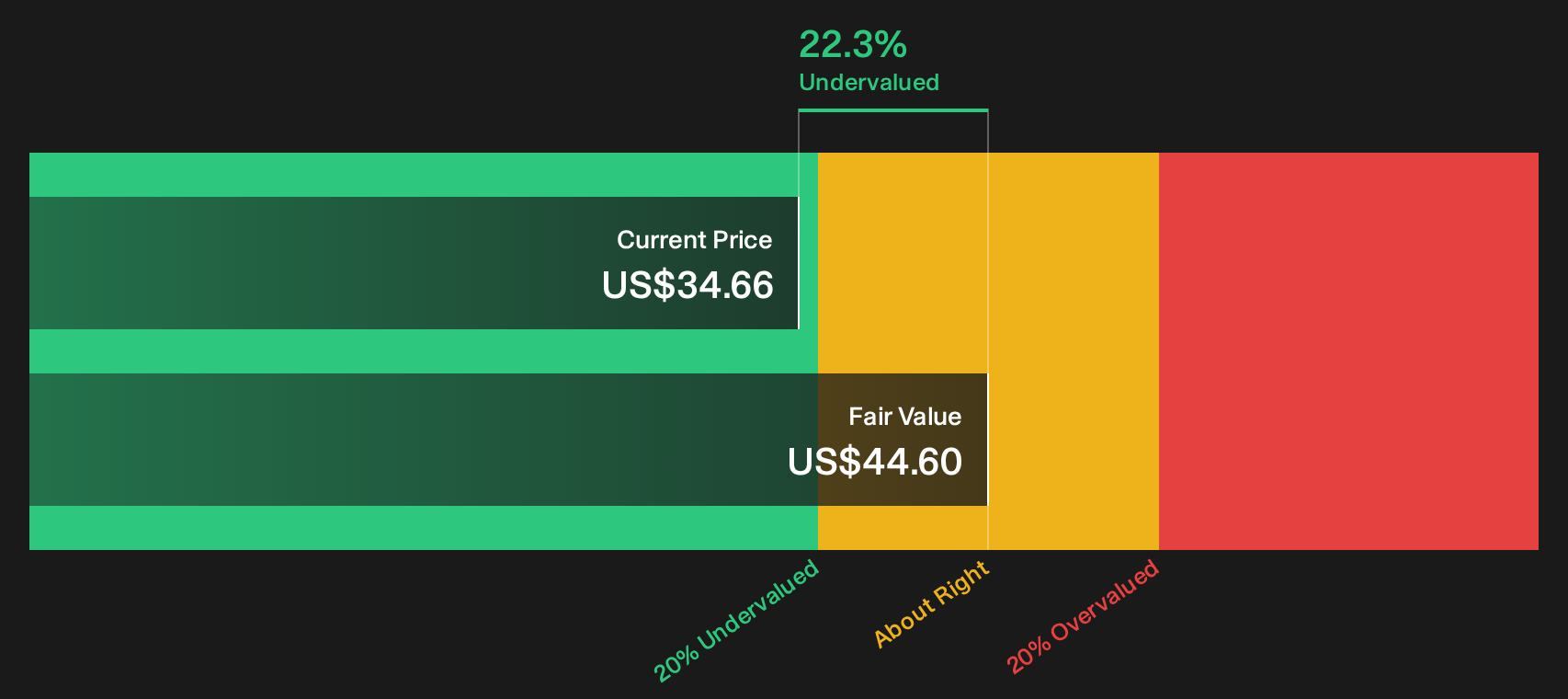
Simply Wall St performs a discounted cash flow (DCF) on every stock in the world every day (check out Rollins for example). We show the entire calculation in full. You can track the result in your watchlist or portfolio and be alerted when this changes, or use our stock screener to discover 33 high quality undervalued stocks. If you save a screener we even alert you when new companies match - so you never miss a potential opportunity.
Next Steps
Mixed messages on Rollins can easily push you to one side or the other, so move quickly to review the data yourself and pressure test both the bullish and cautious angles. Then weigh the 3 key rewards and 2 important warning signs.
Want more ideas beyond Rollins?
If Rollins leaves you uncertain, broaden your watchlist with a few focused stock ideas that match different goals, risk levels, and income needs.
- Target potential mispricing by scanning companies that combine quality fundamentals with discounted valuations through the 33 high quality undervalued stocks.
- Strengthen your income stream by reviewing businesses with higher yields that still aim for resilience in their payouts via the 5 dividend fortresses.
- Protect your downside by filtering for companies that score well on balance sheet strength and financial robustness using the list of solid balance sheet and fundamentals (24 results).
Have feedback on this article? Concerned about the content? Get in touch with us directly. Alternatively, email editorial-team@simplywallst.com