


What Polaris (PII)'s Raised Guidance Means For Shareholders
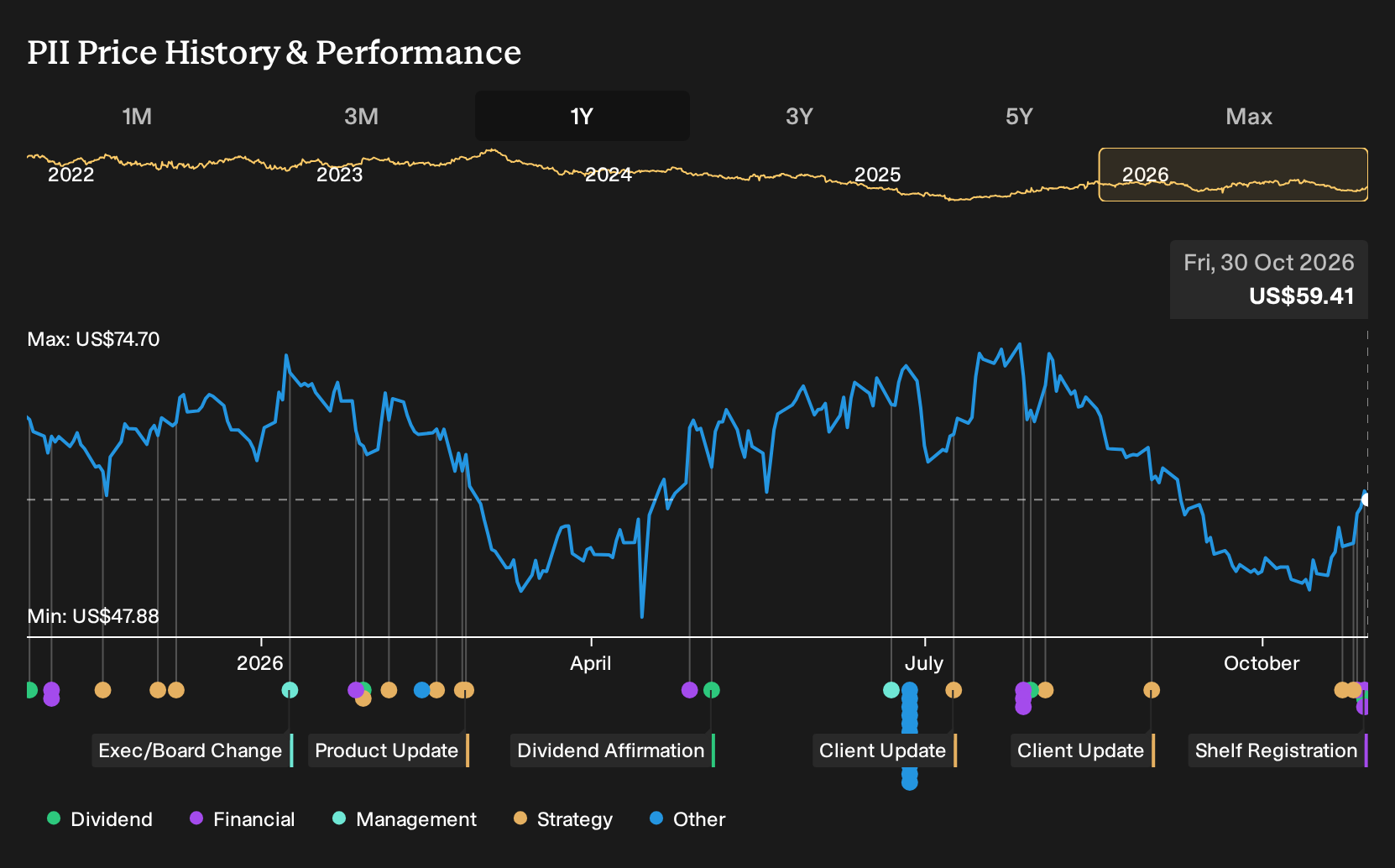
- Polaris reported Q3 2026 sales of US$2,042.6 million and net income of US$38.4 million, then raised full year revenue and adjusted EPS guidance after stronger performance in utility, commercial and government vehicles.
- The shift toward utility and commercial off road demand, together with supply chain and efficiency work, is becoming central to Polaris earnings quality as management addresses elevated commodity and logistics costs.
- The focus now turns to how Polaris’ stronger quarter and higher guidance could influence the longer term investment narrative around margins.
Polaris Investment Narrative Recap
To own Polaris, you need to believe the shift toward utility, commercial and government customers can support steadier demand than purely recreational powersports. The short term swing factor is execution on that mix change while keeping dealer inventory tight and discounting in check. The latest quarter, with higher guidance, supports that story more than it changes it.
The biggest near term risk still sits in consumer and Marine exposure if spending stays soft, which could limit how much the operational work shows up in earnings. Elevated input costs and interest expense also matter, especially while Polaris is only modestly profitable and dividend coverage remains thin.
The RZR Pro R Factory Boost launch fits into this backdrop as a halo product rather than a volume driver. It is engineered for high speed desert racing and carries a US$200,000 price tag, so financial impact likely comes more through brand strength and pricing power than unit count.
For you as an investor, the link back to catalysts is that race focused RZR development can filter into broader RZR and RANGER refreshes that already support share gains and average selling prices. The risk is that heavy spend on premium race platforms does not fully translate into margin improvement if recreational demand or Marine stay under pressure.
Polaris' current earnings sit at a loss of US$260.4 million, with analysts forecasting earnings of US$410.8 million on revenue of US$8.0 billion by 2029. This implies annual revenue growth of 2.3% and an earnings swing of about US$671 million over that period.
Uncover why Polaris' fair value indicates a 16% potential upside to its current price that could close sooner than you expect.
Exploring Other Perspectives
One alternate view focuses on the risk that Polaris’ push into contract heavy utility and commercial customers caps pricing power, even as halo machines like the RZR Pro R Factory Boost grab headlines. Those more cautious analysts were penciling in about US$7.9b of 2029 revenue and US$343.6 million of earnings before this news, which is far more conservative than consensus. That gap shows how wide opinions can be. It makes sense for you to compare several narratives and decide which assumptions feel closest to your own.
Explore 2 other Polaris fair value estimates, including one that suggests up to 10% downside from the current price.
Decide For Yourself
Don't just follow the ticker; dig into the data and build a conviction that's truly your own.
- A great starting point for your Polaris research is our analysis highlighting 2 key rewards and 2 important warning signs that could impact your investment decision.
- See our latest analysis for Polaris. The report includes a comprehensive fundamental analysis summarized in a single visual, the Snowflake, making it easy to evaluate Polaris' overall financial health at a glance.
Looking for more investment ideas beyond Polaris?
Once you have a working thesis on Polaris, casting a wider net can help you stress test your thinking and spot alternatives with different risk and reward profiles.
- For investors willing to take on more volatility in exchange for potential upside, scan a focused group of smaller, lower priced opportunities through 8 elite penny stocks with strong financials.
- If you want quality and valuation discipline in one place, sort through a carefully filtered pool of companies with strong fundamentals using 33 high quality undervalued stocks.
- When capital preservation and resilience matter most, narrow your options to businesses screened for sturdier financial footing via the 29 resilient stocks with low risk scores.
Have feedback on this article? Concerned about the content? Get in touch with us directly. Alternatively, email editorial-team@simplywallst.com