


Tokyo Metro (TSE:9023) Shares Climbed, What Is Behind The Fresh Attention?
Tokyo Metro (TSE:9023) drew fresh attention after announcing a second quarter-end dividend of ¥22.00 per share for the fiscal year ending March 31, 2027, with payments scheduled to begin on December 8, 2026.
Recent trading shows that momentum in Tokyo Metro’s shares has been soft overall, with the share price return down 9.54% year to date and the 1-year total shareholder return declining 8.25%. However, the latest dividend news coincides with a 1-day share price return of 2.05% from a last close of ¥1,445.5, which hints at improving sentiment.
Scan for other income-focused opportunities moving on fresh payout news by checking the hand-picked 28 dividend fortresses alongside Tokyo Metro’s latest dividend decision.
Tokyo Metro now offers a richer dividend but trades not far from its stated price target. Do the current terms still skew in favour of new buyers, or has most of the upside already been used up?
Preferred P/E of 15.7x: Is It Justified For Tokyo Metro?
On simple valuation checks, Tokyo Metro screens as expensive, with a P/E of 15.7x sitting above several reference points even though the share price of ¥1,445.5 is only modestly below a stated target of ¥1,478.
The P/E ratio compares what investors pay for each ¥1 of earnings to what the business currently delivers in profit. For a transportation operator that already generates high quality earnings, a richer multiple often implies that the market is comfortable paying up for steadier profits or limited growth risk.
In Tokyo Metro’s case, earnings are forecast to grow 1.04% per year while returns on equity are described as low at 7.2% and net profit margins have eased from 14.1% to 12.6%. That combination suggests the current P/E leaves little room for disappointment, since investors are already assigning a higher price than the estimated fair P/E of 14.6x that the SWS framework points to as a level the market could move towards.
The premium also shows up clearly against peers. The P/E of 15.7x is above the JP Transportation industry average of 12x and above a peer average of 14.4x. This implies investors are paying more for each unit of Tokyo Metro earnings than for comparable stocks in the same sector.
Explore the SWS fair ratio for Tokyo Metro.
Result: Price-to-earnings of 15.7x (OVERVALUED)
Still, Tokyo Metro faces the risk that softer annual net income growth of 1.04% and a relatively low 7.2% return on equity could pressure that premium P/E.
Find out about the key risks to this Tokyo Metro narrative.
Another View On Tokyo Metro’s Value
The earlier P/E workup presented Tokyo Metro as fully priced. A different lens gives the same message. Our DCF model estimates the value of future cash flows at ¥1,156.58 per share, which is below the current ¥1,445.5 level. That suggests Tokyo Metro is trading on the expensive side rather than at a discount. If earnings only move forward modestly from here, how much patience are investors being asked to have?
Look into how the SWS DCF model arrives at its fair value.
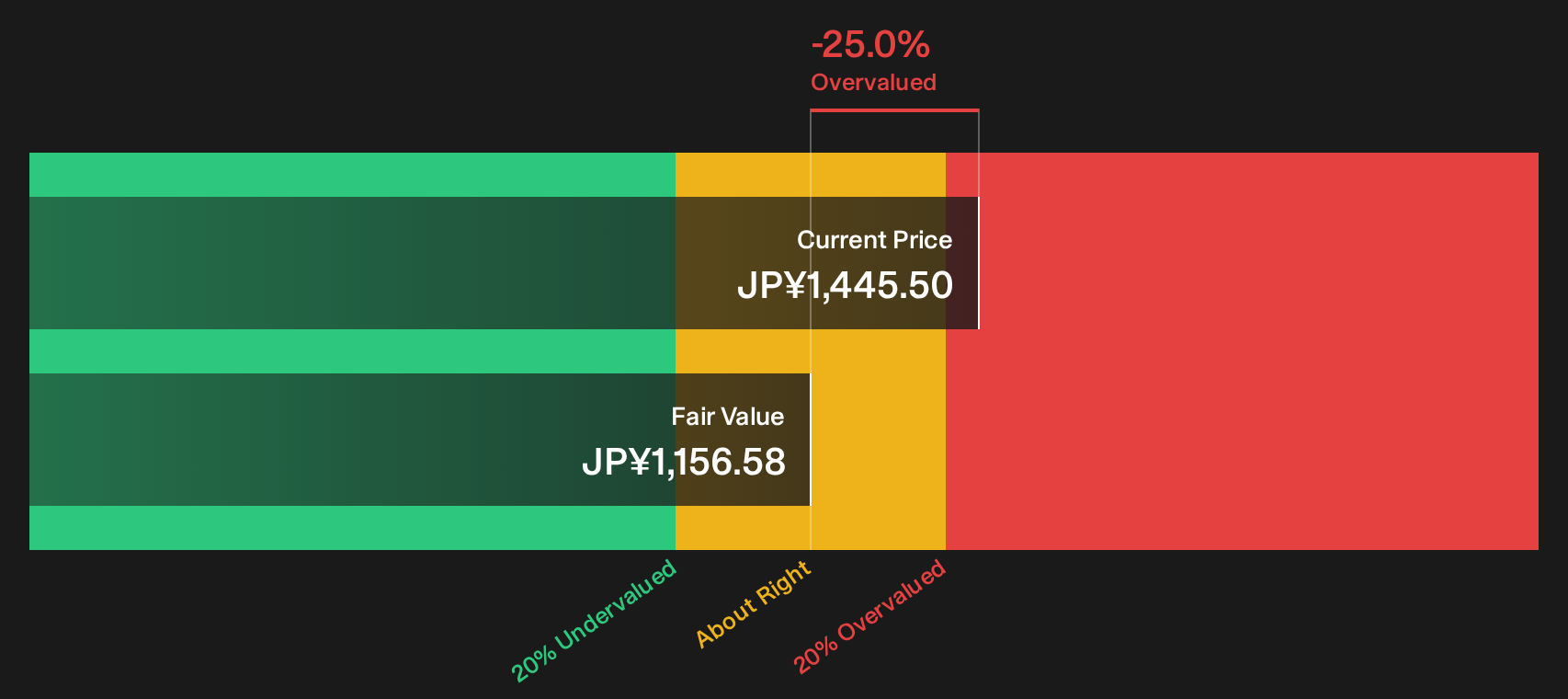
Simply Wall St performs a discounted cash flow (DCF) on every stock in the world every day (check out Tokyo Metro for example). We show the entire calculation in full. You can track the result in your watchlist or portfolio and be alerted when this changes, or use our stock screener to discover 16 high quality undervalued stocks. If you save a screener we even alert you when new companies match - so you never miss a potential opportunity.
Next Steps
If this all feels finely balanced, act quickly and weigh Tokyo Metro’s rich valuation against its mix of pressure points and bright spots using 1 key reward and 1 important warning sign.
Looking For More Investment Ideas Beyond Tokyo Metro?
Tokyo Metro might already be on your list, but you do not want to miss other companies that line up better with your goals and risk comfort.
- Target steadier compounding by scanning companies that combine quality earnings with attractive valuations using the 16 high quality undervalued stocks.
- Prioritise staying power by filtering for companies with strong finances and sturdy balance sheets through the list of solid balance sheet and fundamentals (21 results).
- Catch potential early movers by reviewing a focused 1 elite penny stocks with strong financials before the crowd pays attention.
Have feedback on this article? Concerned about the content? Get in touch with us directly. Alternatively, email editorial-team@simplywallst.com