


Why Vistra Bears Were Right Before The Drop
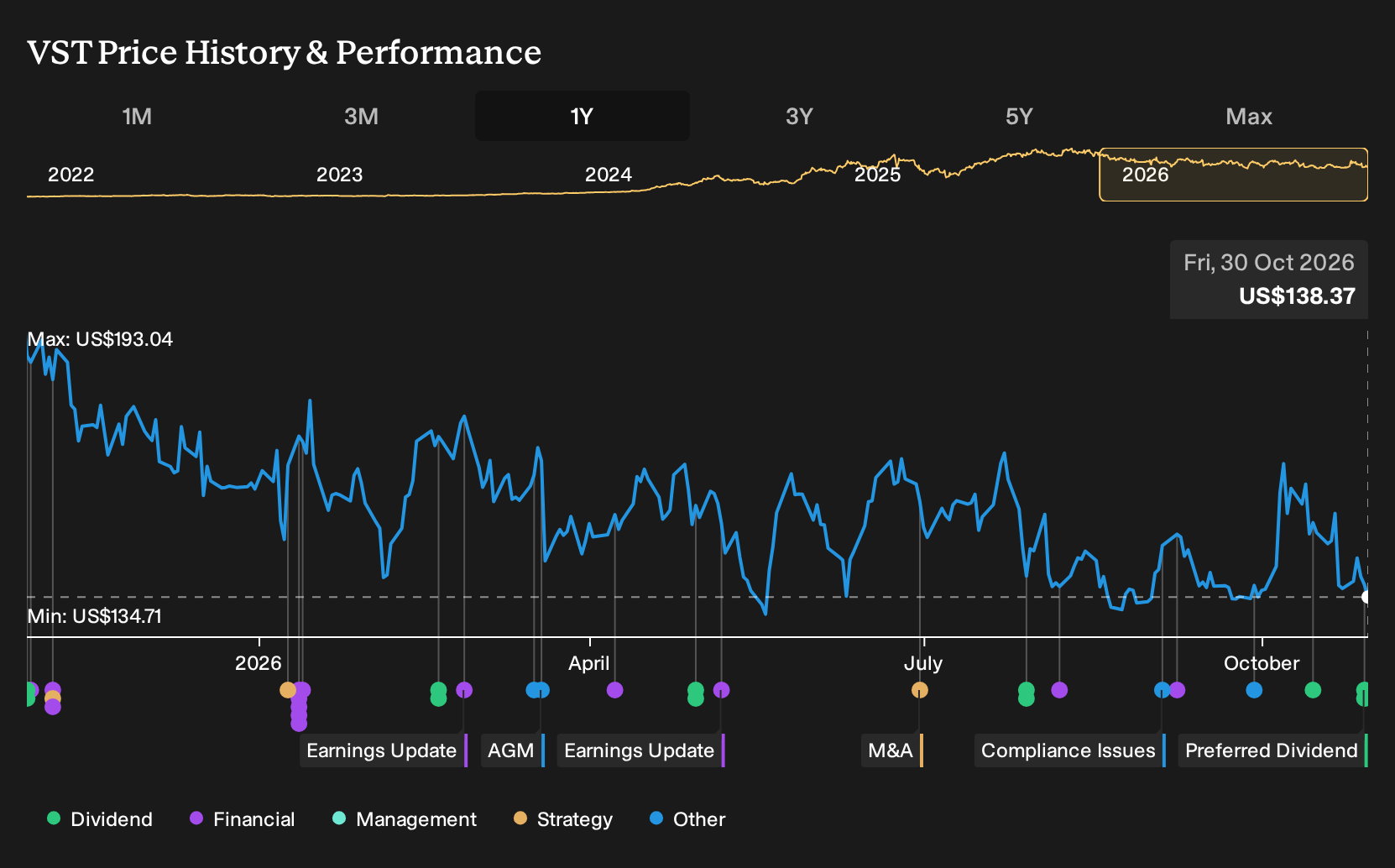
Vistra’s recent headlines talk about big AI data center deals, nuclear loan support, and a swing back to hefty quarterly profits, yet the share chart tells a very different story. Investors who held Vistra over the past year are down 26.1%, including dividends. If you had been weighing a position back on 30 October 2025, how much of that outcome was already hinted at by slipping Q2 2026 revenue and a slightly thinner net margin?
Vistra is not the only name tied to this theme. Zero in on 40 power grid technology and infrastructure stocks and compare how each one is priced.
The Two Vistra Stories Investors Had To Weigh
The shares cost US$190 at the start of the period, and Vistra sat between two sharply different stories about what might happen next.
On the optimistic side, the AI and data center narrative pointed to a Fair Value of US$222, a price implied by assumptions such as 9.7% revenue growth and profit margins reaching 14.0% within three years.
The cautious view anchored on a Fair Value of US$92.69 and focused on risks like tighter emissions rules and renewable buildout pressuring power prices and squeezing net margins in PJM and ERCOT.
What The Vistra Evidence Actually Tested
The most concrete update for Vistra was Q2 2026, when total revenue slipped to US$4,017m from US$4,250m a year earlier and net income eased to US$258m from US$280m. Net margin edged down from 6.6% to 6.4%. That is a long way from the 14.0% profitability the optimistic case had pencilled in, so the results leaned toward the cautious story.
The useful takeaway for other stocks is simple. When a bullish pitch leans on future margin expansion, it can be helpful to check whether the reported net margin is already widening, holding flat, or starting to compress before paying up for that potential gap.
What You Would Be Paying For In Vistra Today
Vistra now trades at US$138 after a 26.1% loss over the past year, and the selected Narrative’s Fair Value sits above that quote based on its own assumptions. The focus is on AI driven power demand, long contracts and a broader mix across nuclear, gas and renewables.
For that view to hold, a buyer today would need to believe AI and data center power needs translate into durable contracted volumes and cash generation from projects already in Vistra’s plan.
"Analysts expect Vistra to keep using rising ERCOT and PJM electricity demand, long-dated data center contracts and a broader mix across nuclear, gas and renewables to support stronger and more diversified cash generation over time. For that to play out, Vistra needs AI and data center driven load growth to translate into contracted volumes and returns on projects like Helix Digital Infrastructure, Cogentrix, nuclear uprates and new gas and solar buildouts, while managing regulatory changes around interconnection and capacity markets."
That disagreement has a full argument behind it. → Uncover the higher Fair Value this Narrative argues for
Another Way To Play AI Power
Vistra is one way to think about AI hungry grids. You can also look at companies built around long lived clean power.
Large data center operators do not just want electrons. They want steady, carbon free supply they can lock in for many years.
One specialist in nuclear heavy generation tries to meet that demand with long duration contracts, policy supported credits and plant life extensions.
Those projects, contracts and market rules around big loads will not move in a straight line.
Watching how this player converts interest into firm agreements could shape how you frame Vistra’s role.
The case is on the record, with the assumptions it rests on. → See the Narrative that values this company 30% above its price
Have feedback on this article? Concerned about the content? Get in touch with us directly. Alternatively, email editorial-team@simplywallst.com