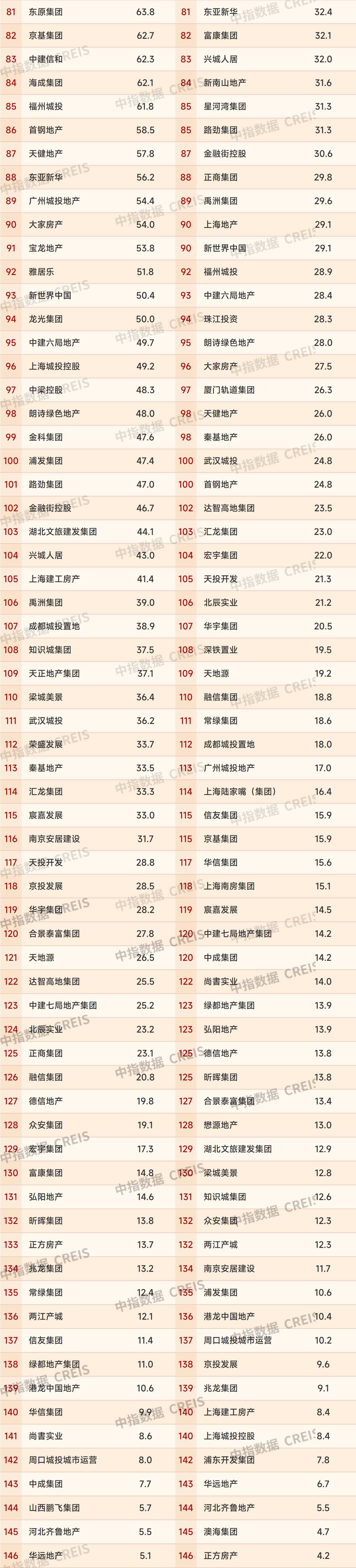
China Index Research Institute: Total sales of 100 Chinese housing enterprises reached 2537 billion yuan in January-October, and the year-on-year decline narrowed
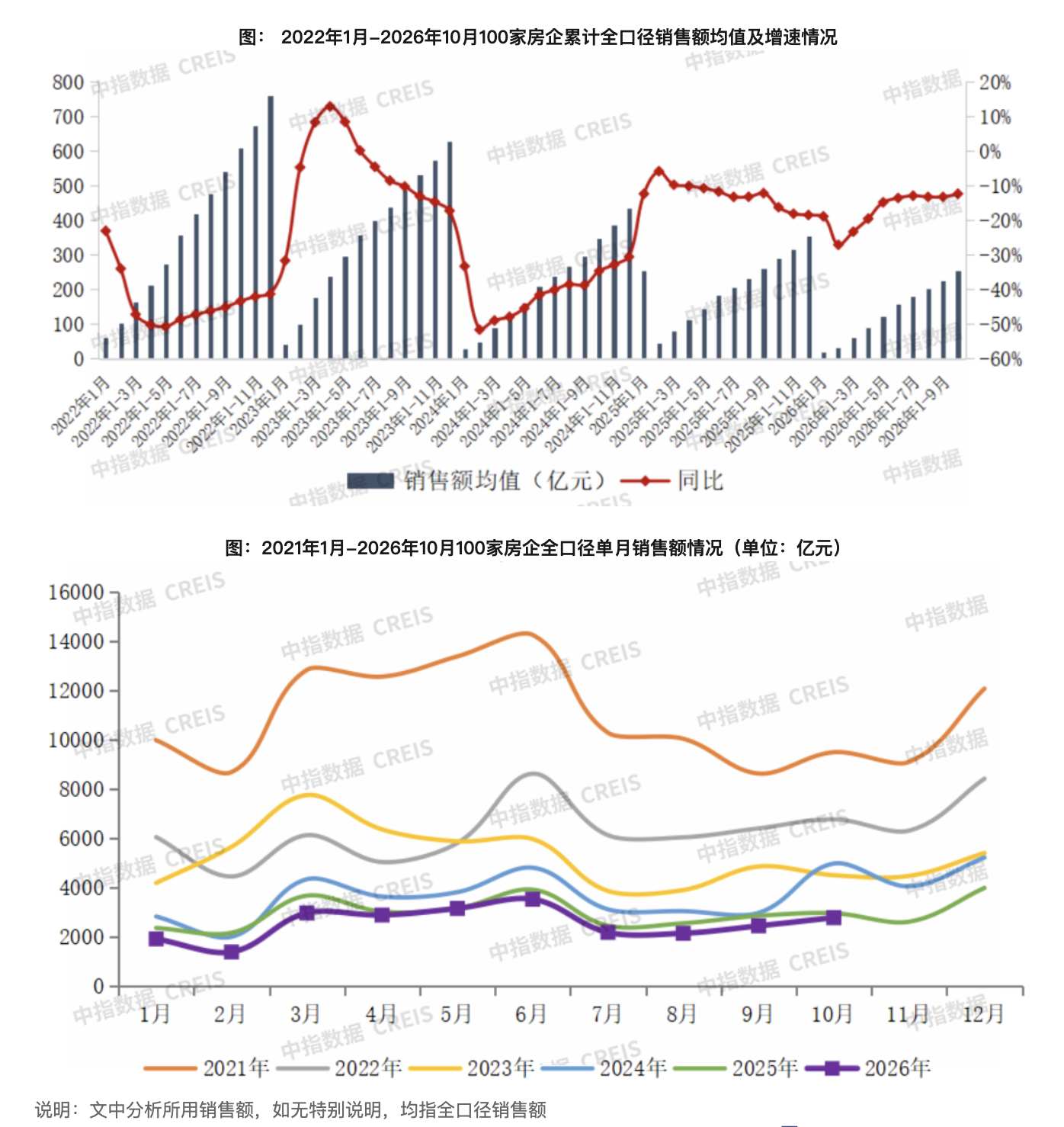
The Zhitong Finance App learned that the China Index Research Institute said that from January to October 2026, the total sales of 100 housing enterprises reached 2537.06 billion yuan. The year-on-year decline was 0.9 percentage points narrower than in January-September. The three factors of strong interest rate discounts on the policy side, concentrated promotion on the supply side, and the low base last year all contributed to marginal sales improvement. However, industry differentiation is still intensifying. The number of 100 billion and 10 billion housing enterprises has narrowed to 6 and 58 respectively. The competitive logic of the industry shifts from competing sales scale to a comprehensive competition of cash flow, product power, and delivery certainty, and the industry reshuffle continues; high-quality projects in core cities have achieved popularity due to multiple factors such as intensive policy support, scarce locations, and product upgrades. Looking ahead to the end of the year, as the National Development and Reform Commission clearly implements incremental policies such as interest rate discounts on home purchase loans, compounded by housing companies' year-end sprint promotions and low base effects, the new housing market in core cities may have some support. The decline in housing enterprise sales is expected to narrow further, but the differentiation among enterprises will continue to intensify.
Performance: The decline in sales of 100 real estate companies in January-October was 0.9 percentage points narrower than in January-September
From January to October 2026, the total sales of 100 real estate companies was 2537.06 billion yuan. The year-on-year decline was 0.9 percentage points narrower than in January-September. It is mainly affected by the following factors: First, policies such as the September 29 mortgage interest rate discount have effectively boosted confidence in buying a home and lowered the threshold for buying a home; second, supply-side cooperation, housing enterprises seize the window to focus on promotion, and the entry of high-quality projects into the market has accelerated the transformation of wait-and-see customers. The third is the impact of last year's low base. However, sales performance among enterprises is still fragmented. Relying on sound capital and reliable delivery credit, some housing enterprises combine the continuous refinement of high-quality land storage layouts and product strength in core cities, making it easier to be favored by buyers in an environment where market confidence is weak, thus achieving positive year-on-year sales growth. From January to October 2026, the trading sales of 100 housing enterprises were 2001.63 billion yuan, and equity sales were 1747.71 billion yuan.
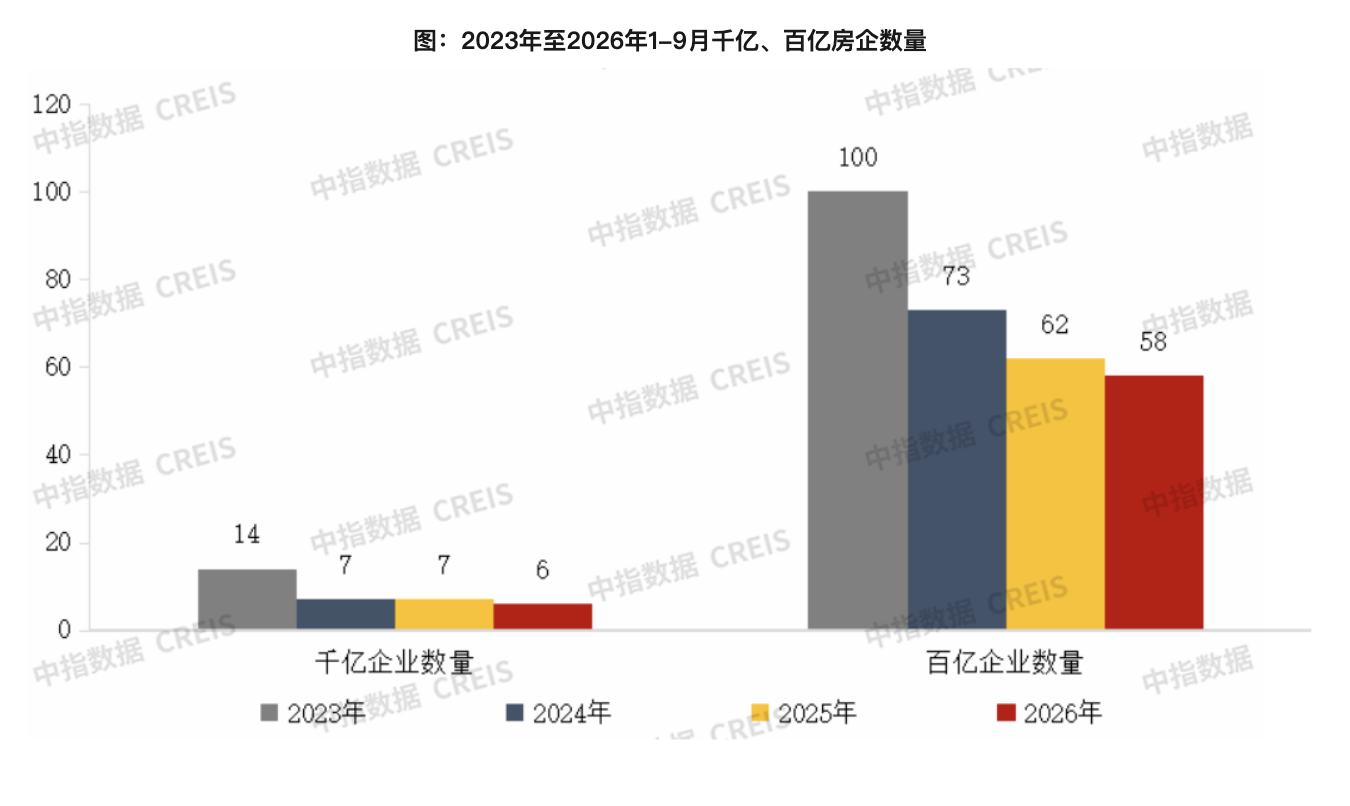
Number of factions: The competitive logic of the industry shifts from competing for sales scale to a comprehensive competition of cash flow, product power, and delivery certainty. The industry reshuffle continues
From January to October 2026, there were 6 100 billion housing enterprises, a decrease of 1 compared to the same period last year; the number of 10 billion housing enterprises was 58, a decrease of 4 compared to the same period last year. Judging from the changes in the sales camp of housing enterprises from 2023 to 2026, the number of 100 billion and 10 billion housing enterprises continued the downward trend. Among them, the number of 100 billion housing enterprises fell further to 6 after falling to 7 in 2024, while the 10 billion housing enterprise echelon continued to fall from 100 to 58 in 2023. The contraction in the echelon size continued between 100 billion housing enterprises and 10 billion housing enterprises. Market resources are further concentrated on a small number of enterprises with steady management and outstanding delivery capabilities. The competitive logic of the industry shifts from competing for sales scale to a comprehensive competition of cash flow, product power, and delivery certainty. The industry is still continuously screening large-scale housing enterprises.
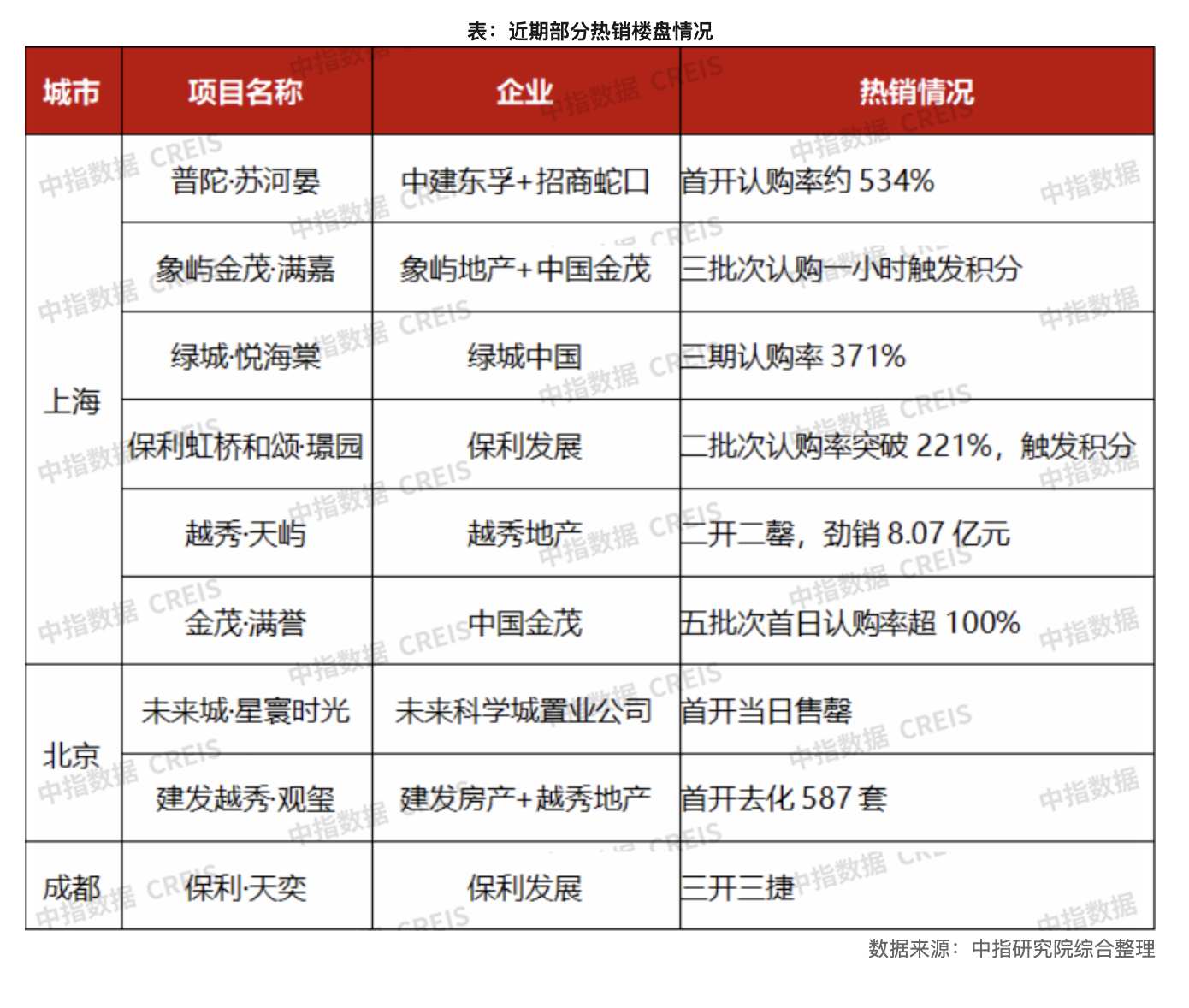
Popular projects: Multiple factors such as intensive policy support, scarce locations, and product upgrades resonate to drive high-quality projects in some core cities to achieve popularity
In October 2026, behind popular projects in core cities, multiple factors such as intensive policy support, scarce locations, and product upgrades resonate. First, the policy mix continues to gain strength to inject “certainty” into the market. Core cities such as Beijing, Shanghai, Hangzhou, and Chengdu centrally introduced new property market policies at the end of August. Interest rate discount policies for home purchase loans were implemented, local rules for existing housing were implemented intensively, and multi-dimensional policies lowered the threshold for buyers to buy homes, strengthened delivery certainty, and encouraged demand to be concentrated in core locations and high-quality products. Second, scarce land and the gap between supply and demand form the soil for an explosion of demand. The total supply of high-quality new homes for improvement in the core mature sector is limited, and the backlog of demand for home purchases has laid the market foundation for the project's popularity. Third, product strength has increased from generation to generation, which has become the key to bridging the gap. Most projects use a “global upgrade” to restructure the three-dimensional space of the community, and use the dividends of the new regulations to increase the actual yield, and superimpose customer co-creation apartment types, sunken courtyards, three-dimensional gardens, and high-standard clubs to form differentiated selling points. Fourth, reality realization and pre-operation have become new selling points, making “certainty” a touchable life. Finally, an accurate total price matching strategy has created a high cost ratio product. Some projects cut into the sector's current demand segment with appropriate pricing, combined with supporting support such as transportation, industry, commerce, and ecology, and ultimately achieved a high subscription rate.
The National Development and Reform Commission has clearly implemented incremental policies such as interest rate discounts on home purchase loans. The new housing market in core cities may have some support, and the performance sprint of housing enterprises at the end of the year may promote marginal sales improvement
In terms of policy, at the central level, on October 8, the Ministry of Natural Resources issued the first batch of typical examples of real estate registration services to support urban renewal and promote 6 practices including “listing with the status quo”; on October 20, the National Development and Reform Commission press conference clearly implemented incremental policies such as reducing interest rates on supplementary mortgages, increasing reloan amounts, and interest rates on home purchase loans; on the same day, six departments including the Ministry of Housing and Construction issued the “Guiding Opinions on Promoting the Renovation and Upgrading of Old Neighborhoods” to implement the “Fifteenth Five-Year Plan for Urban Renewal” and implemented the 1,500 “Urban Renewal” Plan in an orderly manner Major renovation and upgrading projects; October On the 23rd, the Ministry of Finance introduced the steady implementation of interest rate discounts on home purchase loans, which are beginning to show results. On October 23, the Executive Meeting of the State Council studied the coordination of population, economic and social development, and called for optimizing fiscal, social security, housing and other support measures for families to stabilize the size of the newly born population. At the local level, the reform of the commercial housing sales system has entered a period of intensive implementation of rules. Cities such as Wuhan, Tianjin, Hangzhou, Shenzhen, Ningbo, Suzhou, Hefei, and Chengdu issued implementation opinions one after another. At the same time, provident fund policies were implemented centrally. Shenzhen, Tianjin, Hangzhou, Dongguan and other places added new decoration and property fee withdrawals. Hangzhou raised the loan amount increase ratio from 50% to 60%, and the maximum loan amount limit was raised to 3.24 million yuan. Also, in October, Anhui, Hubei and other provinces and cities issued about 23 billion yuan of special bonds to collect and buy unused land stocks.
In terms of the new and second-hand housing market, second-hand housing transactions have remained active since October, and the new housing market is still undergoing an adjustment period. Second-hand housing markets in Beijing, Shanghai and some second-tier cities continued to be highly active. High-quality projects in core areas of some cities are popular, but in most cities, the year-on-year decline is still declining. In terms of land, due to the volume of residential land supply in September, residential land transaction plans and land concession funds in the 300 cities all increased significantly year-on-year in October, but the average premium rate was only 1.4%, and the popularity of the land market is still low. Judging from the energy level of cities, transactions are mainly concentrated in third- and fourth-tier cities.
Looking ahead to the end of the year, with housing companies' year-end promotions and the entry of high-quality projects into the market, the new housing market in core cities may have some support, but the overall trend of bottoming out continues. Second-hand housing transactions are also expected to remain active, and prices are expected to fluctuate in a narrow range.
In terms of sales of housing enterprises, housing enterprises are expected to improve marginally in order to sprint up their performance or increase promotion and promotion efforts at the end of the year. Combined with the low annual base effect, this may drive housing companies' sales decline to narrow. At the same time, the differentiation in sales performance among enterprises will continue to intensify.