


Learn Why The Bull Case For Prologis (PLD) Could Change Following Warehouse Park Joint Venture
- Gaming and Leisure Properties, Inc. has already agreed a joint venture with Prologis to turn the former Hollywood Casino Joliet site into a Class A warehouse and distribution park of more than 3.8 million square feet over three phased developments.
- The project gives Prologis a large, multi year development pipeline in a major Interstate 80 freight corridor, highlighting how the business is leaning into industrial demand rather than relying only on existing logistics assets.
- We will examine how Prologis' investment narrative is influenced by this multi phase Joliet logistics park joint venture with Gaming and Leisure.
Prologis Investment Narrative Recap
To hold Prologis, you need to believe modern logistics hubs, well located warehouses and value added services like data centers and onsite energy can keep drawing tenants over time. The Joliet joint venture fits that script but does not obviously change the near term story. The key swing factor remains how quickly recent leasing converts into rent and cash flow.
The biggest near term risk still sits in funding and execution, not in this single project. Prologis has leaned on equity issuance and has a large proposed SEGRO deal waiting for approvals. If cash generation lags or major projects slip, dilution and slower earnings progress become potential pressure points.
Against that backdrop, fresh holdings disclosures from institutions such as Charles Schwab Investment Management, Millennium and Natixis provide additional insight into how large investors are positioning around Prologis. These filings show positions and option activity but do not, on their own, change the operating outlook.
For you as a shareholder, the value in these announcements is context. Institutional investors are sizing exposure while Prologis advances developments such as Joliet and pursues the SEGRO transaction. Execution on leasing, construction and capital structure remains the catalyst to watch, while balance sheet coverage and potential further equity issuance remain central risks.
What The Prologis Consensus Is Really Pricing In
Prologis' consensus story is built on analysts modeling steady top line expansion alongside leaner profitability over the next few years. The forecast points to revenue growing by 2.3% a year while profit margins step down from 43.0% today to 35.7% by 2029. That combination leaves earnings projected to ease from US$4.3b now to US$3.8b by 2029, a decline of US$0.5b even as the asset base and development pipeline expand.
Prologis' narrative projects US$10.6b revenue and US$3.8b earnings by 2029. This is built on 2.3% yearly revenue growth and a US$0.5b earnings decline from US$4.3b today.
The analyst framework also leans on a much richer valuation multiple down the road. To bridge from earnings of US$3.8b in 2029 to the current price targets, the stock would need to trade on a P/E of 52.9x in that year. This compares with 27.7x today and a US Industrial REITs sector reference of 24.7x. That is a big gap. It suggests the market case hinges less on headline earnings growth and more on investors being prepared to pay a premium for the perceived quality and scarcity of Prologis' logistics and infrastructure network.
Consensus models in steady growth in the share count as well. Analysts are assuming the number of shares rises by about 2.32% each year over the next three years, reflecting a continued use of equity to fund development projects, acquisitions like the proposed SEGRO deal, and potentially ventures similar to Joliet. For existing holders, that means even if revenue lines up with the 2.3% trajectory, per share economics depend heavily on how effectively new capital is put to work.
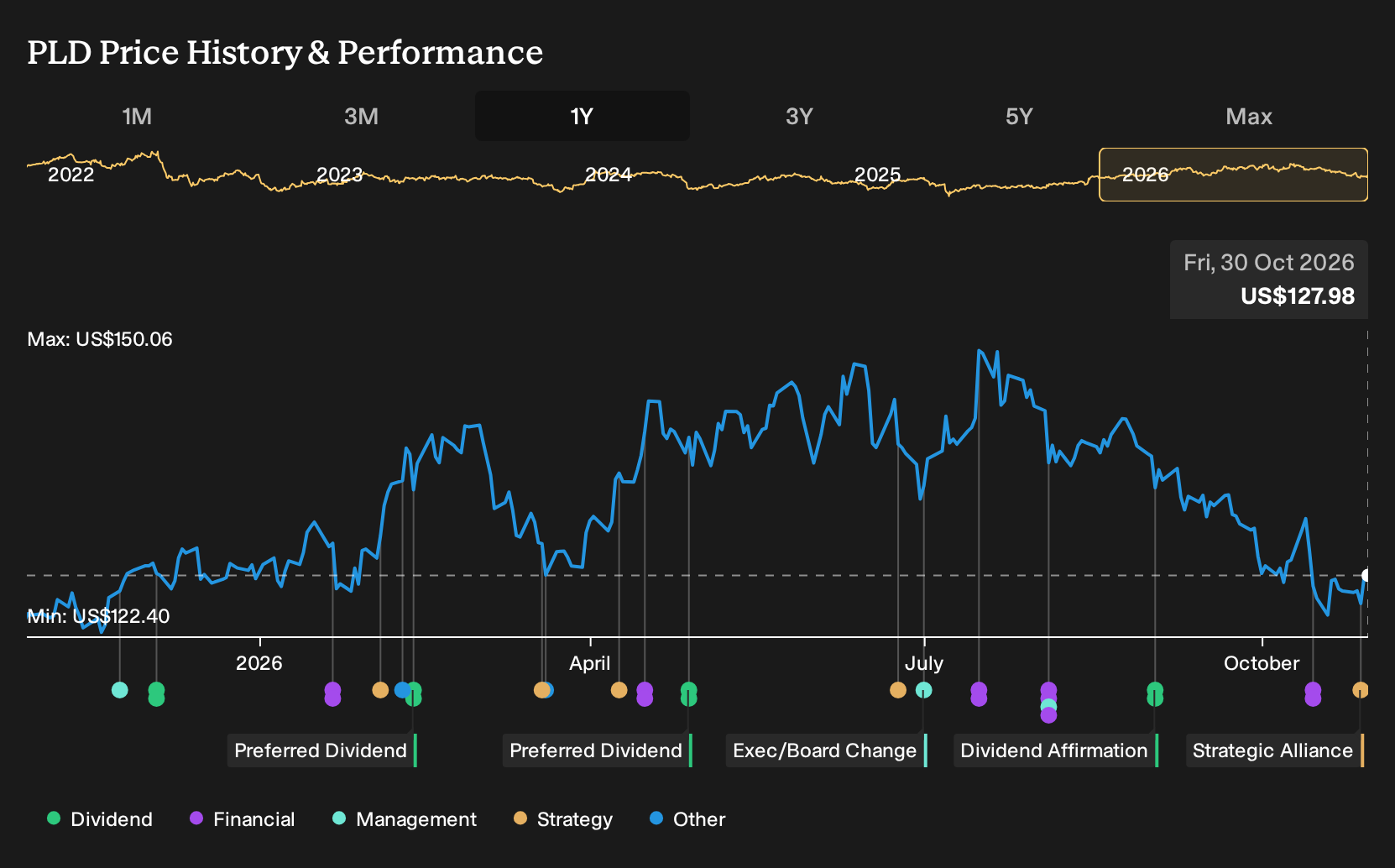
The price target range underlines how wide opinions are. The current analyst consensus of US$152.85 sits between a high case of US$170.00 and a low case of US$140.00, compared with a spot price of US$124.09 as of late 2026. That 18.8% gap between market price and the midpoint target reflects an assumption that Prologis can sustain its industrial footprint, manage development risk, and support a premium multiple despite forecast pressure on earnings and margins.
Uncover why Prologis' fair value indicates a 19% potential upside to its current price that could narrow quickly.
Exploring Other Perspectives
Only two fair value estimates from the Simply Wall St Community cluster tightly between about US$147.47 and US$152.85, which brackets current analyst targets for Prologis. Those retail views predate the Joliet joint venture and the proposed SEGRO deal, so you are weighing them against fresh dilution risk, development execution and shifting freight corridor demand. Investor opinions can differ widely; explore several alternative viewpoints before deciding how Prologis fits your portfolio.
Explore another Prologis fair value estimate, including one that suggests it could be worth just $147.47.
Reach Your Own Conclusion
Don't just follow the ticker; dig into the data and build a conviction that's truly your own.
- A great starting point for your Prologis research is our analysis highlighting 3 key rewards and 2 important warning signs that could impact your investment decision.
- See our latest analysis for Prologis. The report includes a comprehensive fundamental analysis summarized in a single visual, the Snowflake, making it easy to evaluate Prologis' overall financial health at a glance.
Looking for more Prologis style investment ideas?
If the Prologis story has you thinking about how logistics, balance sheet strength and income streams fit together in your portfolio, the Simply Wall St Screener can help you scan for other companies that match the mix of quality and resilience you want.
- If you care most about stability and capital protection, start with a 30 resilient stocks with low risk scores that may hold up better when conditions get tougher.
- For those who want dependable income on top of potential price returns, shortlist companies through a 5 dividend fortresses built around higher yielding payers.
- When you are searching for quality at a reasonable entry point, use a 29 high quality undervalued stocks that focuses on fundamentals and pricing together.
Have feedback on this article? Concerned about the content? Get in touch with us directly. Alternatively, email editorial-team@simplywallst.com