


The US is “inflationary”, but “consumption is difficult”! PCE and GDP hint at the Fed's dilemma
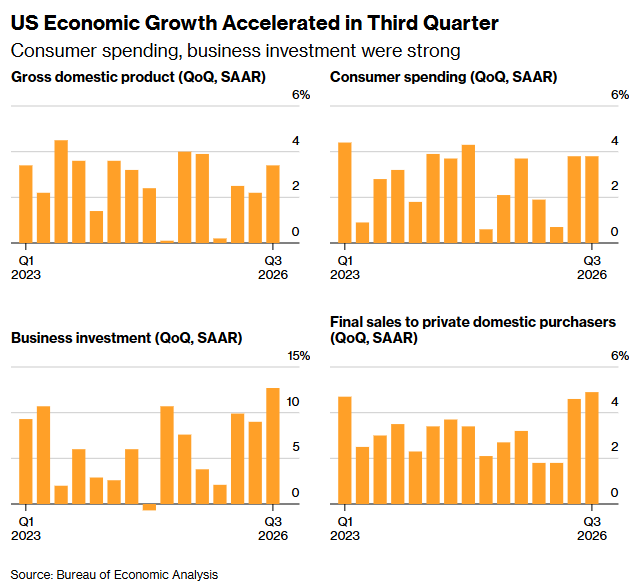
The Zhitong Finance App learned that on Thursday, the US Department of Commerce's Bureau of Economic Analysis (BEA) handed out two responses at once: the initial value of actual GDP for the third quarter was 3.4% month-on-month discount, higher than the 3.2% forecast by economists, the previous value of 2.2%; in September, the PCE price index rose 0.5% month-on-month and 3.6% year-on-year, excluding the core PCE for food and energy, which rose 0.3% month-on-month and 3.1% year-on-year. All four items fell within market expectations.
Economic landscape
Let's look at the GDP segment (all at a month-on-month discount): personal consumption expenditure grew by 3.8%, maintaining this rate for the second quarter in a row; corporate investment grew by 12.7%, the strongest since 2020, with both information processing equipment and industrial equipment rising; equipment spending contributed the highest since 2011 — except for the post-pandemic rebound period; net exports dragged down 3.3 percentage points, the biggest drag since the beginning of last year; inventory contributed 1.6 percentage points; residential investment continued to be a drag. Previously, mortgage interest rates rose to 7.5%.
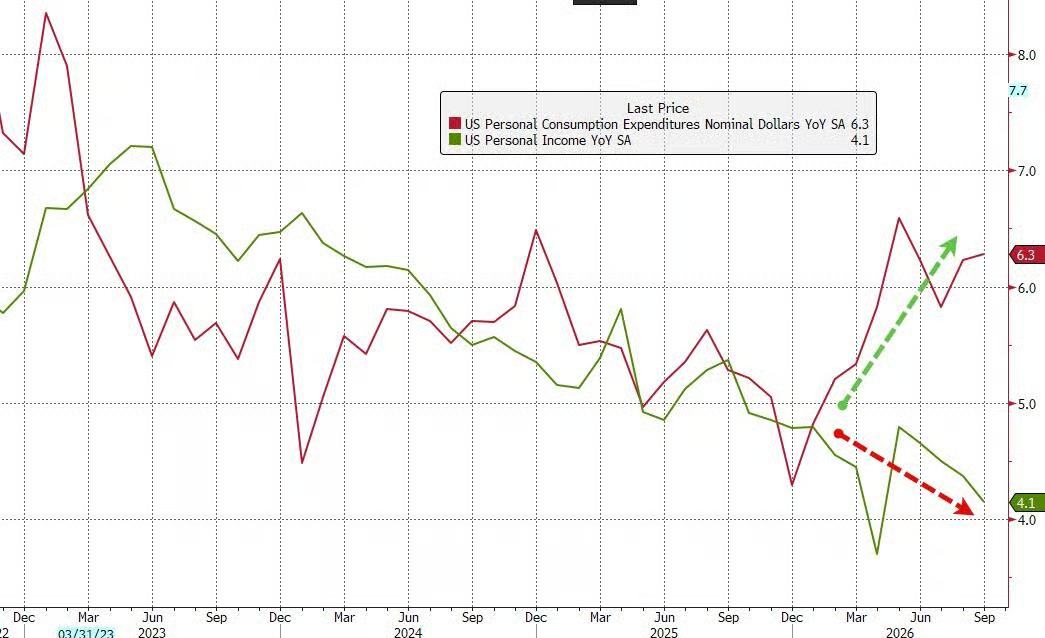
Let's also look at September's income and expenses: personal income increased by $54.5 billion, 0.2% month-on-month (market forecast 0.3%), disposable personal income increased by 52.7 billion US dollars, increased 0.2%, but actual disposable income fell 0.3%; personal consumption expenditure increased by US$113.1 billion, nominal increase of 0.5% (market forecast 0.6%), while actual expenditure only increased by US$2.6 billion, an increase of less than 0.1%, which is basically zero; personal savings of US$91.1 billion, and the savings rate fell to 3.8%.
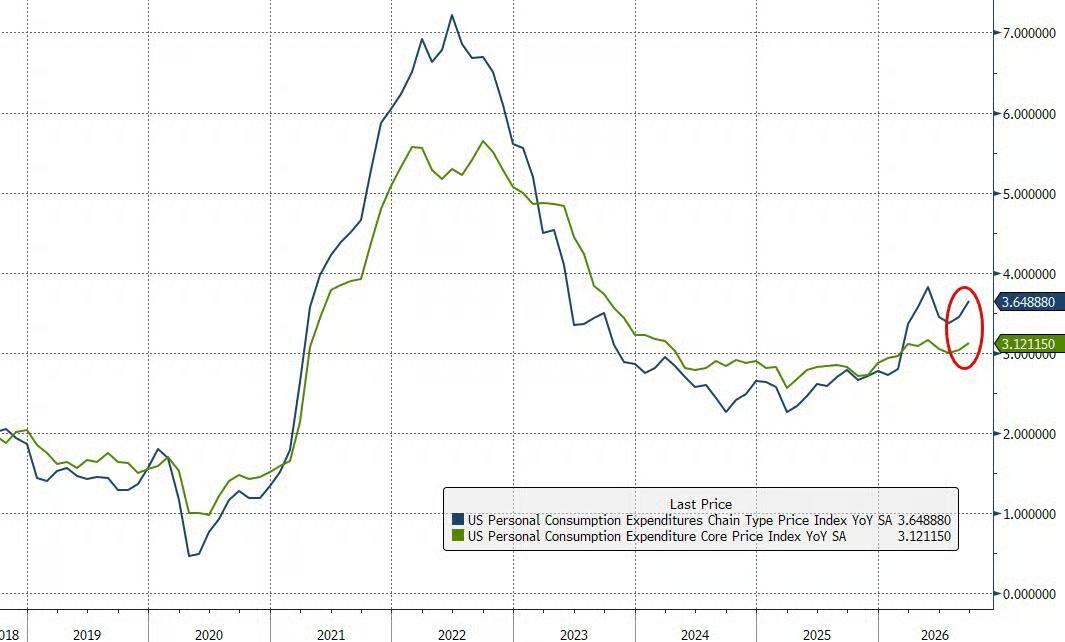
Inflation side: The PCE price index rose 0.5% month-on-month (0.3% in August) and 3.6% yoy (3.4% in August); core PCE rose 0.3% month-on-month and 3.1% yoy, the highest since May, and 3.0% in August.
AI equipment investment and inventory recovery
The growth structure for this quarter was very concentrated. The contribution of equipment spending to GDP was the highest since 2011, and this portion falls heavily on information processing equipment — that is, investments in AI data centers. The 12.7% growth rate of corporate investment is the strongest since 2020. In other words, if AI-related spending is removed, this quarter is far from being as hot as 3.4%.
Net exports dragged down 3.3 percentage points; in fact, they have the same origin: a large amount of equipment that AI investment relies on needs to be imported, and the surge in imports of data center equipment itself depresses net exports; superimposed enterprises rushed ahead of schedule to avoid tariffs, and the import side was further boosted.
Inventory contributions of 1.6 percent are also one-off — rushing in goods will sooner or later have to be digested in the next quarter. Housing investment, which continues to shrink at 7.5% mortgage interest rates, is the only undisputed drag in this report.
This also explains the serious discrepancy between data and sentiment: the GDP reading is one of the strongest in three years, yet consumer confidence at the University of Michigan and the Advisory Council is at an all-time low, and Trump's approval rating is low during his tenure — and the report was published less than a week before the November 3 midterm elections. Some economists are straightforward: given the growing weight of AI-related spending, 3.4% is probably not a true picture of the economy.
The real problem is consumption: the division between nominal and actual
More alarming than the GDP segment is the rift in September's income and expenditure accounts. Nominal expenditure increased by 0.5%, and actual expenditure was approximately equal to zero; nominal revenue increased by 0.2%, and real disposable income decreased by 0.3%. The income growth rate has fallen to its lowest range since April 2022, and consumption is still growing. The gap can only be covered by savings: the savings rate fell further to 4.6% in July (after revision), 4.1% in August (the lowest since November 2022), and 3.8% in September.
Another timing gap must be pointed out: GDP covered July-September, while actual consumer spending in September had already stopped. In other words, 3.4% is a rearview mirror, and zero growth is the reading for the current period — the strong momentum in the third quarter has already lost the relay from the consumer side when entering the fourth quarter.
And the pressure is still increasing. The average price of gasoline in the US is still above $4 per gallon. Prices of gasoline and other energy commodities rose 9.2% month-on-month in September (4.4% in August), and energy spending has been rising for six of the first nine months of this year. Corporate observations also point to polarization: United Parcel CEO Carol Tome said on a performance conference call this week that as long as the employment rate remains stable, “consumers will spend money because they have assets,” but she also emphasized that people without assets are already struggling; Coca Cola said that households at all income levels are prioritizing “value.”
The total retail sales volume for September, which was previously announced, exceeded expectations, and can easily be read as “consumption is still strong.” If you take the structure apart, the conclusion is much more cautious. First, the 0.8% increase is highly dependent on the gas station category. After exclusion, only 0.2% remained; after excluding automobiles, building materials, and catering services, only 0.1% remained. The retail data is seasonally adjusted but not adjusted for inflation. If the 0.6% monthly price increase in September is included, actual retail sales are “flatter than flat.”
Second, actual purchasing power is declining. The report pointed out that wages fell again after adjustment for inflation in September; the reason why consumers are still spending money is largely due to high-income households supported by stock earnings — the so-called K-type economy. The Beige Book released by the Federal Reserve on Wednesday confirms this: from late August to early October, most jurisdictions reported “little or no change” in consumer spending; even in jurisdictions where companies like Dallas reported steady retail sales, there were “some reports that low-income customers are becoming more cautious.”
Inflation: Energy is driving the overall trend, and the core is also rising
Overall PCE rebounded from 3.4% to 3.6% year over year, and almost all can be attributed to energy. But that's not the whole answer. Core PCE rose from 3.0% to 3.1% year over year, the highest since May; in August data, “super-core” service inflation, which excludes housing costs, is already heating up again. This means that even though statistical calibrations have lowered the weight of some commodity prices, the domestic price pressure on the server side has not disappeared. The war in the Middle East and the Russian-Ukrainian conflict pushed up fuel prices, and the Trump administration's tariffs raised the prices of some commodities. Both lines are being transmitted to the core. The report means that PCE has surpassed the Federal Reserve's 2% target for 68 consecutive months — high inflation has continued for almost six years.
Federal Reserve: The December rate hike has been priced, the differences are in 2027
The Federal Reserve kept interest rates unchanged at 10-2 on October 28. The two negative votes came from Governor Lisa Cook (who voted against for the first time during her tenure) and Cleveland Federal Reserve Chairman Beth Hammark. Both advocated raising interest rates by 25 basis points. I just added it in September, the first time in three years.
Three signs are worth remembering: the statement raised the description of economic activity from “solid (solid)” to “expanding at a strong pace (expanding at a strong pace)” while reaffirming that “inflation is still at a high level”; Chairman Kevin Walsh said at the press conference that “economic activity is expanding at a strong pace” and “domestic spending remains resilient,” and that the next six weeks will be an “information-intensive” period; he also clearly denied the forward-looking guidelines and announced that starting 2027, one of the 8 FOMC meetings will change to pure strategic discussions. Interest rate votes and policy statements are not issued.
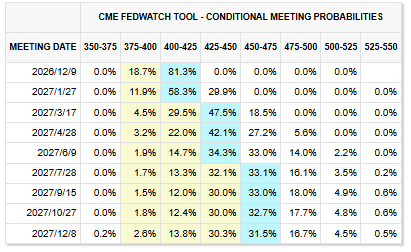
What needs to be clarified is that the 3.4% growth rate is significantly higher than what some Fed officials think is a “non-inflationary growth rate” of about 2%. The CME “Federal Reserve Watch” shows that the probability of raising interest rates by 25 basis points in December after the resolution once rose to 85.0% (78.3% the day before), and is still around 81% after the announcement of GDP and PCE.
Institutional differences focus on 2027: Kai Haige, global head of fixed income and liquidity solutions at Goldman Sachs Asset Management, is expected to resume interest rate hikes in December, and may be further tightened next year if energy prices rise again or data continues to be strong; former Philadelphia Federal Reserve Chairman Patrick Huck expects to stand still in 2027 after a 25 basis point rate hike in December; and Ian Lingen of BMO Capital Markets believes that a third rate hike after December is not necessarily necessary. The tail risk was proposed by Brent Schutt of Northwest Mutual Aid: if October inflation repeats October's partial reading, the market will begin to question the Fed's commitment to the 2% target, and interest rates may be raised by 50 basis points in December.
Political constraints also exist. Inflation and cost of living are the core topics of this election campaign. The November 3 midterm elections will determine the control of Congress, including the right to monitor the Federal Reserve. Standing still before the election not only avoided being interpreted as political intervention, but also allowed time to observe the data; however, once the election passed, this level of restraint disappeared.
Impact on US stocks: Profitability is the support, and AI cash flow is being repriced
Recently, a chip chain from equipment and OEM to storage and complete machines has declined simultaneously, indicating that the market is cutting down on the same variable — not demand, but money to support demand. Now, the market is not hearing “good demand”, but “good demand must first become a bill.” This is exactly the narrative shift in this round of AI transactions: in the past two years, who confirmed orders went up; now, who confirmed spending went down.
Currently, it is not the demand issue that is dragging down the macro-sentiment of US stocks; it is the financing issue. Alphabet's third-quarter revenue was US$127.58 billion, up about 25% year on year, but lower than analysts' estimates of US$128.2 billion; what is even more impressive is that free cash flow was negative US$9.07 billion, negative for the second consecutive quarter. For the first time since its launch, it fell more than 11% before the market.
Microsoft's quarterly revenue was US$92.28 billion, up 19%, and Azure grew 48%, but its annual capital expenditure was about US$170 billion. The AI capital expenditure narrative is shifting from a “story” to a “cash flow” — this is the micro basis for the decline in NASDAQ futures far greater than that of the Dow. The AI hardware chain generally declined before the market. Maywell Technology fell more than 12% (according to some sources, it is negotiating to buy data center optics manufacturer Lumentum), CoreWeave fell more than 6%, and Intel, Seagate, and ARM fell more than 3%.
Support does exist, too. According to LSEG data, 200 of the S&P 500 constituent stocks have published three-quarter reports, of which 84% have exceeded market expectations, and the overall profit growth forecast has been raised to 31.8% year-on-year from 30.6% on October 1. In an environment of high interest rates, profits are the main support for US stocks to absorb valuation pressure.
Equisights Research CEO Parth Talsania's summary is most accurate: this round of sell-off was “an interest rate event with a coat of credit,” and CoreWeave was the “most leveraged” sample of this round of interest rate pressure, not “the first evidence that AI demand is cracking”; “Companies that use cash to collect payments are protected.”
US Treasury yields are still high
The 10-year US Treasury yield closed at 5.021% on October 28. Earlier this month, it broke through 5.3%, a 24-year high; while the 2-year yield fell below 4.7% during the Walsh press conference.
The meaning of the combination of short-term downside and long-term upward trend is very clear: what the market is cutting is a near-end interest rate hike bet. More than 5% on the long end reflects not “how many more times”, but rather the stickiness of term premiums, treasury bond supply, and inflation. In other words, “the Federal Reserve does not raise interest rates” did not really ease the valuation pressure on the stock market — the suppression comes from the long run. Mike Medeiros, of Wellington Investment Management, warned that Walsh's overall bias but conflicted communication means that at some point after the midterm elections, term premiums may accelerate upward again.
Three potential judgments
First, 3.4% is underdeveloped, but it is enough to stop the Federal Reserve from turning. The growth was supported by AI equipment investment (the highest contribution since 2011) and one-time inventory recovery (1.6 percentage points). Net exports dragged down 3.3 percentage points, and housing investment continued to shrink; excluding AI, the economic boom was far below the reading. However, the picture seen by the Federal Reserve is “demand is not cooling down+supply is being impacted,” which is exactly the combination that least supports a policy shift.
Second, inflation cannot only be counted as an energy account. Of the overall 3.6%, energy commodities were the main driver; however, the core rebounded from 3.0% to 3.1%, and ultra-core services had previously reheated up again, indicating that pressure is being transmitted to domestic prices. Exceeding the target for 68 consecutive months has itself posed an issue of policy credibility.
Third, as far as assets are concerned, the direction is determined by long-term interest rates and AI cash flow, not by this rate hike. The probability of an 83% rate hike in December has been fully priced, and the marginal impact is limited; there are two real variables — whether 10-year US bonds can stay below 5%, and whether tech giants can turn AI capital expenditure into free cash flow. Google's negative free cash flow of 9.07 billion US dollars is a sign.