


Berkshire Is at All-Time Highs. How to Play the Stock From Here.
Berkshire Hathaway’s Class B shares (BRK.B) closed at $548.56 on Monday, Oct. 26, up 1.17% and just below their Oct. 22 high of $549.96. The stock has gained more than 8.5% over the past month and 10.8% over three months, bringing the company’s market value to about $1.16 trillion.
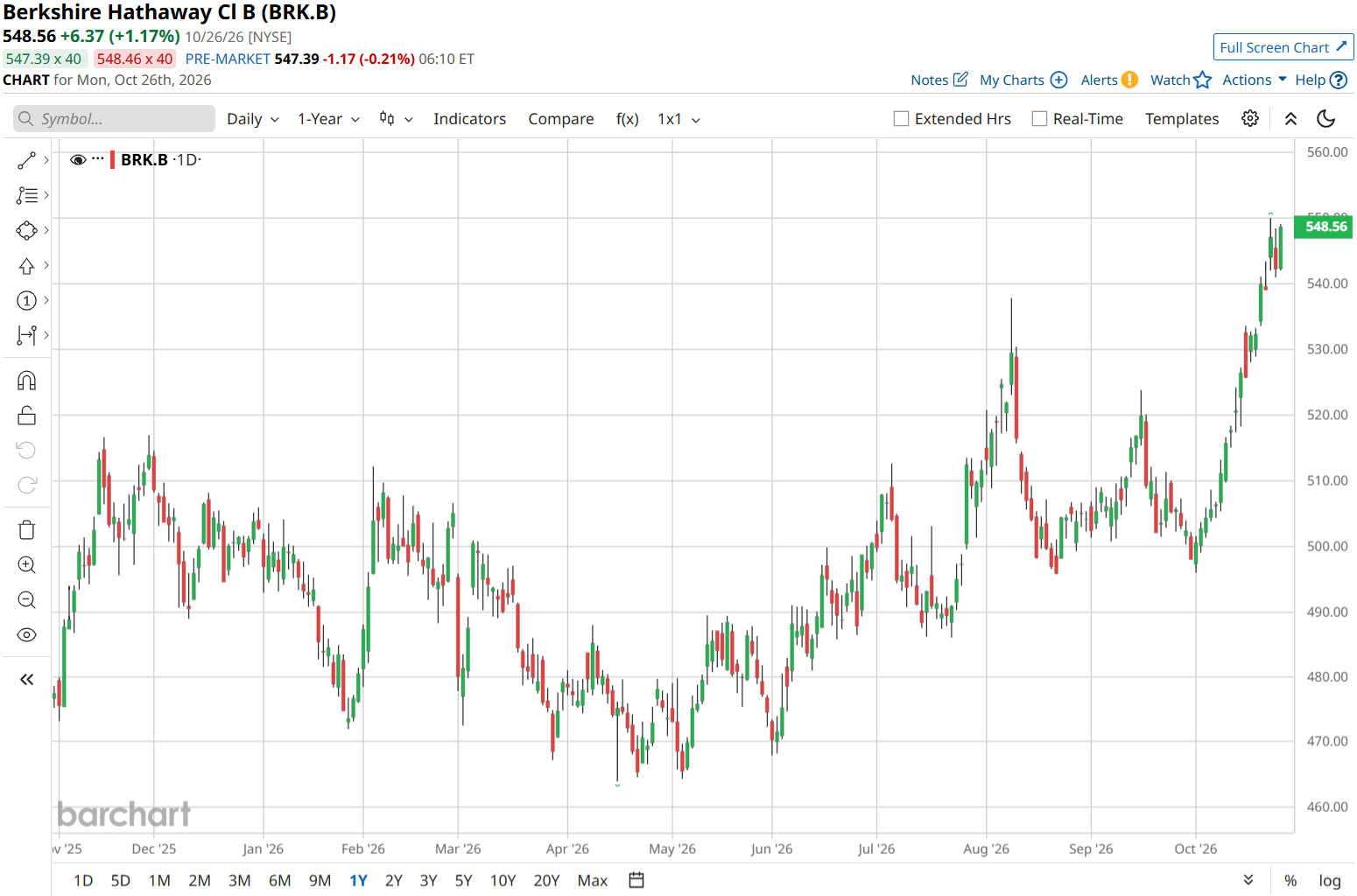
The rally follows a tough 2025, when Berkshire Hathaway badly lagged the market amid concerns about Warren Buffett’s departure as CEO. Greg Abel took over on Jan. 1, 2026, and has since put cash into acquisitions, technology stocks, and share buybacks. Investors appear more comfortable with his approach.
But the recent gains give buyers a reason for caution. Technical Opinion rates BRK.B a 100% Buy, placing it in the top 1% for short-term signal direction. Meanwhile, its relative strength index has reached 76.81, above the 70 level considered overbought. That raises the risk of a pullback, though it does not guarantee one.
With Berkshire Hathaway near its record high, should investors buy now or wait for a better price? Let’s find out.
Do the Numbers Support the Price?
Berkshire Hathaway (BRK.B) makes money from insurance, railroads, utilities, manufacturing, and its investments. Its shares have gained 11.47% over the past 52 weeks and 9.13% this year. At 25.05x forward earnings, compared with the sector’s 11.10x, the stock carries a hefty premium.
Second-quarter results help explain that price, though some businesses did better than others. Revenue grew about 10% to $101.81 billion from $92.52 billion, and operating earnings rose 16.3% to $12.98 billion from $11.16 billion. Net earnings more than doubled to $25.67 billion from $12.37 billion, taking GAAP earnings per Class B share to $11.91 from $5.73. But that included $12.68 billion in after-tax investment gains, so operating earnings give a clearer view of how the businesses performed.
After-tax earnings from manufacturing, service, and retailing rose to $4.47 billion from $3.60 billion. BNSF Railway earned $1.56 billion, up from $1.47 billion, while Berkshire Hathaway Energy’s earnings increased to $891 million from $702 million. Insurance went the other way: underwriting earnings fell to $1.73 billion from $1.99 billion, and insurance investment income dropped to $3.06 billion from $3.37 billion.
Currency movements also helped. A $326 million foreign-exchange gain, compared with an $877 million loss a year earlier, helped lift “Other” earnings to $1.27 billion from $32 million. Berkshire Hathaway also bought back $4.5 billion of stock during the quarter, bringing first-half repurchases to $4.8 billion. Operating cash flow for the first half rose to $21.65 billion from $20.99 billion.
What Makes Berkshire Worth Buying Here?
Berkshire Hathaway’s acquisitions could help it grow into its valuation. Its July 24 purchase of Taylor Morrison for about $6.8 billion in equity value and $8.5 billion in enterprise value expands its homebuilding business. Combining Taylor Morrison with Clayton Properties Group’s 15 builders creates the country’s fourth-largest homebuilder. Together, the businesses delivered nearly 23,000 site-built homes in 2025 and cover 21 states, 52 markets, and more than 700 communities.
The combined business could lower purchasing costs while keeping its builders’ local knowledge. Taylor Morrison also offers mortgage, title, escrow, and homeowners’ insurance services, giving Berkshire Hathaway more ways to earn money from each home purchase.
Berkshire Hathaway is also putting more money into technology. It added roughly 48.1 million Alphabet (GOOG) shares during the second quarter, bringing its holding to about 106 million shares worth $37.76 billion as of June 30. The purchases included a $10 billion private placement, increasing its stake in Alphabet’s advertising, cloud, and artificial intelligence businesses alongside its other operations.
Berkshire Hathaway invested another $330 million in Bending Spoons (BSP) in October, following a $600 million IPO investment. That brings its total commitment to about $930 million and its ownership to 4%. Bending Spoons buys digital businesses and works to improve their products and operations, giving Berkshire Hathaway a share in their growth and any future acquisitions.
Analyst Targets and the Road Ahead
Berkshire’s next earnings release is scheduled for November 6, with analysts expecting September-quarter earnings of $5.91 per share, down 5.59% from $6.26 a year earlier.
The full-year estimates tell a similar story. Analysts expect 2026 earnings of $21.83 per share, up 5.87% from $20.62.
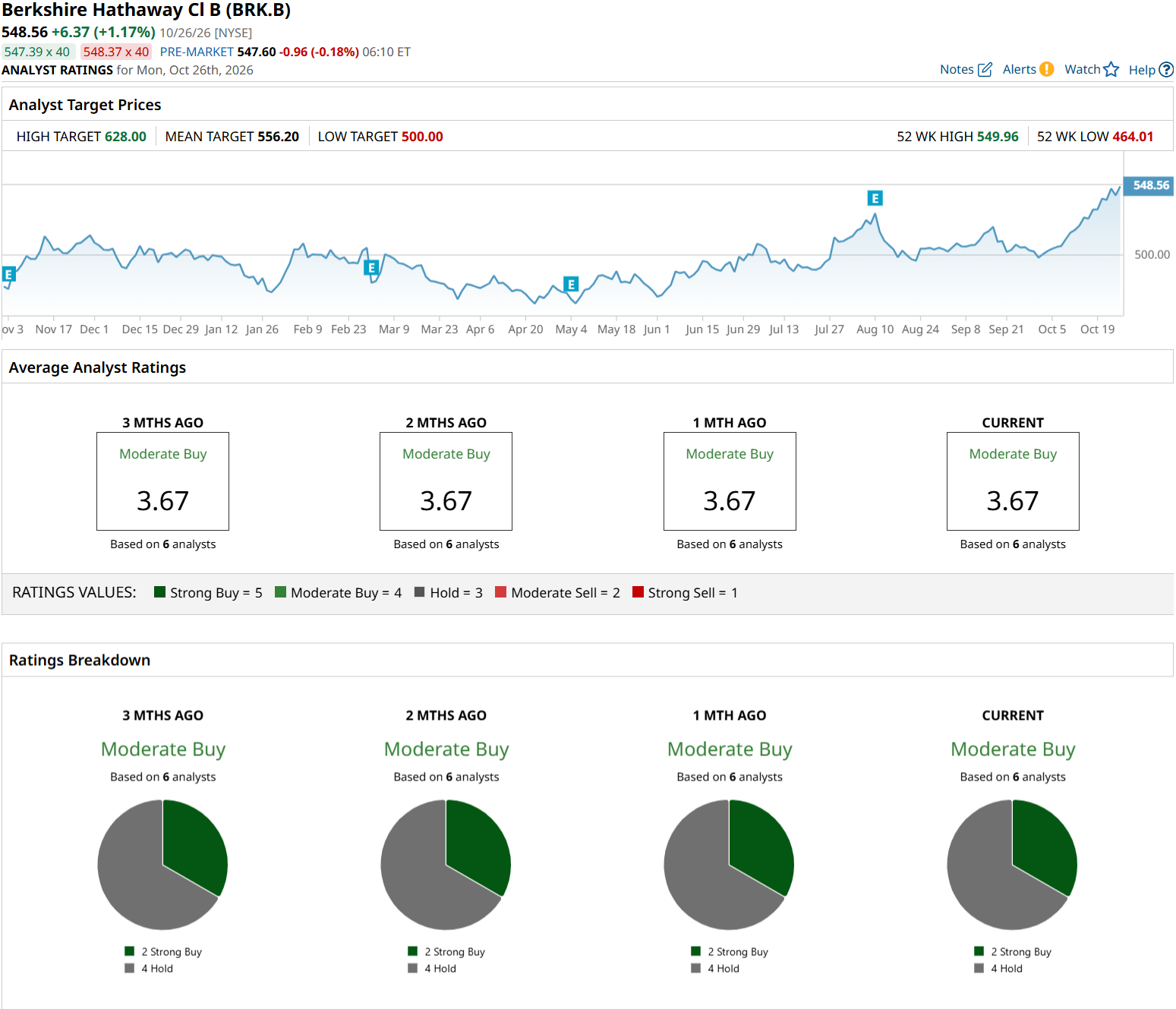
UBS’s Brian Meredith raised his target to $628 from $604 on Oct. 22 while maintaining a “Buy” rating. DA Davidson also maintained “Buy” and increased its target to $592 from $531.
Across the six analysts in the supplied survey, the consensus is “Moderate Buy.” However, the mean target of $556.20 implies only 1.39% upside from current price levels.
Conclusion
Berkshire looks more like a hold than a stock to chase here. Abel’s investments give shareholders reasons to stay invested, but the premium valuation and just 1.39% upside to the average analyst target leave little room for disappointment. Existing investors can hold, while new buyers may be better off waiting for a pullback or starting small. Near term, a pause or modest pullback looks more likely than another sharp rally, especially with earnings expected to decline in the September quarter. The Nov. 6 report could change that picture, but at this price, patience looks more attractive than chasing momentum.
On the date of publication, Ebube Jones did not have (either directly or indirectly) positions in any of the securities mentioned in this article. All information and data in this article is solely for informational purposes. For more information please view the Barchart Disclosure Policy here.