


Financial Report Forecast | After the stock price falls by 30% before facing a major financial report test, can the increase in HBM4 volume and DRAM prices reignite the rise of SK Hynix (SKHY.US)?
The Zhitong Finance App learned that SK Hynix (SKHY.US) will release the results for the third quarter of the 2026 fiscal year on October 28. Since listing on the NASDAQ in mid-July 2026, the stock has experienced a period of sharp fluctuations, with the share price fluctuating from $124.8 to $199.87 per share over the past three months.
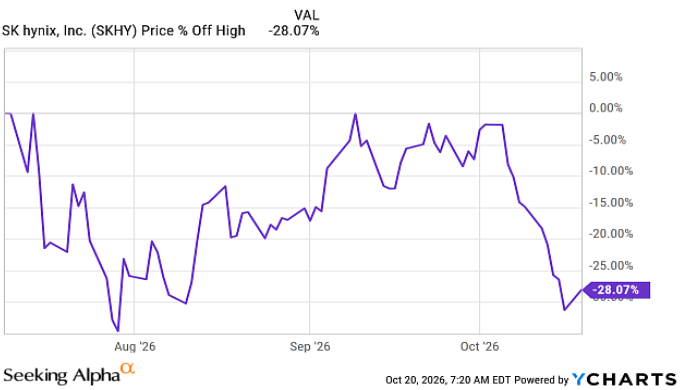
On a few trading days before SK Hynix announced its results for the second quarter of the 2026 fiscal year in late July, the company's stock price fell by more than 25%. However, when the Q2 results were released and the market saw SK Hynix's impressive operating performance, the stock price rose 57% in less than two months. Currently, the stock price is lower before another financial report (October 28) is released, down about 28% from its all-time high.
Although the second-quarter results themselves were not flawless, according to compiled data, the market generally expected second-quarter revenue of US$56.79 billion, while SK Hynix actually recorded US$54.55 billion at the time, which was nearly 4% lower than the revenue consensus. This may be the reason why the stock price initially came under pressure after the earnings report. However, management then explained the key reason why revenue fell short of expectations: SK Hynix decided to lock about 50% of shipments under multi-year long-term agreements (LTAs), similar to the current strategy of storage vendors such as Micron (MU.US).
SK Hynix intends to abandon the flexibility brought about by short-term price surges in the spot market in exchange for more predictable cash flow growth prospects. Meanwhile, the company also delayed some high-value DRAM and HBM shipments from Q2 to the second half of 2026 to ensure that customer deployments proceed as planned. As a result, the decline in stock prices did not last long after the earnings report.
In fact, another layer of risk pressuring current stock prices comes from macroeconomic factors and technological progress of Chinese storage manufacturer Changxin Storage. However, analyst Oakoff Investments does not believe that these factors have substantially changed SK Hynix and its peers.
First, factors such as macro risks and rising yields related to the debt market have not directly impacted SK Hynix, because the company currently does not need to be funded through debt issuance; its key customers may need to raise capital, but hyperscale cloud vendors that are major end customers currently seem to have no barriers to financing.
Second, market discussions on Changxin storage mainly focus on commercialized DRAM and low-end architectures, which are far from the high-density HBM4 and advanced packaging that SK Hynix focuses on. The analyst believes that it is currently almost impossible for Changxin Storage to shake SK Hynix's moat, so it does not pose a medium-term risk.
In terms of profitability, SK Hynix Q2 recorded an operating profit of approximately US$45.2 billion based on revenue of US$54.55 billion, with an EBIT margin of 76.3% in Korean won. In contrast, TSM.US's Q2 EBIT margin was 60.3%, and Micron's Q1 profit margin was 67.6%.
Oakoff Investments pointed out that SK Hynix's current profitability has surpassed the world's best pure wafer foundries, proving that its pricing ability is extremely strong. Shipments of DDR5 and high-capacity HBM3E/HBM4 servers helped the company obtain significant price advantages in the DRAM business unit. The average sales price of Q2 DRAM hybrid increased 30% month-on-month; the average sales price of NAND Flash jumped more than 50% month-on-month. Although the market previously feared that advances in optimization algorithms might lead to a decline in NAND demand, hyperscale cloud vendors are currently still expanding context windows and KV cache storage for AI inference models, and the analyst believes this trend will not stop next year.
In terms of product development, SK Hynix began mass production and shipped 12-layer HBM4 chips to key customers in Q2. The company said during the performance conference call that at present, the yield and quality of HBM4 are close to the level of HBM3E in the mature stage, and the current focus is on steadily increasing production capacity.
Oakoff Investments pointed out that this provided important support for SK Hynix's subsequent profit growth, because since it had already reached such a yield level in the second quarter, this meant that the risk of high waste and loss in the early stages of mass production of the product had been greatly reduced. Unit costs are expected to continue to decline. As long as HBM is stacked on a sufficient scale, the high operating profit margin in the second quarter has a continuing foundation.
Regarding the upcoming third quarter, management confirmed in a conference call that the average sales price of hybrid DRAM in the second half of the year should expand faster than in the first half of the year: “With the actual volume of HBM4 shipments and the increase in 1c nano traditional DRAM shipments, we expect the bit growth in the second half of the year to be higher than the level of the first half of the year. Furthermore, considering changes in customer needs and product structure, the continued growth in HBM4 sales and the increase in the contribution of high value-added products will also have a positive impact on our mixed average sales price. This will result in higher shipments and continued improvements in the product structure, which in turn will drive up our average selling price and profit in the second half of the year.”
According to information, the company indicated a 10% month-on-month increase in DRAM bit shipments in the third quarter. After the HBM4 yield standards are met, this portion of the additional shipments will maintain a high gross margin. Even if SK Hynix's profit exceeded expectations like in the second quarter, performance itself is not the only focus; performance guidance is the core. Based on this, Oakoff Investments remains optimistic.
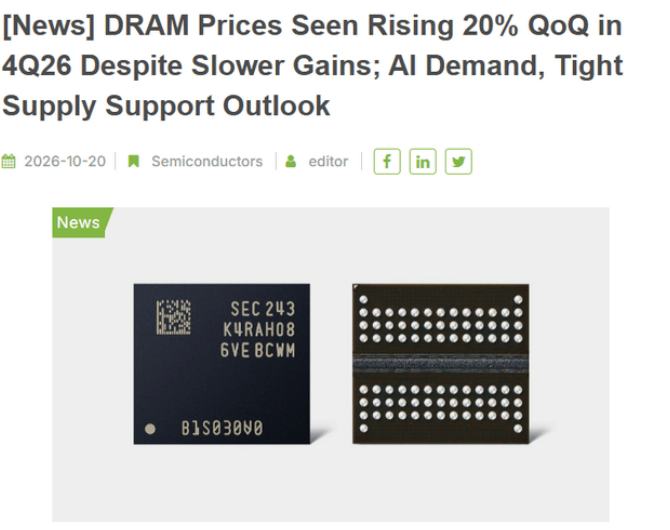
According to TrendForce data, DRAM contract prices should rise 13% to 18% month-on-month in the third quarter of 2026, while NAND flash memory contract prices are expected to rise 10% to 15%. However, in the fourth quarter of 2026, the agency expects DRAM prices to increase 20% month-on-month — according to Oakoff Investments, the pricing environment is becoming more and more unfavorable to buyers and sellers like SK Hynix.
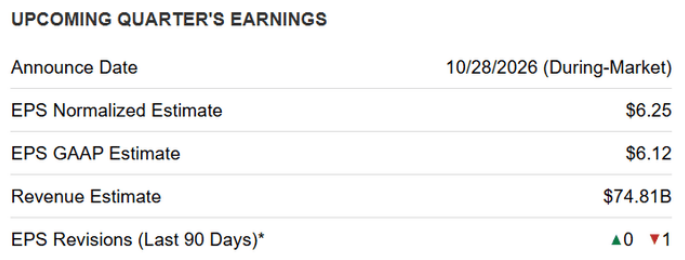
For the upcoming Q3 results, compiled data shows that the market expects SK Hynix's adjusted earnings per share of $6.25, GAAP earnings per share of $6.12, and revenue expectations of US$74.81 billion. In the past 90 days, EPS predicts 0 upgrades and 1 downgrade. The analyst believes that against the backdrop of a negative correction after Q2, it is not very difficult for SK Hynix to exceed expectations this time.
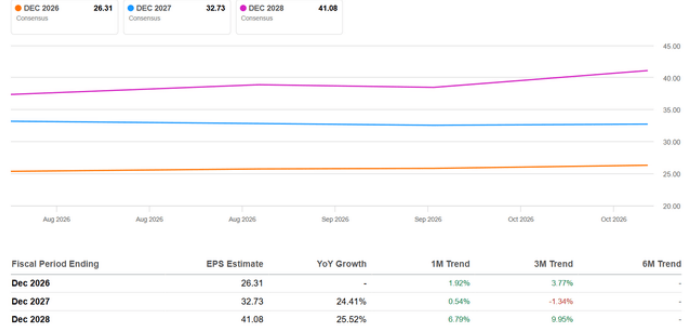
At the valuation level, the current market's agreed expectations for SK Hynix's 2026-2028 EPS are $26.31, $32.73, and $41.08, respectively, corresponding year-on-year growth rates of 24.41% and 25.52%, respectively; based on the 2027 EPS calculation, the forward price-earnings ratio is only 4.37 times, and 5.43 times and 3.48 times for the 2026 and 2028 fiscal years, respectively.
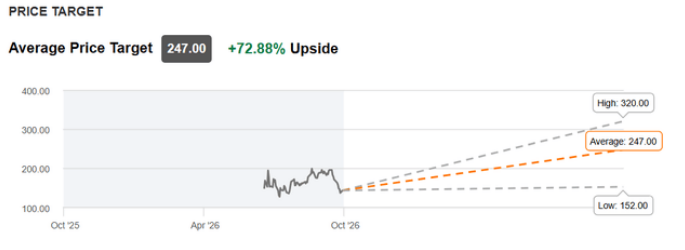
Oakoff Investments believes that for a semiconductor company with an EPS growth rate of more than 24%, this valuation may seem too low, but storage stocks have strong cyclical properties, so it is not surprising that the market offers discounts. However, since the market expects the company's EPS to grow 25.52% year-on-year in fiscal year 2028, this means that fiscal year 2027 is not the peak of the cycle. Based on this, the analyst assumes that SK Hynix's FY2027 EPS is 35 US dollars, which is slightly higher than the agreed median forecast, and assumes an increase of more than 25% in FY2028, giving a price-earnings ratio of 5 to 8 times the 2027 fiscal year, and arrived at a target price of about $227.5.
Bank of America analysts also had a positive outlook on SK Hynix. The bank mentioned in a research report that Bank of America believes SK Hynix may give a strong fourth quarter outlook on October 28, including a special cash dividend; South Asia Technology in Taiwan has issued a positive fourth quarter forecast. Bank of America also pointed out that the monthly contract price of PC memory increased by more than 15%, and the spot price remained stable.
However, Bank of America also mentioned that investors in Singapore have mixed feedback on the storage cycle: hedge fund investors are partial, and most long-term investors are still bullish. Market concerns include high borrowing costs for AI cloud companies, increased storage supply from China, and slowing AI spending.
The analyst also listed the main risks: First, the storage cycle often shifts when a few people notice; second, services such as TrendForce and Semianalysis make memory price dynamics highly transparent to technology investors, and SK Hynix's performance exceeding expectations may have been priced by the market. Even if the company greatly exceeds expectations and provides strong guidance, the stock price may not necessarily have a positive logical reaction; third, if the company's performance falls short of expectations, the stock price may drop drastically; fourth, it may underestimate the potential impact of Chinese competitors, if Chinese manufacturers prove that their technology is in line with SK and Hynix Western peers are close, and the market may severely punish all storage stocks.
Although the risk is not low, Oakoff Investments believes that SK Hynix is likely to exceed upcoming performance expectations, and management guidance may bring an upward surprise. The basis for this judgment includes: the current storage cycle has not peaked soon, and there is still plenty of room for the operating side to rise next year; SK Hynix is still one of the purest leaders in the industry with high profit margins that have not shown signs of deterioration, and its profit margin has not deteriorated; its valuation model shows that the company is undervalued by more than 67% and is expected to converge in the next 12 months or so.