


Duke Energy (DUK) Has Investors Looking Closer, But What Is Driving The Attention?
Duke Energy: recent returns and business scale
Duke Energy (DUK) has drawn investor attention after a recent share price of US$124.98, alongside a roughly 10% gain over the past month and a modest advance over the past year.
The utility group carries a market value near US$97.4b and reports annual revenue of about US$32.8b with net income of US$5.2b, primarily from its U.S. electric and gas operations.
Recent trading tells a mixed story for Duke Energy. The 10.3% 1 month share price return and 6.4% year to date gain point to improving momentum, even though the 3 month share price return declined 3.0% and the 1 year total shareholder return is 1.6%.
Scan for other power grid operators showing similar momentum to Duke Energy by focusing on our curated list of 42 power grid technology and infrastructure stocks in the utilities space.
Duke Energy has just logged a sharp 1 month rebound and now trades about 5% below the average analyst target, yet screens at a premium to some fair value estimates. Is the market’s caution on this utility justified?
Most Popular Narrative: 6.7% Undervalued
Duke Energy’s most followed valuation story pegs fair value at about $133.94, versus a last close of $124.98, which points to a modest discount that investors are weighing against execution and regulatory risk.
Major economic development wins in Duke Energy territories, including large data center projects, are now supported by about 7.6 to 7.8 GW of executed electric service agreements and a 15.4 GW late stage pipeline that is expected to be fully contracted by the first half of 2027, which could translate into multi year load growth and higher regulated revenue as this contracted demand is served.
See why 89 investors see Duke Energy as 7% undervalued.
Result: Fair Value of $133.94 (UNDERVALUED)
Still, the thesis around Duke Energy could be tested if US$10b of planned equity issuance dilutes earnings per share or if higher financing costs reduce returns.
Find out about the key risks to this Duke Energy narrative.
Another view on Duke Energy’s valuation
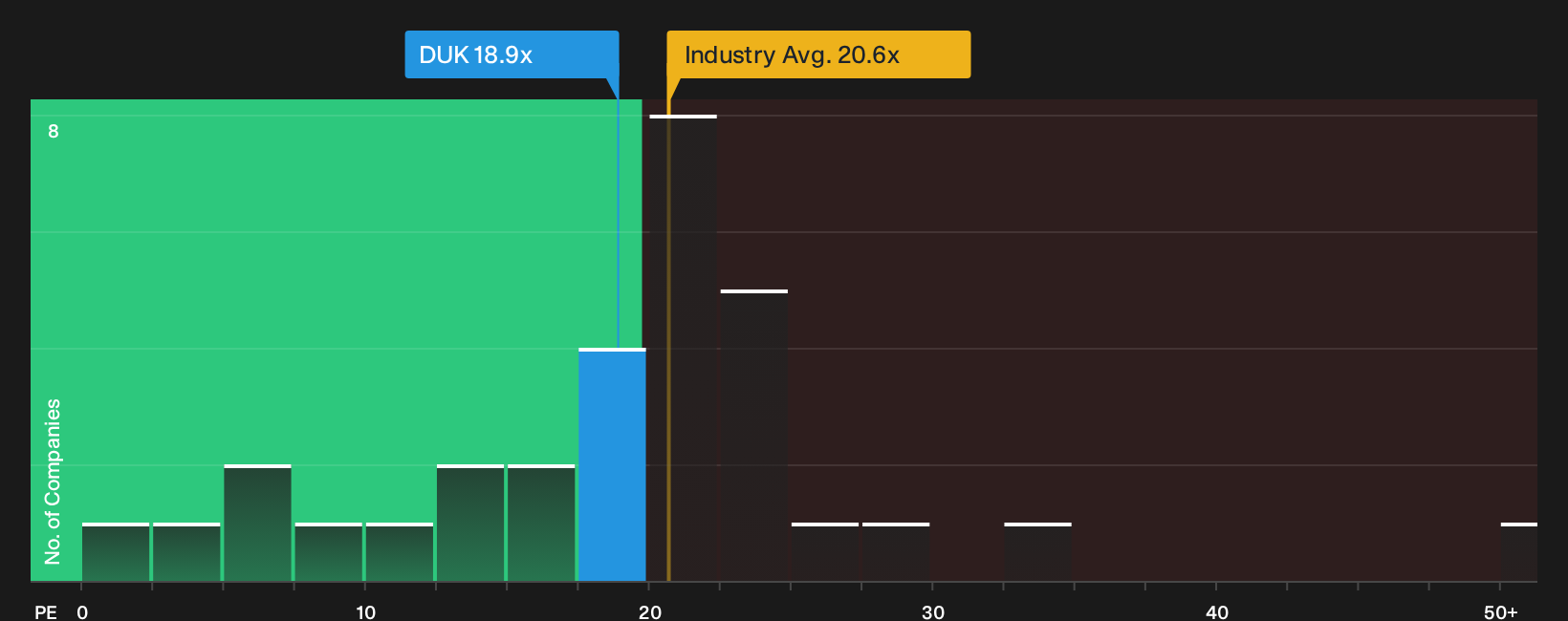
The first narrative leans on analyst targets and growth assumptions. A different lens comes from the P/E ratio. Duke Energy trades on 18.9x earnings, compared with 21.5x for peers and a 21.2x fair ratio, which indicates a discount that could either close or widen if sentiment shifts.
This gap offers potential upside if the market moves toward that fair ratio, but it also means you are exposed if earnings, regulation or financing costs disappoint before the multiple re rates. The key question is whether this lower P/E reflects risk that still needs to be priced in, or an opportunity that others are overlooking.
See what the numbers say about this price in our valuation breakdown See what the numbers say about this price — find out in our valuation breakdown.
Simply Wall St performs a discounted cash flow (DCF) on every stock in the world every day (check out Duke Energy for example). We show the entire calculation in full. You can track the result in your watchlist or portfolio and be alerted when this changes, or use our stock screener to discover 29 high quality undervalued stocks. If you save a screener we even alert you when new companies match - so you never miss a potential opportunity.
Next Steps
If the mixed signals around Duke Energy leave you on the fence, that is exactly the moment to check the underlying data yourself and move fast to form an independent stance. To round out the picture, weigh both sides of the story by looking at 4 key rewards and 2 important warning signs
Looking for more Duke Energy style investment ideas?
If Duke Energy has sharpened your focus on quality opportunities, do not stop here. Broaden your watchlist using focused screeners that surface clear, data backed ideas quickly.
- Target quality at a discount by reviewing the 29 high quality undervalued stocks that combine solid fundamentals with prices that sit below their assessed worth.
- Lock in potential income streams by scanning the 5 dividend fortresses that pair higher yields with business models built around regular cash returns.
- Protect the downside first by reviewing a 30 resilient stocks with low risk scores that filters for resilient balance sheets and lower risk profiles before you commit capital.
Have feedback on this article? Concerned about the content? Get in touch with us directly. Alternatively, email editorial-team@simplywallst.com