


Earnings Growth May Test The Case For ORIX JREIT Stock (TSE:8954)
- ORIX JREIT refinanced part of its borrowings by taking a new JPY 2,000 million long term floating rate loan and using the proceeds to prepay JPY 2,000 million of short term loans, keeping overall interest bearing liabilities and LTV unchanged as of October 20, 2026.
- This shift from JPY 8,000 million in short term loans to a larger JPY 354,197 million long term debt balance extends funding maturity, while earnings still rely heavily on debt financed assets.
- The focus now turns to how ORIX JREIT's reliance on longer dated floating rate debt may shape the investment narrative from here.
Compare ORIX JREIT's refinancing move with other balance sheet focused plays by scanning our hand picked list of solid balance sheet and fundamentals (23 results), which may offer a different mix of debt, maturity, and yield.
What Is ORIX JREIT's Investment Narrative?
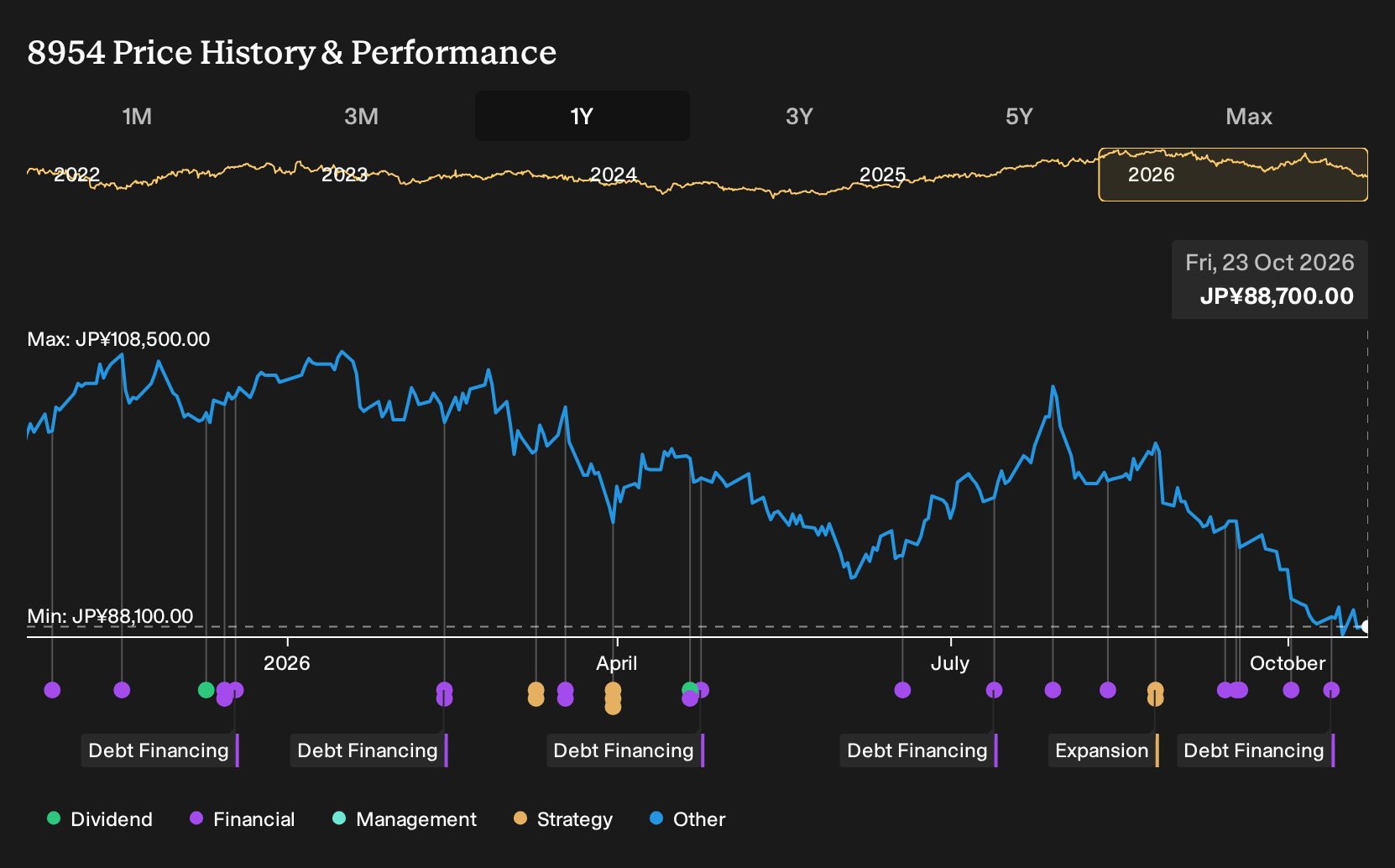
To own ORIX JREIT, you have to be comfortable with a simple trade off. The portfolio throws off income from 121 properties, spread across offices, logistics, retail, residential, and hotels, and that cash flow is paired with meaningful borrowing and a relatively high payout. Net income and funds from operations recently rose year on year, yet the unit price is still down about 13% over three months, which suggests the market is questioning how durable that income looks against the balance sheet.
The latest refinancing fits squarely into that debate. ORIX JREIT is not increasing total debt or LTV, just switching JPY 2,000 million from short term to long term funding on a floating JBA 3 month TIBOR base. This marginally smooths near term refinancing risk without changing reliance on higher risk funding sources. For a unitholder, the bigger swing factors remain leverage, interest costs on floating rate borrowings, and whether earnings growth around 24.7% can keep supporting a 5.52% dividend that is not well covered by profits.
Even so, before treating ORIX JREIT as a straightforward income story, one issue on the liability side still hangs over the case.
There's only one way to know the right time to buy, sell or hold ORIX JREIT. Head to Simply Wall St's company report for the latest analysis of ORIX JREIT's Fair Value.
The Verdict Is Yours
Disagree with this assessment? Extraordinary investment returns rarely come from following the herd, so consider your own analysis carefully.
- A great starting point for your ORIX JREIT research is our analysis highlighting 3 key rewards and 2 important warning signs that could impact your investment decision.
- See our latest analysis for ORIX JREIT. The report includes a comprehensive fundamental analysis summarized in a single visual, the Snowflake, making it easy to evaluate ORIX JREIT's overall financial health at a glance.
Looking For More Investment Ideas Beyond ORIX JREIT?
If ORIX JREIT has you thinking harder about balance sheets, debt profiles, and income resilience, it can help to look across a wider field of opportunities using the Simply Wall St Screener.
- For investors who want potential upside with smaller market values and stronger finances, scan our curated list of 1 elite penny stocks with strong financials that match those filters.
- If value and quality sit at the top of your checklist, check companies that combine both traits in our 14 high quality undervalued stocks and see which ones merit a closer look.
- For readers who care most about dependable distributions and balance sheet strength, filter for income focused ideas through our 29 dividend fortresses and compare their profiles side by side.
Have feedback on this article? Concerned about the content? Get in touch with us directly. Alternatively, email editorial-team@simplywallst.com