


Learn Why The Bull Case For Unity Stock Could Change Following High Skill Immigration Reform
- Unity Software is back in focus after the proposed SMARTER Act in Washington raised the prospect of wider high skill immigration, a key input for its global real time 3D and AI development platform.
- The policy debate directly touches Unity Software’s core constraint: specialist engineering talent, which influences product delivery timelines, AI feature rollout and long term cost structure.
- This article examines how Unity Software’s investment narrative is shaped by potential changes to immigration rules that target high skill talent.
Scan how other high skill, AI focused platforms are positioned for a similar policy catalyst by reviewing our curated list of 39 profitable AI stocks that aren't just burning cash.
Unity Software Investment Narrative Recap
To own Unity Software, you need to believe its real time 3D and AI tools can turn a large creator base into a more profitable, more diversified software platform over time. The SMARTER Act debate matters mainly at the margin. Easier access to high skill engineers could support faster delivery of Unity Vector, Unity 6 and privacy centric ad tech.
The near term swing factor is still execution on AI products and the Create subscription business, while managing costs in a still unprofitable model. The biggest risk remains heavy investment that keeps R&D and operating expenses high without clear payback, particularly as Unity pushes into non gaming sectors and faces strong engine competitors.
The most relevant recent thread here is Unity Software’s push into AI driven capabilities like Unity Vector and newer engine versions such as Unity 6. Those projects are resource hungry. Extra access to specialist talent through any immigration change could ease hiring bottlenecks for applied AI, infrastructure and privacy engineering teams.
For you as a shareholder, the question is whether Unity can staff and ship these products quickly enough to deepen adoption across gaming and newer industries like automotive and architecture. If execution stalls, high spending could weigh on the path toward profitability. If delivery remains on track, these tools sit at the center of the key product catalysts already in focus.
Unity Software Analyst Expectations and Valuation Setup
Unity Software's story on Wall Street leans heavily on what analysts think the business can earn several years from now rather than what is happening in the income statement today. Forecasts on file assume revenue can expand at 20.7% a year over the next three years while the company moves from a loss of $587.5 million today to forecast consensus earnings of $991.4 million by 2029.
That swing in the income line is very large. It implies an earnings change of about $1.6b from current levels to the 2029 estimate, helped by an expected shift in profit margins from a loss of 29.0% today to a positive 27.8% in three years. For anyone tracking the path to profitability, those margin moves sit alongside the talent question raised by the SMARTER Act because both feed directly into Unity's long term cost base and capacity to build and maintain new AI tools.
On the top line, analysts are tying their price targets to a 2029 revenue figure of $3.6b and earnings of $991.4 million. The consensus framework assumes Unity Software trades on a P/E of 31.4x in that year, using a discount rate of about 8.9% to translate those future results into a present value. That multiple is slightly higher than the 30.6x cited for the broader US software group, which puts more pressure on Unity to deliver the product roadmap investors are already watching, from Unity Vector to data privacy centric ad technologies.
The valuation bridge is sensitive to both operating metrics and share count. Analyst models currently bake in share dilution of about 2.85% a year for the next three years, reflecting stock based compensation and other issuance. For existing shareholders, this means any benefit from revenue growth and higher earnings needs to be weighed against the reality that ownership of the future earnings pool is spread across a larger base of shares.
Unity Software's narrative projects $3.6b revenue and $991.4 million earnings by 2029. This requires 20.7% yearly revenue growth and an earnings increase of about $1.6b from current earnings of a $587.5 million loss.
Uncover why Unity Software's fair value indicates a 24% potential upside to its current price that may not last much longer.
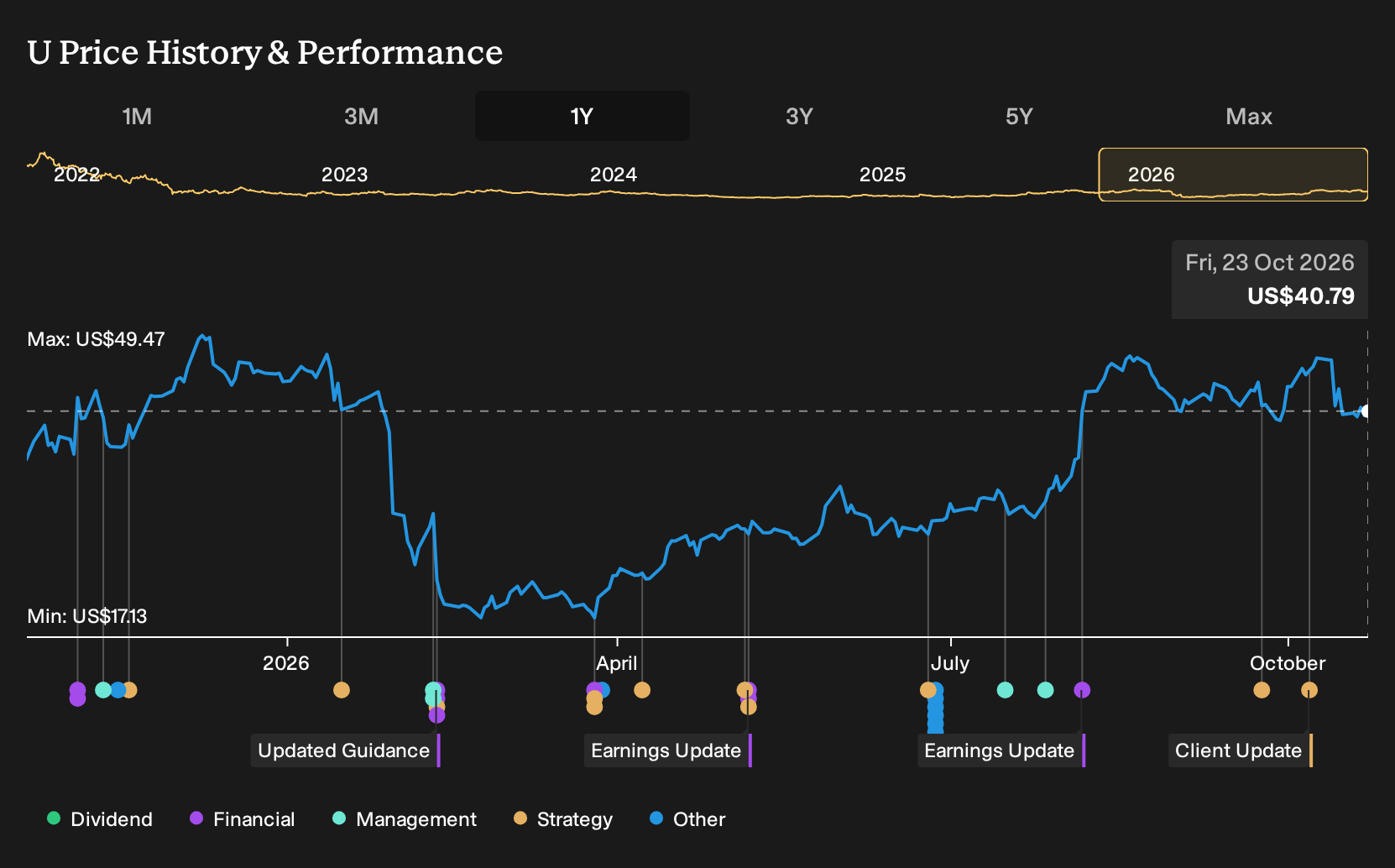
Exploring Other Perspectives
For Unity Software, the bullish twist is margin potential rather than talent risk. The most optimistic analysts were already penciling in revenue of about $3.8b and earnings of $1.7b by 2029, far above the consensus $3.6b and $991.4 million. The SMARTER Act could easily push both narratives in new directions.
Explore 3 other Unity Software fair value estimates, including one that suggests potential upside of as much as 113% from the current price.
The Verdict Is Yours
Don't just follow the ticker. Dig into the data and build a conviction that's truly your own.
- A great starting point for your Unity Software research is our analysis highlighting 3 key rewards and 1 important warning sign that could impact your investment decision.
- See our latest analysis for Unity Software. The report includes a comprehensive fundamental analysis summarized in a single visual, the Snowflake, making it easy to evaluate Unity Software's overall financial health at a glance.
Looking For More Ideas Beyond Unity Software?
If you want to pressure test your thesis on Unity Software and round it out with other possibilities, the Simply Wall St Screener is a useful way to compare different types of opportunities side by side.
- For investors who care most about valuation support, it can be helpful to scan a curated set of 29 high quality undervalued stocks that pair stronger fundamentals with more modest pricing.
- If capital preservation ranks higher on your checklist, you might prefer to filter for 30 resilient stocks with low risk scores that score well on resilience and financial stability.
- When the goal is to back sturdier balance sheets, a focused pass through our list of solid balance sheet and fundamentals (24 results) can quickly surface candidates with healthier finances.
Have feedback on this article? Concerned about the content? Get in touch with us directly. Alternatively, email editorial-team@simplywallst.com