


Earnings Beat Expectations Might Change The Case For Investing In Lincoln National Stock (LNC)
- Lincoln National has recently reported a 12% earnings surprise and carries a positive Earnings ESP of 0.31%, alongside a Zacks Rank #3, pointing to earnings results that exceeded prior analyst models.
- The pattern of earnings beats paired with a positive Earnings ESP suggests Lincoln National’s underlying business performance is tracking ahead of earlier external expectations on profitability.
- We will now look at how Lincoln National's positive Earnings ESP and repeated earnings beats could influence its broader investment narrative.
Lincoln National Investment Narrative Recap
To own Lincoln National, you need to be comfortable with a reshaping story. The big idea is that more earnings come from diversified, capital efficient products in life, annuities, group protection and retirement services, while legacy blocks and funding are steadily tidied up. Recent earnings beats and a positive Earnings ESP mainly reinforce that execution on this plan is on track rather than altering it.
The near term swing factor is whether profitability from the existing variable annuity and retirement books holds up while fee and spread based lines keep contributing. The key risk remains pressure from persistent retirement outflows, equity sensitive variable annuities and normalizing group protection loss ratios, which could cap margins if trends move against Lincoln National at the same time.
Recent commentary around earnings highlights how Lincoln National is leaning into product mix changes, technology investment and capital actions. The last 12% earnings surprise and positive Earnings ESP indicate that near term profitability from this reshaped mix has, so far, tracked ahead of earlier external expectations, which matters if you care about consistency during a business transition.
That same earnings update also sits against a backdrop where analysts expect earnings to decline on average over the next three years, even as the stock trades at a low P/E and at a large discount to some intrinsic value estimates. For you, the practical question is whether those reported results show enough operational follow through in annuities, group protection and reinsurance execution to offset the known risks in variable annuities, retirement outflows and a dividend that is not well covered by free cash flow.
What The Lincoln National Forecasts Actually Assume
Lincoln National's current analyst playbook is fairly clear once you strip it down to the moving parts. Revenue is modeled to rise by 4.1% per year over the next few years, while profit margins step down from 11.7% today to 8.5% in 2029. On those assumptions, earnings are expected to move from US$2.3b today to US$1.9b by 2029, with consensus also building in modest share count growth of about 0.79% annually.
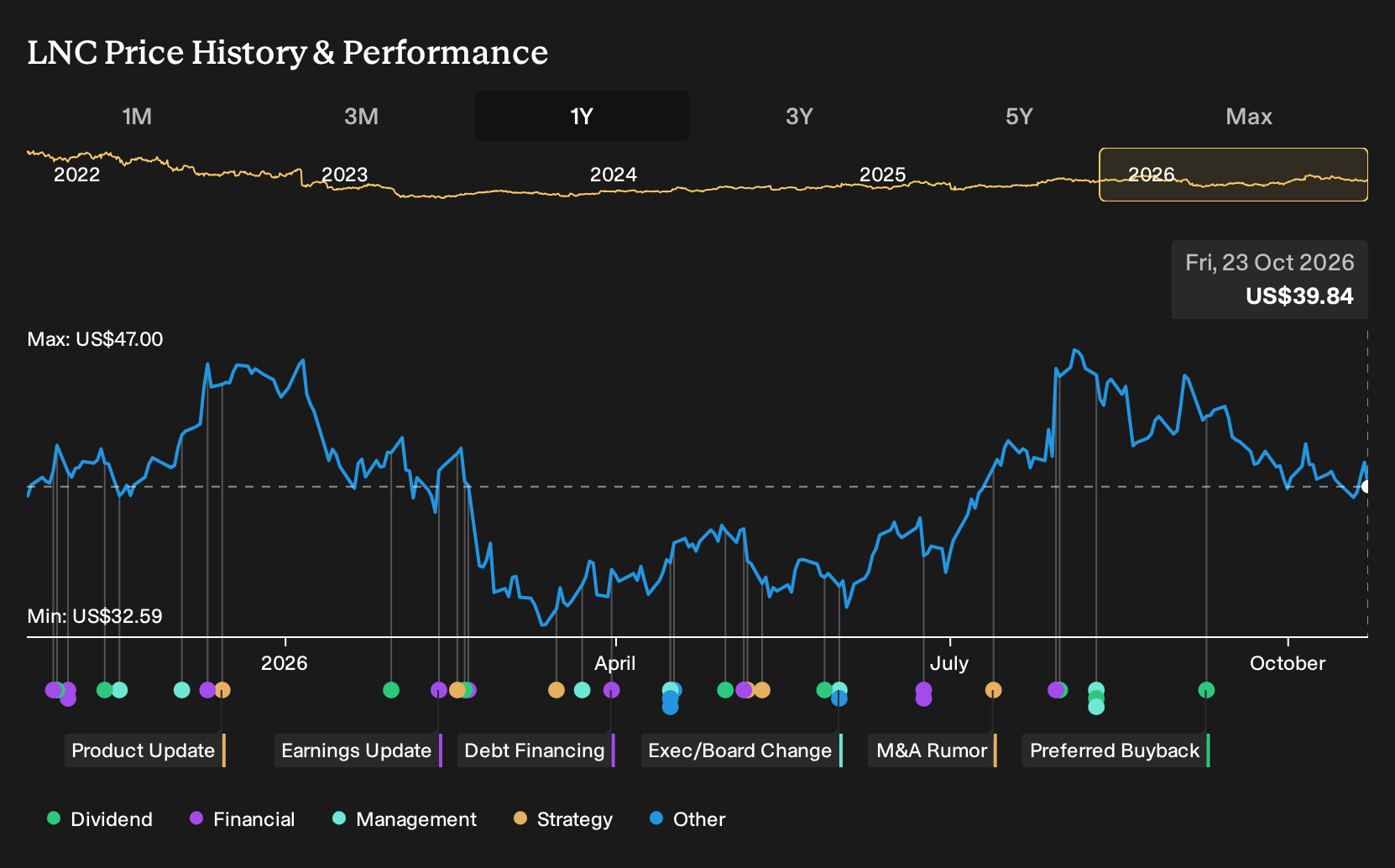
Valuation work then ties those operating expectations to a specific set of numbers in 2029. The analyst group is using a revenue line of US$21.9b and earnings of US$1.9b in that year, along with a P/E of 6.3x, compared with roughly 3.4x today and a stated industry multiple of 10.7x. Those figures are discounted back using a rate close to 7.6% and are meant to reconcile to a consensus target of US$47.92 per share, against a spot price around US$40.30.
On that framework, Lincoln National is framed as a case where analysts are comfortable with lower margins and lower absolute earnings but still see more value in the equity than the market price implies today. The gap between the current quote and the US$47.92 target is about 15.9%, while the spread between the highest and lowest targets runs from US$60.00 down to US$35.00. This gives you a sense of how wide the opinion range is on what this reshaped business should be worth.
Lincoln National's narrative projects US$21.9b revenue and US$1.9b earnings by 2029. This assumes 4.1% yearly revenue growth and an earnings decline of US$0.4b from US$2.3b today.
Uncover why Lincoln National's fair value indicates a 20% potential upside to its current price that could narrow quickly if sentiment shifts.
Exploring Other Perspectives
One alternate view leans hard into capital returns. Bullish analysts point to plans for up to US$400 million to US$600 million of capital returns over two years and were penciling in revenue of about US$22.9b and earnings of US$1.7b by 2029. That outlook is more optimistic than consensus and was set before this latest Lincoln National earnings surprise, so you may want to compare how that upbeat case could shift once fresh results feed into the models.
Explore 3 other Lincoln National fair value estimates, including one that suggests as much as 184% upside from the current price.
Decide For Yourself
Don't just follow the ticker, dig into the data and build a conviction that's truly your own.
- A great starting point for your Lincoln National research is our analysis highlighting 4 key rewards and 3 important warning signs that could impact your investment decision.
- See our latest analysis for Lincoln National. The report includes a comprehensive fundamental analysis summarized in a single visual, the Snowflake, making it easy to evaluate Lincoln National's overall financial health at a glance.
Looking For More Investment Ideas Beyond Lincoln National?
Lincoln National may already be on your radar, but your portfolio can benefit from a broader bench of ideas. Use the Simply Wall St Screener to quickly filter for companies that fit the risk, quality, and income profile you care about most.
- If you want potential mispricings with strong fundamentals to back them up, start with a curated 29 high quality undervalued stocks that fit strict quality and valuation filters.
- For investors who put capital preservation first, focus on a 30 resilient stocks with low risk scores that screens for resilience using a dedicated risk scoring framework.
- If balance sheet strength is non negotiable, build your watchlist from a list of solid balance sheet and fundamentals (24 results) that already pass tough financial health checks.
Have feedback on this article? Concerned about the content? Get in touch with us directly. Alternatively, email editorial-team@simplywallst.com