


Allianz Stock And Other Safe Haven Financials For Euro Area Bond Stress
French politics, surging bond yields and the threat of a Moody’s downgrade have turned euro area government debt into the main story for equity investors this week. When capital starts hunting for perceived safety, some stocks linked to core euro area sovereign and high quality financial issuers can move from background actors to the main stage. This piece explains that shift and highlights 3 stocks that screen well on quality as this story unfolds.
The three stocks below are a small sample of what screens well on quality as stress builds around euro area debt, and the full filter run surfaced 17 more banks, insurers and core sovereign issuers with similarly robust stories that are not covered here. To identify and analyze your own highest conviction candidates, head straight into the Core euro area safe-haven sovereign bonds and high‑quality financials screener
Allianz (XTRA:ALV)
Overview: Allianz is a large German insurer and asset manager providing property and casualty cover, life and health policies, and investment products worldwide.
Operations: Allianz generates about €81.5b from Property-Casualty, €26.3b from Life/Health and €8.9b from Asset Management, with strong exposure to German-speaking and wider European markets.
Market Cap: €160.3b
Allianz fits this safe-haven screen as a globally systemic German insurer and asset manager whose balance sheet strength can matter when investors prize stability.
"Ongoing digital transformation and AI driven operational efficiencies are expected to improve expense ratios and underwriting profitability, which in turn could support higher net margins and overall earnings."
What happens to those margins and earnings outcomes depends heavily on how one unseen pressure inside the core European insurance book evolves.
That pressure point is exactly where the story gets interesting, and the full narrative for Allianz shows how Allianz’s digital push and capital strength could reshape that risk reward trade off.

Commerzbank (XTRA:CBK)
Overview: Commerzbank is a major German lender focused on retail and corporate clients, offering everyday banking, lending, investing and wealth services.
Operations: Commerzbank generates about €7.1b from Private and Small Business Customers, €4.4b from Corporate Clients and €0.3b from segment adjustments.
Market Cap: €39.2b
Commerzbank is positioned in the core euro area banking segment. When investors look for German balance sheet strength over peripheral risk, this franchise is often one of the first they consider.
"Accelerating digital and AI capabilities, including around €600m of planned AI spending through 2030 with a target of about €500m of annual value from cost savings, better pricing, fraud reduction and client interaction tools, support a case that Commerzbank can keep improving efficiency and earnings quality."
The key variable is how any future shift in its business mix affects the stability of headline returns.
If that mix shift is the real swing factor, the full narrative for Commerzbank explains how Commerzbank’s efficiency push could separate headline returns from old cycle risks.

ING Groep (ENXTAM:INGA)
Overview: ING Groep is a large Dutch bank offering everyday banking, mortgages, business lending and wholesale services across core euro area markets.
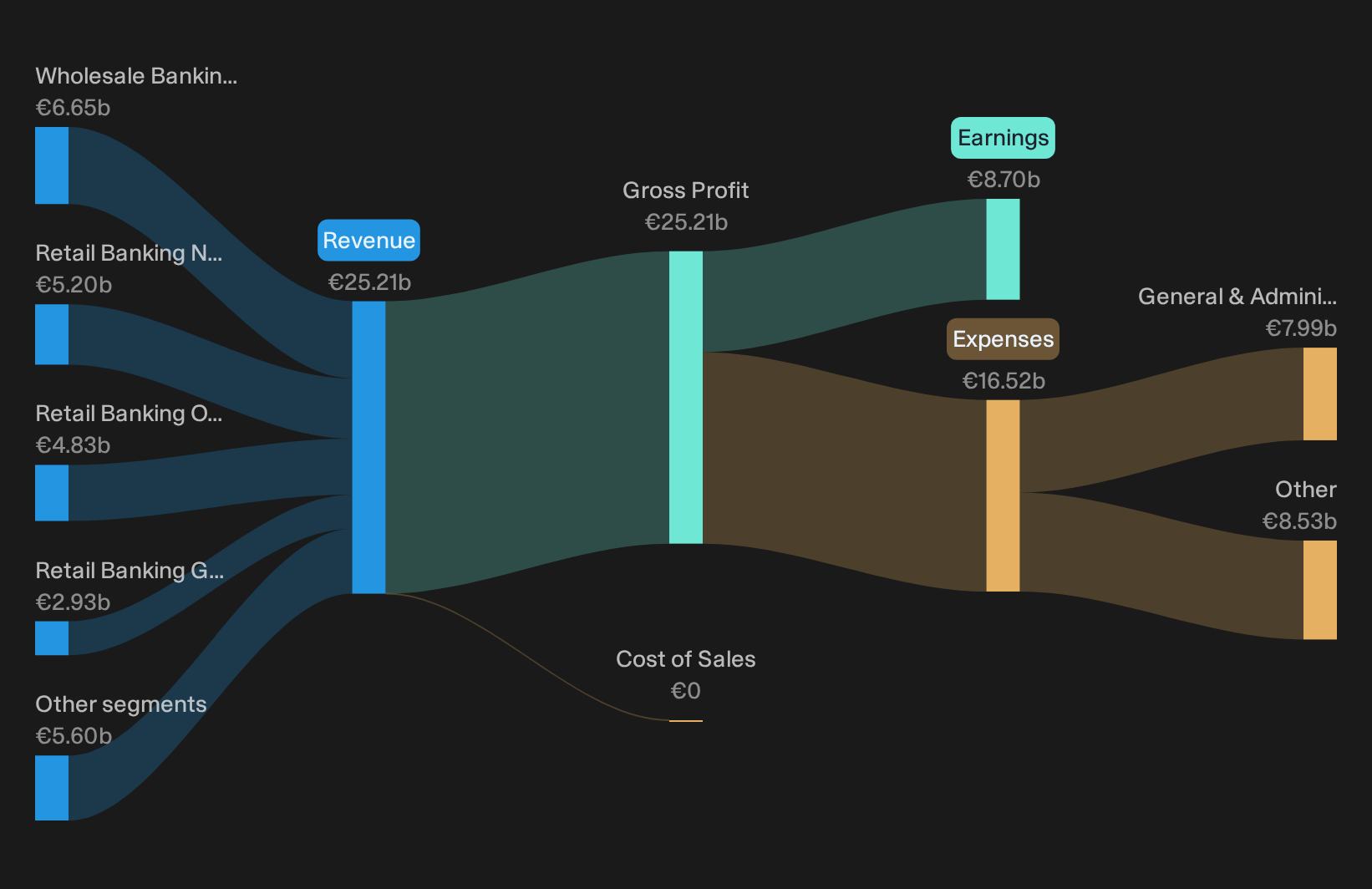
Operations: ING Groep generates about €6.6b from Wholesale Banking and roughly €20.2b from its combined retail segments across the Netherlands, Belgium, Germany and other markets.
Market Cap: €80.8b
ING Groep matters for this core euro area screen because it gives you a large, well capitalised Dutch lender with broad European reach just as investors reassess risk around countries like France.
"First, there is the pan-European drive among governments to invest heavily in public infrastructure that is screaming out for repairs and refurbishment after decades of neglect. Public Investment, in turn, is one of the key stimulants of economic activity, providing banks with more and better opportunities to lend, while steepening the rate curve at the same time, thus enhancing NII."
The real swing factor is how one emerging source of fee based revenue ultimately shapes the quality and resilience of those future earnings.
That fee engine is only the starting point, and the full narrative for ING Groep outlines how ING Groep could accelerate earnings resilience while credit and rate cycles continue to shift.
Seeking Alternatives Before The Crowd
Fresh ideas move first. By the time every headline chases the same breakout, the best entry points are already dropping away. Scan these under the radar lists while it matters and consider acting early.
- Look for cash generators that are quietly building momentum and use the list of solid balance sheet and fundamentals (204 results) to focus on businesses with balance sheets that appear designed to handle shocks.
- Target high income opportunities before yields get compressed as more money moves in, and use the 226 dividend fortresses to concentrate on curated high payout candidates.
- Consider the potential impact of real asset scarcity while it is still less widely followed by tracking the 35 elite gold producer stocks, which screens for established producers.
Have feedback on this article? Concerned about the content? Get in touch with us directly. Alternatively, email editorial-team@simplywallst.com