


Western Digital (WDC.US) is also unable to escape the “favorable decline”. What exactly is the pricing of AI transactions?
The Zhitong Finance App learned that Western Digital (WDC.US) handed over a report card three months ago that was sufficient for a rise or fall, but it was sold off in an after-market transaction after the earnings report. After the US market on Thursday, as of press release, the company declined 6% after announcing the results for the first quarter of fiscal year 2027. In the previous regular trading session, the stock had closed down 6.43% to $354.19.
An impressive report card
Western Digital's adjusted earnings per share for the first quarter of fiscal year 2027 were $4.64, higher than analysts' expectations of $4.08; revenue increased 55% year over year to $4.38 billion, exceeding consensus estimates of $41.4 billion. Non-GAAP gross margin expanded to 58.1% from 43.9% in the same period last year, operating margin was 49.1%, and adjusted earnings per share surged 161% year over year. Operating cash flow for the quarter was $1.60 billion, free cash flow of $1.38 billion, and the quarterly cash dividend increased 17% to $0.175 per share.
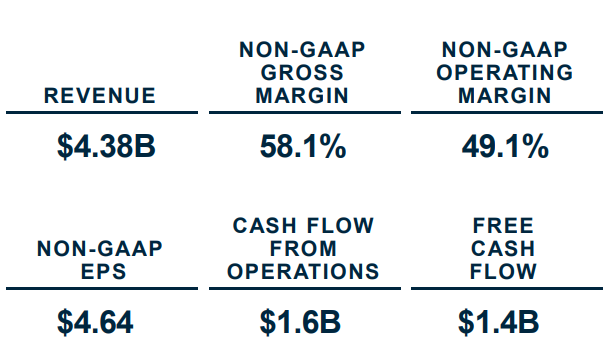
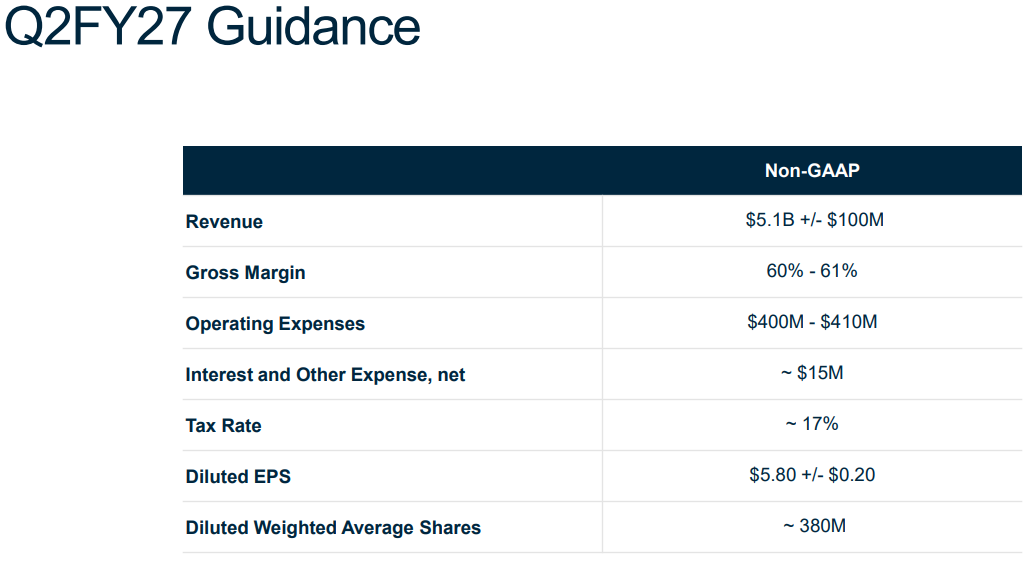
Stronger guidance. The company expects revenue of $5 billion to $5.2 billion for the second quarter, with a median value of 5.1 billion dollars, which is about 12% higher than analysts' expectations of 4.57 billion dollars; adjusted earnings per share are 5.60-6.00 dollars, and the median value of $5.80 is about 20% higher than the consensus of $4.82. CEO Irving Tan said “the 2027 fiscal year started strongly, with results exceeding expectations, driven by robust customer demand and disciplined execution.”
This was a complete win, including the gross profit margin that had suppressed stock prices until now: the company originally guided 55% to 56%, but actually achieved 58.1%.
December Quarterly Guidance and LTA: Who Has the Right to Say the Price
There are no flaws in the guidelines themselves — median revenue exceeding expectations by 12% and median earnings per share exceeding expectations by 20%. What is really worth breaking down is the customer structure and contract structure.
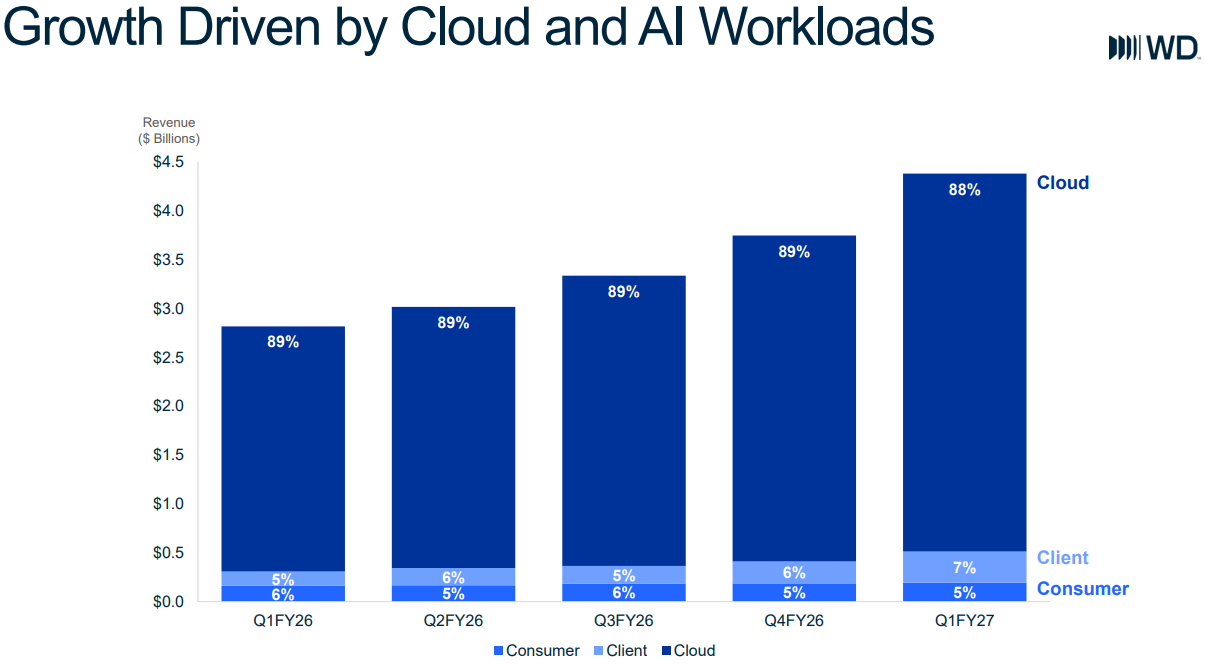
Structurally, the cloud business accounted for 89% of Western Digital's revenue in the previous quarter ($3.3 billion, +43% year over year), and the top three customers accounted for about 39% of net revenue for fiscal year 2025. The high concentration of buyers means that their financing conditions are Western Digital's order visibility.
In terms of contracts, the company has signed long-term agreements (LTAs) covering most of the 2027 fiscal year (or calendar year), part 2028, and a small number of 2029. According to Sennesael's explanation, such agreements usually agree on the base quantity and basic pricing, and leave room for additional quantities at different prices; the customer wants to extend the supply commitment to 2030 and 2031, but the company has yet to sign it. The price elasticity of this structure is asymmetrical: during the price increase cycle, basic pricing locks up upward elasticity; and once customer financing deteriorates and the pace of orders slows down, it is difficult to unilaterally lift penalties for the base quantity. The pricing power then slipped from “supply and demand” to “balance sheets of both parties to the contract.”
The technology route is the only hedging variable: the 44TB HAMR product will be shipped in the first half of the 2027 calendar year, the first batch will be certified with four hyperscale customers, the 50TB product plan will be launched in the second half of 2027, the UltraMR target will account for about 60% of near-line EB shipments by the end of fiscal year 2027, the long-term EB demand growth target is higher than 25%, and high-bandwidth hard drive engineering samples have been sent to five customers. The average mixed price per TB year-on-year increase in the previous quarter has risen to 18% — 19% from the previous high single digits. The route confirms the quantity; the LTA determines the price; the financing conditions determine whether the volume and price can be realized at the same time.
It wasn't the performance that was killed; it was the source of financing behind the performance
The real turning point happened during the phone call. Chief Financial Officer Kris Sennesael said that capital expenditure will account for an average of 4% to 6% of revenue over the next five years, but it will be “slightly higher” in the next two years; the company also suggests that investment costs will rise. According to industry research, the company more than tripled its capital expenditure year over year in the first quarter of fiscal year 2027 to invest in higher capacity hard drives, which led to a contraction of free cash flow profit margin by about 3 percentage points.
As a result, the market heard not only “good demand”, but “good demand must first become a bill.” This is exactly the narrative shift in this round of AI transactions: in the past two years, who confirmed orders went up; now, who confirmed spending went down.
The comparison case has already been performed twice in the last week. On October 15, TSMC reiterated its 2026 capital budget of 60 billion to 64 billion US dollars. Chief Financial Officer Huang Wende said that spending from 2026 to 2028 will be significantly higher than the previous three years, with revenue of 46.72 billion US dollars in the third quarter, up 41% year on year, and the fourth quarter guidance of 52.3 billion US dollars to 54.3 billion US dollars higher than the expected $50.5 billion; as a result, TSMC shares fell 2%, applied materials fell 3.7%, and the harvest fell eight times in a row — the first time since the stock was listed in 1984. The next day, Asmack handed over record quarterly sales, saying that the 2027 and 2028 planned supply “could not fully meet customer needs”. CEO Christophe Fouquet said some customers wanted to place orders for 2029 or even 2030; the stock price was still being dragged down about 4% by the sector.
Equisights Research CEO Parth Talsania's summary is most accurate: this round of sell-off was “an interest rate event with a coat of credit,” and CoreWeave was the “most leveraged” sample of this round of interest rate pressure, not “the first evidence that AI demand is cracking”; “Companies that use cash to collect payments are protected.”
Three readings of financing constraints
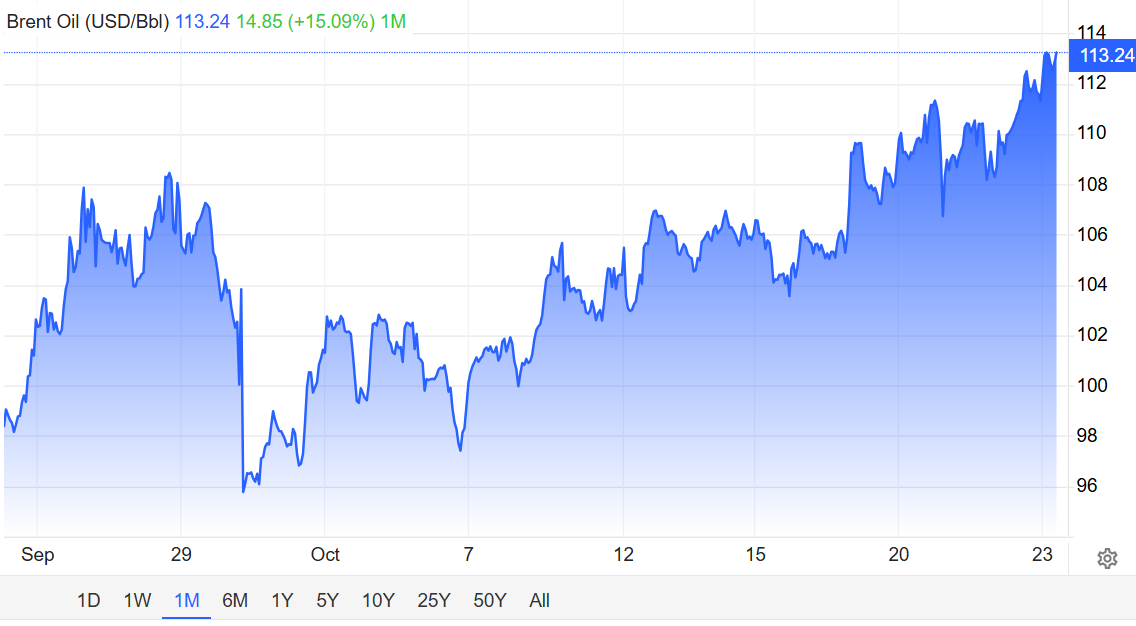
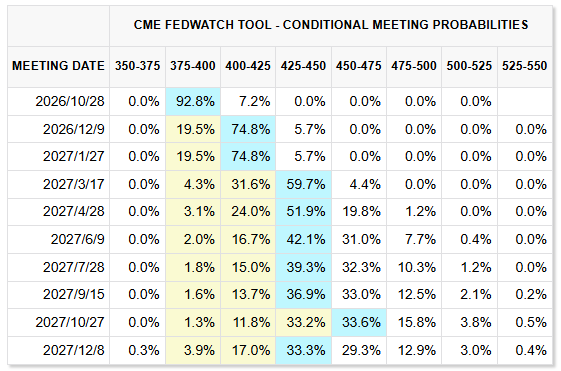
On the macro side, oil and interest rates. On October 22, the escalation of the situation in the Middle East prompted Brent crude oil to rise about 2.8% to $111.85 per barrel, and WTI to $98.80. Oil prices are driving up inflation expectations, which in turn is driving up the pricing of interest rate hikes: According to CME FedWatch, the market's probability of the Federal Reserve's interest rate hike in December has reached about 80%. On the same day, spot gold fell 2.79% and silver fell 5.78% — interest-free assets and the longest-lasting AI infrastructure assets are being crushed by the same interest rate curve.
Cash flow from clients and cloud vendors. According to estimates, in the second quarter of 2026, the gap between capital expenditure and revenue growth of the seven major North American cloud vendors widened to 72 percentage points, consolidated free cash flow turned negative, and external financing rose to 61% of capital expenditure. Specifically for the company: Meta's three-quarter report raised the lower limit of capital expenditure guidance for the full year from $130 billion to $135 billion, and maintained the upper limit at $145 billion. The cost was to shift free cash flow in a single quarter from +10.63 billion dollars to -212 billion US dollars in the same period last year. The demand-side signals are full, and the financing-side accounts are tight.
On the credit side, Xinyun is a pressure gauge. CoreWeave's unsecured bond yield rose to about 15%, the 5-year credit default swap spread widened to about 1,067 basis points, and Australian data center operator Firmus withdrew its $5 billion IPO due to poor subscription. This determines whether “second-tier buyers” other than hyperscale manufacturers can continue to place orders.
Western Digital's own rift: from “expansion slope” to “downward rigidity”
The gross profit margin of 58.1% is the strongest figure in the market, but what the market is really pricing is whether its slope can continue.
The three restrictions are clearly placed. First, the company clearly indicates an increase in investment costs; however, reducing the cost per TB by about 10% per year is only a long-term goal. Sennesael has previously indicated that the pace of product transformation and higher investment costs of DRAM and NAND will affect quarterly results. Second, the ratio of capital expenditure to revenue will be higher than the long-term center of 4% to 6% in the next two years, and the conversion efficiency of free cash flow will be structurally reduced — the 3 percentage point contraction estimated by industry research is evidence that the market decouples “high gross profit” from “high free cash flow.” Third, the pricing cycle for hard drives is extremely long: it takes about 52 weeks to produce a hard drive, and the company requires customers to place orders at least 52 weeks in advance. Today's sales price is next year's production capacity and cash flow for the next year.
In other words, the market is no longer paying for the “expansion slope,” but is beginning to discount “downward rigidity”: if the cost reduction per TB is eaten up by input costs and capital expenditure rises again, 58.1% is not a step, but a peak.
The double loss framework of “being killed after exceeding expectations” and the three conditions for breaking the game
Closing the above chain results in a lose-lose framework: the performance exceeds expectations, the market says “it has been included, and the expenses are more expensive”; the performance falls short of expectations, and the market says “the cycle has peaked.” Both sides beat the valuation; the only difference is the slope. This is why analysts directly point to the question in the after-market report — “Can data center spending momentum maintain the current rate, and whether huge on-hand orders can be converted into actual revenue”.
Breaking the game requires three conditions to be loosened at the same time:
First, the financing side. Either interest rates peaked (the December rate hike price fell from 80%), or AI credit spreads narrowed—CoreWeave issuers have completed refinancing and the new cloud IPO window has reopened, which is a more effective sign than any performance guide.
Second, the pricing side. If the CY2029-2031 long-term agreement is implemented in a tight supply environment according to the current price range, it is tantamount to contractualizing a cyclical gross margin level, turning the “peak” back into a “step”.
Third, the supply side. HAMR and UltraMR are distributed on schedule, and the cost per TB is reduced by about 10% per year. The scale effect is used to offset input costs, and the downward rigidity of gross margin is restored back to the expansion slope.
Missing one of the three, no matter how good the performance is, will only make the valuation a little more expensive.
Pricing rights are not in the hands of demand fundamentals for the time being
This is not the “end of the benefits” of being isolated together. On Thursday, ASML.US (ASML.US) closed down 6.93% to $1,560.54, TSM.US fell 4.52% to $412.35, Micron (MU.US) fell about 6% to $856.49, and SanDisk (SNDK.US) fell 8.51% to $1,260.93. A simultaneous decline in the chain from equipment and OEM to storage and complete machines indicates that the market is cutting down on the same variable — not demand, but money to support demand.
Notably, this main line is the cleanest in Micron and SanDisk — they are compressed in valuation, not performance.
Micron's revenue for the latest fiscal quarter was $54.229 billion, up 379% year on year, and net profit of 37.701 billion US dollars, up more than 10 times year over year; however, the stock price fell back from $1,09.7.39 on October 1 to $856.49 on October 22, a range drop of about 22%. SanDisk's latest quarterly revenue was $8.97 billion, up 372% year over year. It closed at $126.93 on October 22. The price-earnings ratio (TTM) has been reduced to 17.10 times, the net market ratio is 11.58 times, and the market value is US$182.2 billion, down about 29% from $1,787.69 on October 1.
Record performance and reduced valuations — this is the standard pattern where “fundamentals have not been falsified and discount rates have been repriced”. The seller hasn't turned around: For Western Digital, 23 institutions are targeting an average price of $669.61, a maximum of $1,050, and a minimum of $450.
The huge gap between the three companies' target prices and current prices is itself a sign: sellers are still using demand narratives for pricing, and the market has switched to financing narrative pricing. Before the two converged, any financial report that exceeded expectations was only a litmus test, not a watershed.
The real information in Western Digital's earnings report is not 58.1% gross profit margin, nor is it exceeding expectations of 20% earnings per share; rather, it proves that when AI transactions switch from demand narratives to financing narratives, the stored pricing power has moved from order books to credit terms. Orders are still on, prices are still rising, and technical routes are still being fulfilled, but the marginal determination of the price has moved from “how many goods” to “who has money to buy and how much to borrow money”.