


Is it really oversold? At a time when CoreWeave (CRWV.US) stocks and bonds were double slashed, bankruptcy bets plummeted, and Wall Street frequently watched bullish reports
The Zhitong Finance App learned that CoreWeave (CRWV.US) is experiencing a crisis of confidence unfolding in real time on Wall Street, and different markets have given different answers. According to reports, as rising interest rates were compounded with concerns about AI infrastructure, a “new cloud” with high debt like CoreWeave was viewed by many market participants as the weakest deal in the AI field; however, during the same period, the implied probability that “CoreWeave will go bankrupt by the end of 2028” on the market Polymarket plummeted 8 percentage points to 14% on Wednesday, triggered by a strong three-quarter report from SpaceX. At the same company, while the yield on unsecured debt is approaching 15%, the bankruptcy bet is rapidly falling.
I voted for bonds first
Barclays credit analyst Andrew Keches wrote in his report to clients on Tuesday that sentiment “is unquestionably negative,” and specifically pointed out “the rate at which AI emotions change on a daily basis.” This statement was confirmed in terms of price.
CoreWeave was listed in March of last year, and its market capitalization peaked at around $90 billion three months later. Today, there is only about $34 billion left. The stock price fell 29% this month; its unsecured debt yield was about 15%. What is more sensitive is the price of default insurance: the 5-year credit default swap (CDS) spread rose 164% in the past year, increased by another 30% in October, and recently reported around 1,067 basis points (10.67%). Last week, the company's stock price fell more than 15% in a single week, the yield on bonds maturing 2030 jumped 500 basis points to nearly 16%, and the market focused on its debt of around $50 billion.
Sector Resonance: Not CoreWeave
The same story is unfolding across the new cloud sector: Nebius shares fell 27% this month, IREN fell 32%; Australian data center operator NextDC fell 40% on Wednesday after cutting its annual profit forecast; and earlier this month, Firmus, another Australian data center company, cancelled its IPO plan due to market fluctuations. The UK's new cloud Nscale is in the center of waiting — the company, which was invested by Nvidia, submitted a listing application on the NYSE last month, and investors are waiting to see if it progresses.
Research firm Gartner's predictions cast an even longer shadow on this concern: by 2030, more than 80% of new cloud vendors will stop operating independently. Data on the financing side is also shrinking: AI-related bond issuance fell from $113 billion in June to $23 billion in September.
Debt wall and refinancing gap
CoreWeave is one of the largest companies in this group and is deeply tied to the US AI market. According to FactSet data, Nvidia is its largest institutional investor and holds about 9% of the company's shares; last year, more than two-thirds of the company's revenue came from Microsoft. The customer list includes investment-grade buyers such as Microsoft and Meta, which distinguishes it from its peers.
But balance sheets are a different story. CoreWeave has about $20.7 billion in debt due before 2030, followed by an additional $14.9 billion, and future financing also faces the prospect of higher interest rates. The company held $5.5 billion in cash and equivalents at the end of the second quarter; according to FactSet, analysts expect its upcoming disclosure of negative free cash flow for the third quarter to expand to $10.1 billion, the highest level since the company began publishing quarterly financial data. Baird software analyst Rob Oliver estimates that the company will need about $30 billion in financing in 2027 — he also said, “The results may provide some financing measures to secure confidence, but they won't need that amount until the first quarter of next year.”
A race between growth and consumption
Looking at the timeline for a long time, the company's undertone is “high growth+high consumption.” According to reports, CoreWeave had revenue of 5.1 billion US dollars and net loss of 1.2 billion US dollars in 2025; the market expects revenue to double this year, but capital expenditure will increase by about 4 times, reaching 35 billion to 39 billion US dollars, and cash consumption will expand accordingly. CEO Mike Intrator said in an internal memorandum at the time that the market sometimes “misunderstood and reacted irrationally,” and emphasized that order reserves were sufficient to cover debt obligations. Since its IPO in March of last year, Intrator and its associated entities have sold nearly $1 billion in shares, mostly according to pre-set trading plans — a detail that is unfriendly to bondholders in the context of a year-on-year decline in stock prices.
Two external variables of the financing window: midterm elections and regulatory approvals
More subtle than company fundamentals is the financing window itself. Sources revealed that considering the political backlash faced by the data center, the high-yield bond market has actually been suspended until the midterm elections are over in two weeks; a source requesting anonymity said that fixed income investors “hope that licensing and regulatory requirements will be substantially resolved” before committing to funding. “After the recent turmoil, the suspension made sense,” said Seth Meyer, global head of client portfolio management at Janus Henderson.
This means that CoreWeave's refinancing schedule is partly tied to a calendar unrelated to the company's operations.
Management's response and “will Nvidia get the bottom of it”
Faced with the pressure, Intrator tried to cool down in a memo sent to employees on Thursday. He emphasized that the company has multiple financing options: “Our financing model combines infrastructure-backed loans, corporate bonds, equity, and customer advances,” adding that the company “also has the added flexibility to issue additional shares over time, depending on market conditions and our capital requirements.”
Another question that has been discussed over and over is whether Nvidia will take action. Nvidia invested $2 billion to acquire 10% of CoreWeave's shares in January this year, with a purchase price of $87.20 per share; even though it surged 6% on the day of the announcement, the current price of the stock was only $61.82. Nvidia CEO Hwang In-hoon said last week that CoreWeave doesn't need to be backed up, but some investors believe that the chip giant's further participation may be necessary if the credit situation continues to deteriorate.
Multiple counterattacks
Notably, the seller was not one-sided. Goldman Sachs, J.P. Morgan Chase, and Barclays all released bullish reports this week, highlighting the company's GPU mortgages and a list of investment-grade customers such as Microsoft and Meta; Goldman Sachs wrote, “Not all new clouds are the same — if measured in terms of performance and execution capabilities, CoreWeave is likely to be in the top quarter or even the top tenth of the new cloud.” There is a difference in tone here: Barclays's negative statement comes from its credit analyst Keches, while this week's bullish report comes from the stock/seller research side.
Piper Sandler reiterated CoreWeave's “preferred” rating on Wednesday, saying that financing concerns in the AI infrastructure sector were exaggerated; Cantor Fitzgerald and Bank of America also remained bullish. J.P. Morgan's estimate on Friday gave the bulls a more specific anchor: a typical five-year contract can generate a medium double-digit unleveraged internal rate of return, which is higher than CoreWeave's mixed capital cost of about 9% to 11%. The differences are just as real: HSBC maintains a reduced holdings rating and a target price of $39; Goldman Sachs raised the rating but lowered the target price from $139 to $106.
The spillover effects of SpaceX's earnings report
The turning point came from an earnings report that did not belong to Xinyun. SpaceX's revenue for the third quarter increased 161% year over year. The growth in computing power-related businesses was particularly strong, driving its stock price up about 8% and driving technology stocks to rise in general; traders immediately repriced the extreme downside risk of interbank infrastructure targets, and the implied probability of CoreWeave going bankrupt before the end of 2028 on Polymarket fell 8 percentage points to 14%.
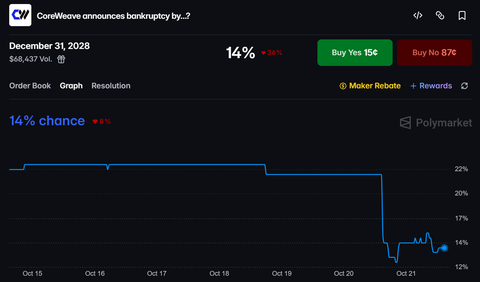
There is more than one evidence on the demand side: Musk said on SpaceX's third-quarter conference call that the company received far more computing power requests than it could provide, and “we are being chased by every hyperscale manufacturer and dozens of small companies to rent more computing power.” The company's revenue reserves reached US$104.2 billion at the end of the second quarter, and added more than US$25 billion in commitments at the beginning of the third quarter.
The problem facing pricing
As a result, the market faced a problem split in half: the credit market — a 15% unsecured yield, a CDS of 1,067 basis points, a $20.7 billion maturity wall, and a financing window that could be pushed back by politics and regulation; on the other, the stock market — a list of investment-grade customers, GPU-backed loan structures, seller ratings increases, and a SpaceX financial report proving that demand for computing power is still tight.
CoreWeave is expected to release the third quarter results next month. At that time, the financing arrangement will be the focus; Baird's Oliver judged that management may make comments on financing measures in the results, but the actual use of the money will not be until the first quarter of next year. In other words, the credit market's patience, sellers' confidence, and demand-side sentiment will be tested simultaneously by the same financial report for the next six to eight weeks. Until then, a 14% probability of bankruptcy, a 15% bond yield, and a share price of $61.82 will still be three mutually dragging prices.