


What Investors Got Wrong About WIN Semiconductors Before A 430% Jump
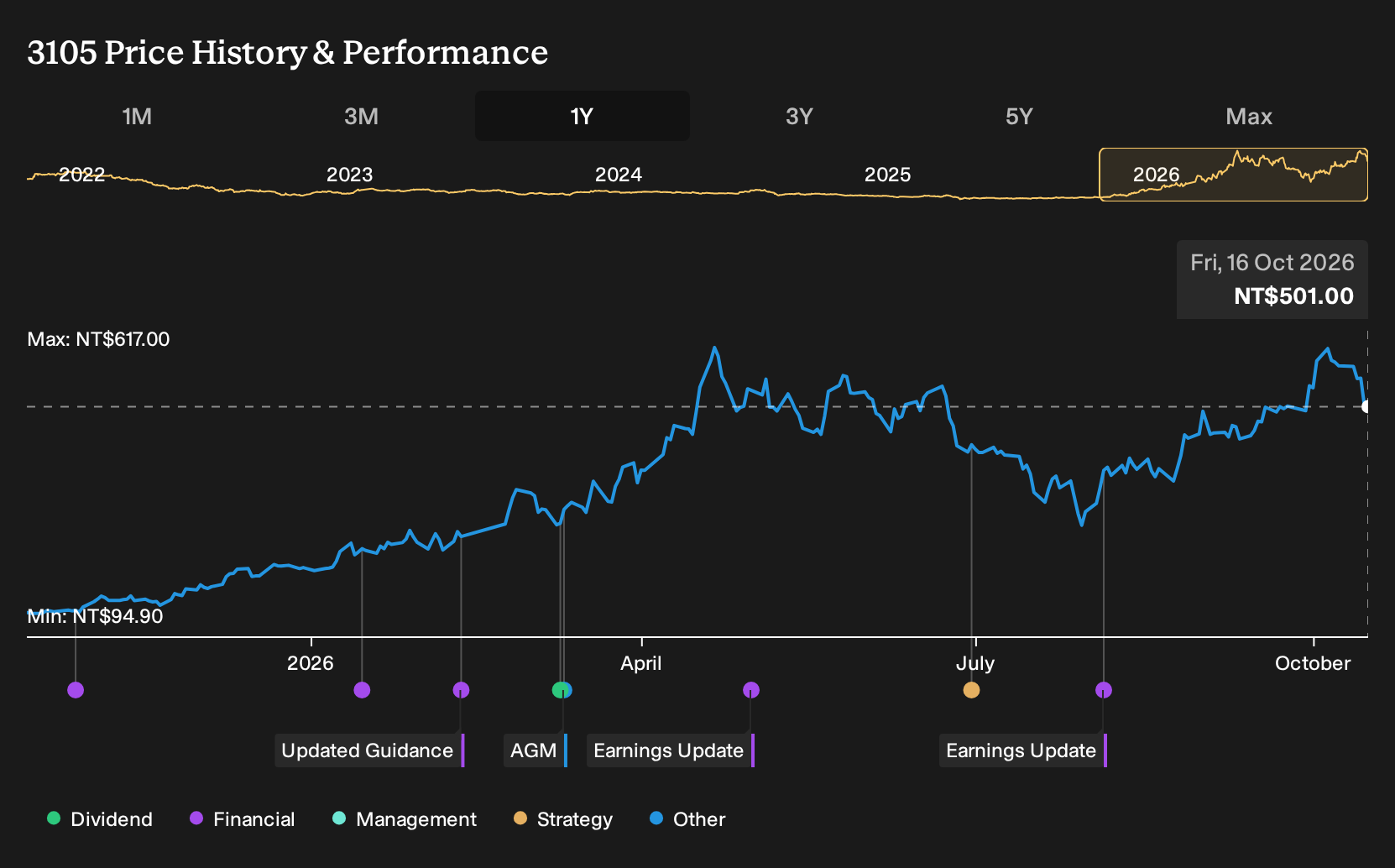
WIN Semiconductors did not just talk about Low Earth Orbit satellite projects and Wi-Fi 7 power amplifiers at the start of this period. Holding WIN Semiconductors over the past year would have returned 430.1%, including dividends. If you had bought on 16 October 2025, you would now be staring at that outcome and the later Q2 2026 swing to an 18.6% net margin, asking what exactly had to be believed back then about this business.
A Narrative on Simply Wall St is one investor's written case for a company, with its growth, margin and multiple assumptions spelled out. Those assumptions imply an estimated Fair Value.
If the move has made WIN Semiconductors harder to judge, start where the gap is still open and scan 191 high quality undervalued stocks.
The Argument You Would Have Been Weighing Up On WIN Semiconductors
The shares cost NT$95.5 at the start of the period, and anyone looking at WIN Semiconductors then had two very different stories on the table.
The bullish narrative put fair value at NT$119, or 25% above the start price. It leaned on the idea that Wi-Fi 7 and satellite projects could support higher free cash flow as depreciation eased and net margins moved toward 20.0% in the assumptions.
The bearish case set fair value at NT$69, or 28% below the start price. It focused on US China geopolitical risk, onshoring trends, and capacity underutilisation keeping margins under pressure even if profit margin assumptions rose only to 8.3%.
What The Results Changed For WIN Semiconductors
WIN Semiconductors reported Q2 2026 revenue of NT$5,257.268m and net income of NT$977.1m, compared with Q2 2025 revenue of NT$3,780.398m and a loss of NT$420.966m. Net margin shifted from a decline of 11.1% to a positive 18.6%. That change in profitability highlighted the case for margin potential rather than the more cautious view.
The key assumption here was margin power. When you assess another stock built on a similar premise, track net income and net margin together across several reports instead of relying on a single bullish or bearish narrative.
What WIN Semiconductors' Price Now Demands You Believe
WIN Semiconductors now trades at NT$501, after a reported 430.1% total return over the past year. The selected Narrative places its Fair Value below that market level, framing today’s quote as already baking in a confident glide path.
The argument leans on mix improvement into infrastructure, aerospace, Wi-Fi and AI related optics while holding utilization and costs steady. Anyone paying NT$501 has to judge whether that shift can outrun weaker cellular demand and mid 20s gross margin guidance without eroding earnings power.
"The main thing that has to go right is WIN Semiconductors successfully shifting its revenue mix toward higher margin infrastructure, aerospace, Wi-Fi and AI related optical applications, while keeping CapEx and depreciation tightly controlled so that improving mix translates into durable margin recovery."
The price and this Narrative do not agree. → Uncover what this Narrative says WIN Semiconductors is actually worth
Looking Beyond WIN Semiconductors
After watching WIN Semiconductors, you might wonder what supports all that connectivity.
Every wireless chip and networking device still needs reliable ways to move and manage data.
Another large firm quietly builds the plumbing for that world, from specialized networking silicon to software that keeps private cloud and mainframe systems running.
Its hardware helps move information quickly, while its software keeps workloads secure, available and easier to control.
If demand for computing and connectivity keeps stretching higher, that combination could end up playing a different, more central role than many expect.
One Narrative has already put a figure on it. → Uncover the company trading 50% below one Narrative's Fair Value
This article by Simply Wall St is general in nature. We provide commentary based on historical data and analyst forecasts only using an unbiased methodology and our articles are not intended to be financial advice. It does not constitute a recommendation to buy or sell any stock, and does not take account of your objectives, or your financial situation. We aim to bring you long-term focused analysis driven by fundamental data. Note that our analysis may not factor in the latest price-sensitive company announcements or qualitative material. Simply Wall St has no position in any stocks mentioned.
Have feedback on this article? Concerned about the content? Get in touch with us directly. Alternatively, email editorial-team@simplywallst.com