


Visa (V) Could Be 64% Overvalued As Stablecoin Rollout Tests Valuation
Visa (V) just pushed its stablecoin work out of the lab and into real-world use, moving Visa Direct’s USDC prefunding from pilots to commercial rollout through processor Inyo Global.
Visa’s recent product announcements around stablecoins, tokenization and new partnerships in China and crypto-linked cards arrive while momentum in the stock is clearly positive. The share price return over the past 90 days is 11.49%, contributing to a 15.37% year to date share price gain and a 20.14% total shareholder return over the last 12 months. Multi year total shareholder returns of 74.92% over three years and 80.33% over five years indicate that investors have been rewarding Visa’s expansion in digital payments and money movement services rather than treating these updates as isolated headlines.
Scan beyond Visa and see how other payment and fintech players are reshaping money movement in our hand picked list of 20 high quality undiscovered gems.
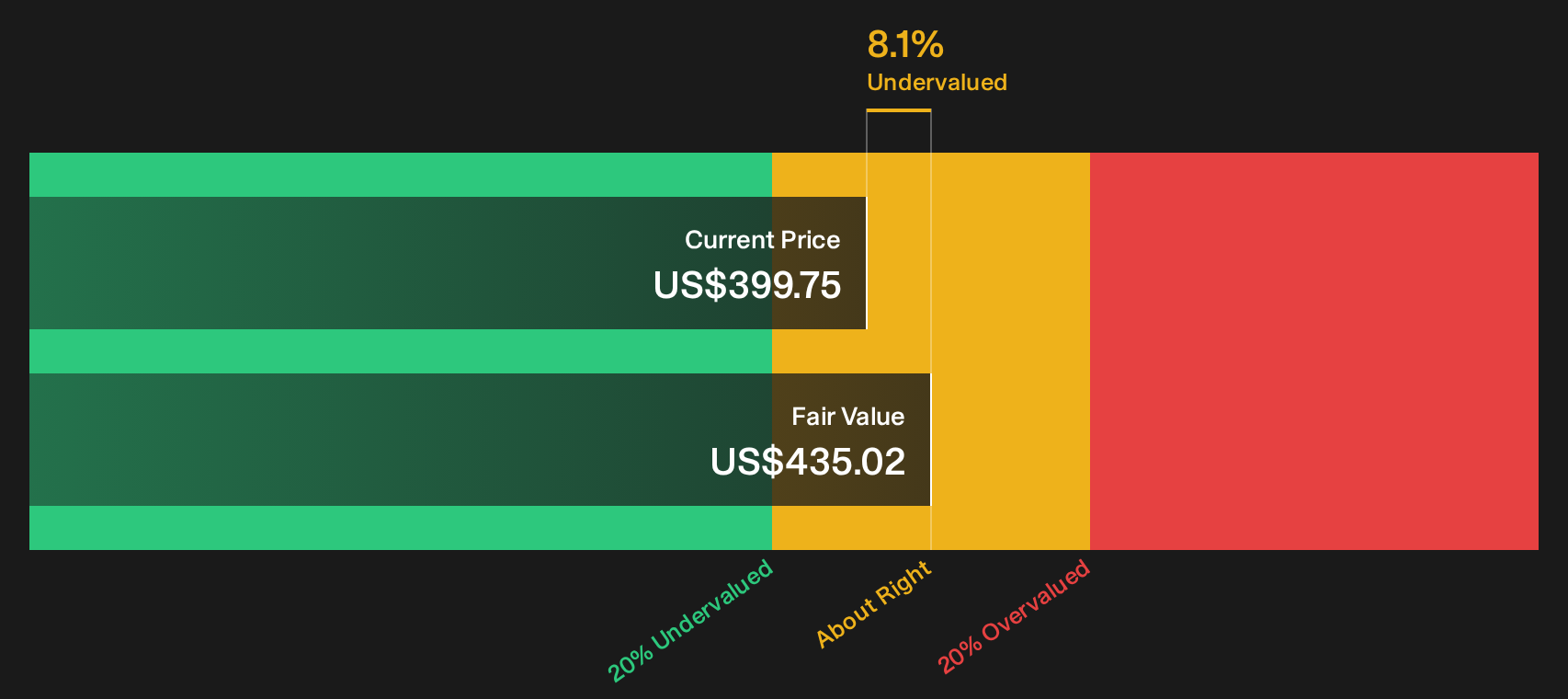
Visa now trades near record highs while sitting about 5% below the average analyst target and roughly 8% under some intrinsic value estimates. Where does fair value really land after this latest leg up?
Most Popular Narrative: 64% Overvalued
Visa last closed at $399.75 while the most followed narrative on Simply Wall St pegs fair value at $243.70, which implies a wide gap between price and intrinsic worth according to that framework.
Visa executes steadily on its three-pillar strategy: Consumer Payments volume growing 8-9% in constant dollars driven by secular cash-to-card conversion and cross-border recovery, CMS at ~20% initially decelerating to ~12% by FY30, VAS sustaining 20-25% growth before decelerating to ~15% by FY32 as the business matures. The DOJ antitrust case resolves with a monetary settlement and limited routing adjustments, painful but not structurally disruptive to the debit network economics. A2A rails remain fragmented outside Brazil and India; Visa monetizes the trend indirectly via Visa Direct. Non-GAAP operating margins expand from ~67.7% (FY2025) to ~71% by FY2030 as VAS scales and operating leverage is captured. Revenue grows in low-double-digits in FY2026-FY2027 (consistent with management guidance of "low-double-digit adjusted net revenue growth"), decelerating to 7-8% by FY2033-FY2035 as the base grows and secular conversion matures in developed markets.
See why 11 investors see Visa as 64% overvalued.
Result: Fair Value of $243.70 (OVERVALUED)
Still, that script depends on a benign outcome to the DOJ case and assumes alternative account to account networks do not compress Visa’s pricing power faster than expected.
Find out about the key risks to this Visa narrative.
Another View On Visa’s Valuation
Esteban’s narrative points to Visa trading at a 64% premium to a $243.70 fair value, which leans heavily on long range margin and growth assumptions. A very different picture comes from our DCF model, which puts fair value at $435.02 and flags the stock as undervalued at $399.75. Which framework feels more realistic to you?
Look into how the SWS DCF model arrives at its fair value.
Next Steps
Mixed messages on Visa’s value and risk profile so far. Act while the debate is fresh and review the data for yourself through the 3 key rewards and 1 important warning sign.
Looking for more investment ideas beyond Visa?
Do not stop at a single ticker. Broaden your watchlist with other potential opportunities that fit different goals, risk levels and income needs.
- Target fresh upside potential by scanning a focused group of smaller companies using the 13 elite penny stocks with strong financials.
- Prioritise quality at a reasonable entry point by reviewing the 33 high quality undervalued stocks.
- Strengthen your income stream and stress test payout resilience through our 7 dividend fortresses.
This article by Simply Wall St is general in nature. We provide commentary based on historical data and analyst forecasts only using an unbiased methodology and our articles are not intended to be financial advice. It does not constitute a recommendation to buy or sell any stock, and does not take account of your objectives, or your financial situation. We aim to bring you long-term focused analysis driven by fundamental data. Note that our analysis may not factor in the latest price-sensitive company announcements or qualitative material. Simply Wall St has no position in any stocks mentioned.
Have feedback on this article? Concerned about the content? Get in touch with us directly. Alternatively, email editorial-team@simplywallst.com