


How to Play CRM Stock as Salesforce Buys the Loops AI Platform
Salesforce (CRM) is working to turn one of its biggest market concerns into a growth opportunity. After spending much of 2026 grappling with fears that agentic artificial intelligence (AI) could erode traditional software licensing, the company is increasingly positioning AI as a catalyst for growth rather than a threat to its business model. That shift in narrative gained fresh momentum on Oct. 12, when Salesforce shares rose 2% following the announcement of a definitive agreement to acquire Loops, an AI-powered analytics platform.
While Salesforce has not disclosed the deal’s financial terms, the acquisition is expected to close in early November of the company's fiscal 2027. The move is intended to strengthen Salesforce’s agentic analytics strategy by helping customers uncover the factors influencing business performance, determine which actions to prioritize, and translate insights into action within their workflows.
The acquisition will also expand the capabilities of Tableau, Salesforce’s analytics platform, by incorporating Loops’ technology and specialized talent once the transaction closes. Tableau Executive Vice President and General Manager Mark Recher said in the company’s press release that Loops will build on Tableau’s mission to help users understand and act on data, “using powerful agentic AI to uncover the drivers behind business performance and surface where teams and agents can take action in real time.”
So, with Salesforce continuing to expand its AI capabilities through strategic acquisitions, here’s a closer look at CRM stock.
About Salesforce Stock
Headquartered in San Francisco, California, Salesforce is a global leader in customer relationship management (CRM), providing businesses with tools to strengthen customer relationships and manage interactions more effectively. Founded in 1999, the company helped pioneer cloud-based software and continues to adapt as enterprises embrace AI-driven digital transformation. A key part of this shift is Agentforce, Salesforce’s flagship AI initiative, which brings autonomous AI agents into business workflows to handle tasks for employees and customers alike.
At its core, Salesforce brings together data from across an organization to create a comprehensive 360-degree view of each customer. Its extensive portfolio spans sales, service, marketing, commerce, and IT, helping businesses streamline operations and improve coordination across teams. Together, these solutions reflect Salesforce’s evolving approach to customer management, combining connected data, automation, and AI to meet the demands of an increasingly digital business environment.
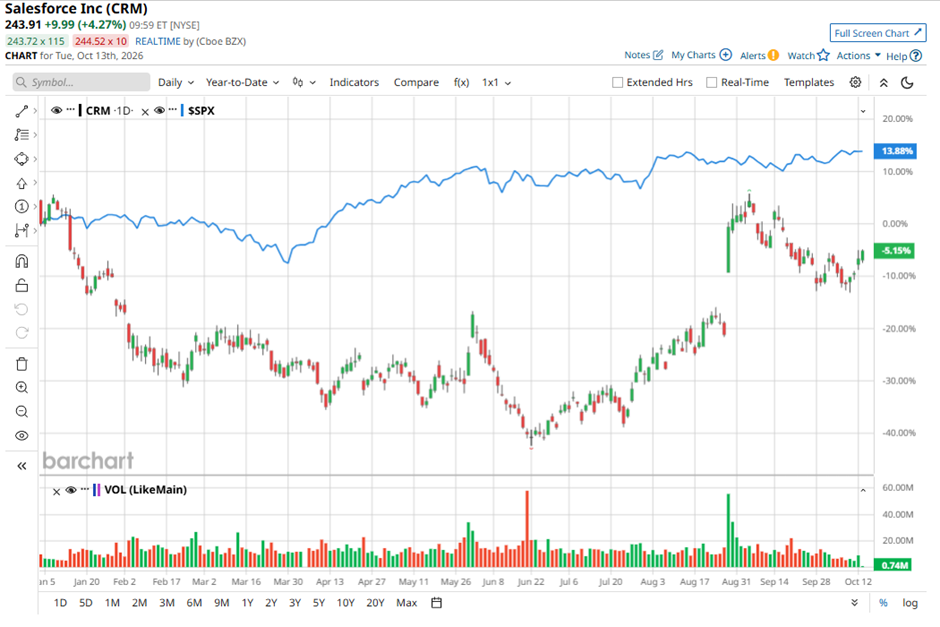
Beyond its core CRM offerings, Salesforce’s ecosystem includes several widely used platforms, such as Slack for workplace collaboration, Tableau for data analytics, and MuleSoft for application integration and connectivity. With a market capitalization of roughly $194 billion, Salesforce has felt the heat from growing fears that AI could disrupt traditional software business models. The concerns have weighed on its share price, which has slipped 7% in 2026, although CRM stock is currently up 4% for the past 52 weeks.
This performance stands in stark contrast to the broader S&P 500 Index ($SPX), which has advanced 16% over the past 12 months and 13% year-to-date (YTD). However, Salesforce’s recent performance suggests the tide may be turning. Supported by its underlying fundamentals, CRM stock has rebounded 48% over the past three months, signaling renewed momentum despite lingering concerns about AI’s impact on the software industry.
Inside Salesforce’s Q2 Earnings Report
Salesforce delivered a strong fiscal 2027 second-quarter performance on Aug. 26, beating Wall Street’s revenue and earnings expectations as its AI ecosystem gained traction and profitability improved sharply. Total revenue climbed 11% year-over-year (YOY) to $11.35 billion, edging past analysts’ consensus estimate of $11.32 billion. Subscription and support revenue, the company’s primary recurring revenue engine, grew 12% YOY to $10.8 billion, underscoring continued demand for its core cloud-based software offerings.
The top-line performance also benefited from contributions from recent portfolio integrations, including Informatica, helping reinforce its revenue growth. However, the biggest earnings highlight came from the bottom line, where operational discipline and improved financial leverage fueled a substantial beat. Salesforce reported GAAP diluted EPS of $4.29, while non-GAAP diluted EPS surged 103% YOY to $5.90, comfortably exceeding Wall Street’s consensus estimate of $3.27.
AI remained a key growth driver, with Agentforce gaining commercial momentum. Agentforce’s annual recurring revenue (ARR) surpassed $1.5 billion, soaring 240% YOY as businesses increasingly adopted AI agents alongside human workflows. Meanwhile, combined ARR from Salesforce’s broader AI and data offerings approached $3.9 billion, representing 210% YOY growth. These gains highlight the company’s push to expand its agentic AI capabilities and growing adoption among major global clients across industries.
Salesforce’s forward-looking indicators also pointed to healthy demand and revenue visibility. Current remaining performance obligations (cRPO), which reflect contracted revenue expected to be recognized over the next 12 months, rose 14% YOY in constant currency to $33.5 billion. Management also emphasized that AI is generating value across the company’s platform, citing strong demand for its AI and data products as their combined ARR approached the $4 billion mark.
Cash generation strengthened considerably during the quarter. Operating cash flow climbed 71% YOY to $1.3 billion, while free cash flow jumped 81% to $1.1 billion. Salesforce also returned $364 million to shareholders through dividends and continued executing its $25 billion accelerated share repurchase program, highlighting its focus on shareholder returns alongside investments in growth.
Looking ahead, Salesforce raised its full-year fiscal 2027 revenue guidance to a range of $46.1 billion to $46.4 billion, representing YOY growth of 11% to 12%. The company also projected full-year non-GAAP EPS of $16.67 to $16.71. The upgraded revenue outlook, combined with accelerating AI adoption and strong cash flow generation, provides investors with a clearer picture of Salesforce’s growth ambitions as it continues expanding its AI-driven business.
What Do Analysts Think About Salesforce Stock?
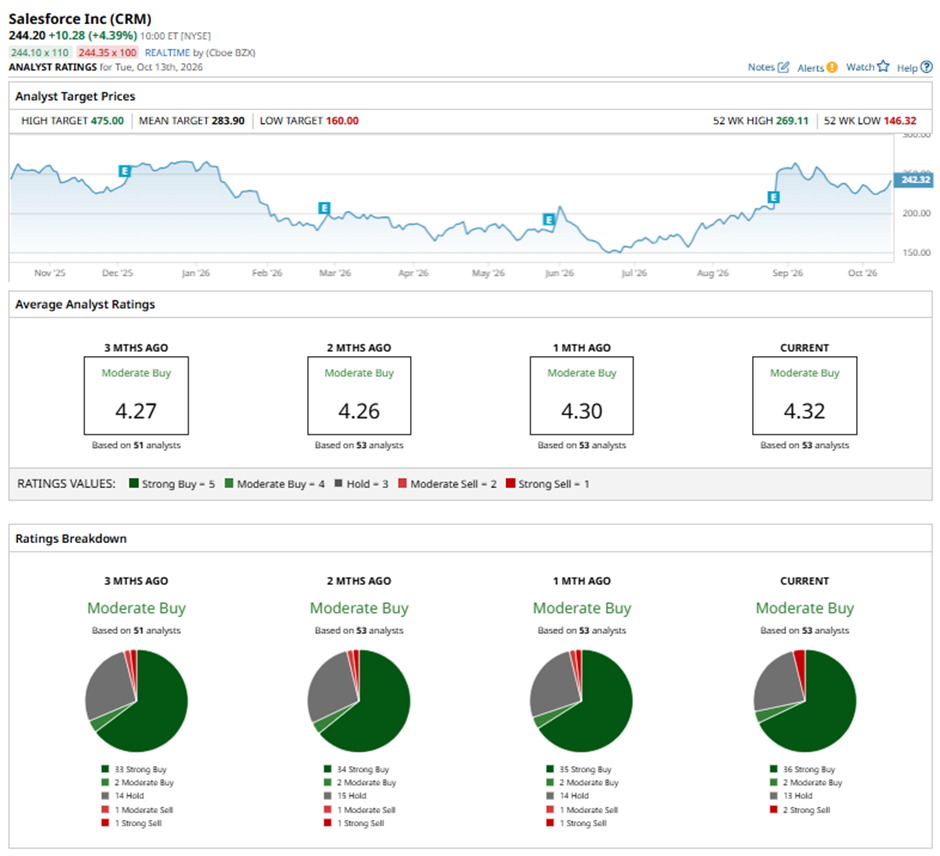
Wall Street remains bullish on Salesforce, with CRM stock carrying a consensus “Moderate Buy” rating among 51 analysts. Of those analysts, 34 recommend a “Strong Buy” rating, two favor a “Moderate Buy,” 13 have a “Hold” rating, and two analysts have a “Strong Sell” rating. The average price target of $284.88 points to potential upside of 15% from current levels, while the Street-high target of $475 signals a much steeper potential rally of 92%, highlighting the wide gap between mainstream expectations and the most bullish outlook.
On the date of publication, Anushka Mukherji did not have (either directly or indirectly) positions in any of the securities mentioned in this article. All information and data in this article is solely for informational purposes. For more information please view the Barchart Disclosure Policy here.