


AI Workflow Push Might Change The Case For Investing In Voya Financial (VOYA)
- Voya Financial expanded its long running partnership with Unqork by adopting UnqorkAI to support AI enabled retirement experiences and modernize key enterprise workflows, with a focus on security, governance, and controlled costs.
- The move signals that Voya Financial is leaning on targeted AI tools not just for client front ends but also for workflow efficiency across regulated retirement and benefits processes.
- The next area of attention is how Voya Financial's investment narrative could be shaped by this wider UnqorkAI deployment across retirement workflows.
Voya Financial Investment Narrative Recap
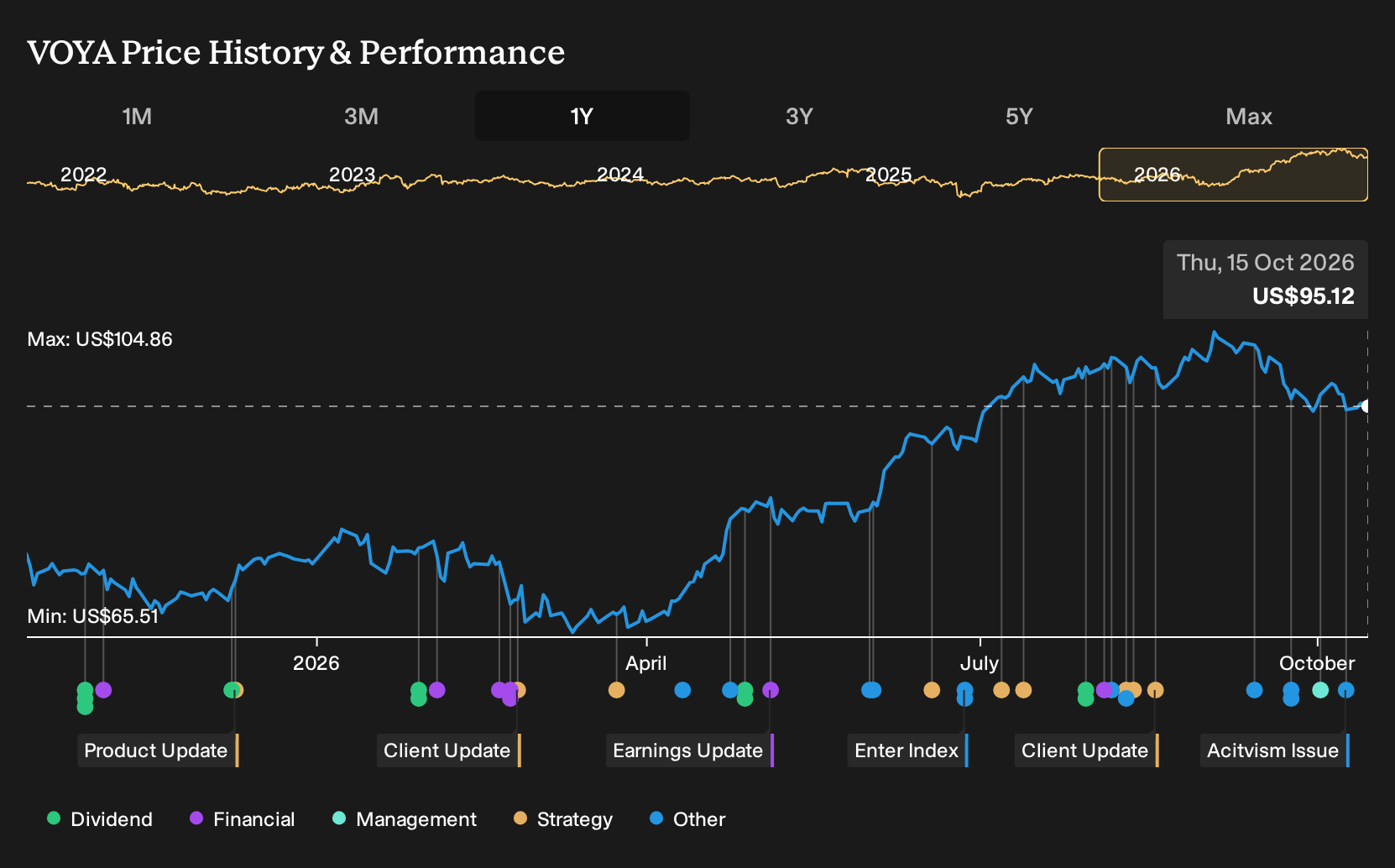
For a shareholder in Voya Financial, the core belief is that the workplace focused retirement, benefits, and investment platform keeps converting employer relationships into fee based flows without letting earnings volatility from alternatives or stop loss pricing dominate the story. The near term operational swing factor still sits in delivering on earnings expectations after the Q2 2026 miss and stabilising margins as capital markets stay unpredictable.
The biggest risk right now is not AI execution; it is distraction. The TOMS Capital no confidence campaign could drag focus away from underwriting discipline, AI rollout, and expense control. If the board dispute stays contained, the UnqorkAI deployment and broader automation efforts look more like incremental efficiency tools than a near term catalyst shift.
The most relevant announcement alongside the AI partnership is the leadership reshuffle that moves current Chief Technology and Operations Officer Santhosh Keshavan into the Chief Risk and Global Operating Officer role from January 1, 2027, with Rajat Kalia stepping in as Chief Technology Officer. That change brings risk, operations, and technology into a tighter loop just as Voya Financial scales AI across retirement workflows.
For you as an investor, that matters less as a personality change and more as an execution question. The short term watchpoints are whether this structure keeps AI projects like UnqorkAI aligned with strict governance, cost control, and regulatory demands while still simplifying onboarding and service. Any stumble that adds operational risk or slows AI deployment would run counter to one of the clearer catalysts in the current Voya Financial story.
Voya Financial's current analyst storyline points to revenues of US$8.5b and earnings of US$1.1b by 2029. That path assumes about 1.4% yearly revenue growth and an earnings increase of roughly US$533m from current earnings of US$567m.
Uncover how Voya Financial's fair value indicates a 14% potential upside to its current price that may not last much longer.
Exploring Other Perspectives
Some of the most optimistic analysts frame the real catalyst around Voya Financial as stronger policy driven retirement inflows rather than AI or the TOMS Capital campaign. Before this news, that group was modeling revenues of about US$8.7b and earnings near US$1.3b by 2029. You can weigh that against more cautious forecasts and decide which storyline fits your view, knowing this fresh AI and governance news may reshape both sets of expectations.
Explore another Voya Financial fair value estimate, including one that suggests up to 53% upside from the current price!
Decide For Yourself
Don't just follow the ticker; dig into the data and build a conviction that's truly your own.
- A great starting point for your Voya Financial research is our analysis highlighting 4 key rewards and 1 important warning sign that could impact your investment decision.
- See our latest analysis for Voya Financial. The report includes a comprehensive fundamental analysis summarized in a single visual, the Snowflake, making it easy to evaluate Voya Financial's overall financial health at a glance.
Looking for more investment ideas beyond Voya Financial?
Once you have a handle on Voya Financial, it can help to compare it with other businesses that share similar qualities or offer very different risk and income profiles.
- For investors who want potential growth with tight capital discipline, scan a curated 20 high quality undiscovered gems that combine solid fundamentals with less crowded ownership.
- If capital preservation is your priority, focus on resilience first and returns second by filtering for 32 resilient stocks with low risk scores that score well on financial strength and business stability.
- Income focused readers who like to see cash coming back regularly can zero in on 7 dividend fortresses that pair higher yields with balance sheets that can support ongoing payouts.
This article by Simply Wall St is general in nature. We provide commentary based on historical data and analyst forecasts only using an unbiased methodology and our articles are not intended to be financial advice. It does not constitute a recommendation to buy or sell any stock, and does not take account of your objectives, or your financial situation. We aim to bring you long-term focused analysis driven by fundamental data. Note that our analysis may not factor in the latest price-sensitive company announcements or qualitative material. Simply Wall St has no position in any stocks mentioned.
Have feedback on this article? Concerned about the content? Get in touch with us directly. Alternatively, email editorial-team@simplywallst.com