


How Private Credit Launch At Moody's Stock Has Changed Its Investment Story
- Moody’s Corporation and Allvue Systems recently launched the Moody’s Analytics EDF-X Private Credit Model, a forward looking tool built on de-identified Allvue borrower data that estimates both hard and soft credit events in the private credit market.
- The model aims to give lenders and investors earlier insight into borrower stress in a market that Moody’s projects could approach US$4t in assets by 2030, supporting portfolio monitoring, manager evaluation and capital allocation decisions.
- Next, the focus will be on how Moody’s private credit EDF-X launch could influence the investment narrative built around recurring analytics.
Moody's Investment Narrative Recap
To own Moody’s, you need to believe in a long run shift toward data heavy, recurring risk tools and in continued demand for independent credit assessment across public and private markets. The key near term swing factor is still issuance and transactional activity, which ties directly into how comfortably Moody’s can support its high margin model.
The new EDF-X private credit model looks helpful for reinforcing that recurring analytics story, but it does not change the main short term catalyst, the upcoming September quarter earnings release. The biggest current risk remains that issuance and private credit activity cool from recent levels, exposing Moody’s high fixed cost base and leverage.
The EDF-X launch with Allvue is the announcement that plugs most cleanly into this thesis. It deepens Moody’s presence in private credit, a segment where management has already reported strong transaction activity and growing mandates, and it leans into the firm’s broader push toward API delivered analytics and workflow tools that sit inside client decision systems.
For you as a shareholder, the relevance sits in execution. If EDF-X scales across Allvue’s client set and into Moody’s broader Analytics suite, it can support higher recurring usage tied to private credit risk management. If adoption is slower or competing approaches gain traction, the expected uplift from private credit focused analytics and AI driven products could prove more modest.
Forecasts, Moody's EDF-X and What Analysts Are Baking In
Analysts are effectively tying the Moody's EDF-X private credit rollout back to a bigger math problem you need to understand. The street is working off a view that Moody's can grow revenue at 6.4% a year for the next three years while nudging profit margins from 34.3% to 35.9%. That frame supports a consensus projection that earnings could move from US$2.8b today to US$3.5b by 2029, a value change of US$0.7b that assumes the heavier use of recurring analytics tools, including private credit models like EDF-X, feeds into higher overall profitability.
On those same assumptions, Moody's narrative projects US$9.8b revenue and US$3.5b earnings by 2029. This requires 6.4% yearly revenue growth and an earnings increase of US$0.7b from US$2.8b today.
Market pricing then layers a valuation multiple on top of that earnings path. To line up with the current analyst targets, investors would have to accept Moody's trading on a P/E of 31.8x those 2029 earnings, compared with 28.9x today and below the US Capital Markets industry level of 39.6x. That set up effectively asks you to decide whether tools like EDF-X, along with broader AI and workflow integrations, are enough to justify paying more for each dollar of future profit than you are paying for each dollar of earnings today.
Private credit analytics sit in the middle of that question. If lenders and asset managers come to treat EDF-X style borrower stress signals as part of everyday risk control, then a larger slice of Moody's income could come from contractual subscriptions instead of transaction heavy issuance cycles. If adoption is patchier, or if rivals win a larger share of those workflow slots, the same earnings and P/E assumptions could start to look more demanding, even if the absolute forecasts for 2029 do not change.
Uncover how Moody's fair value indicates a 21% potential upside to its current price that investors may see realized sooner than expected.
Exploring Other Perspectives
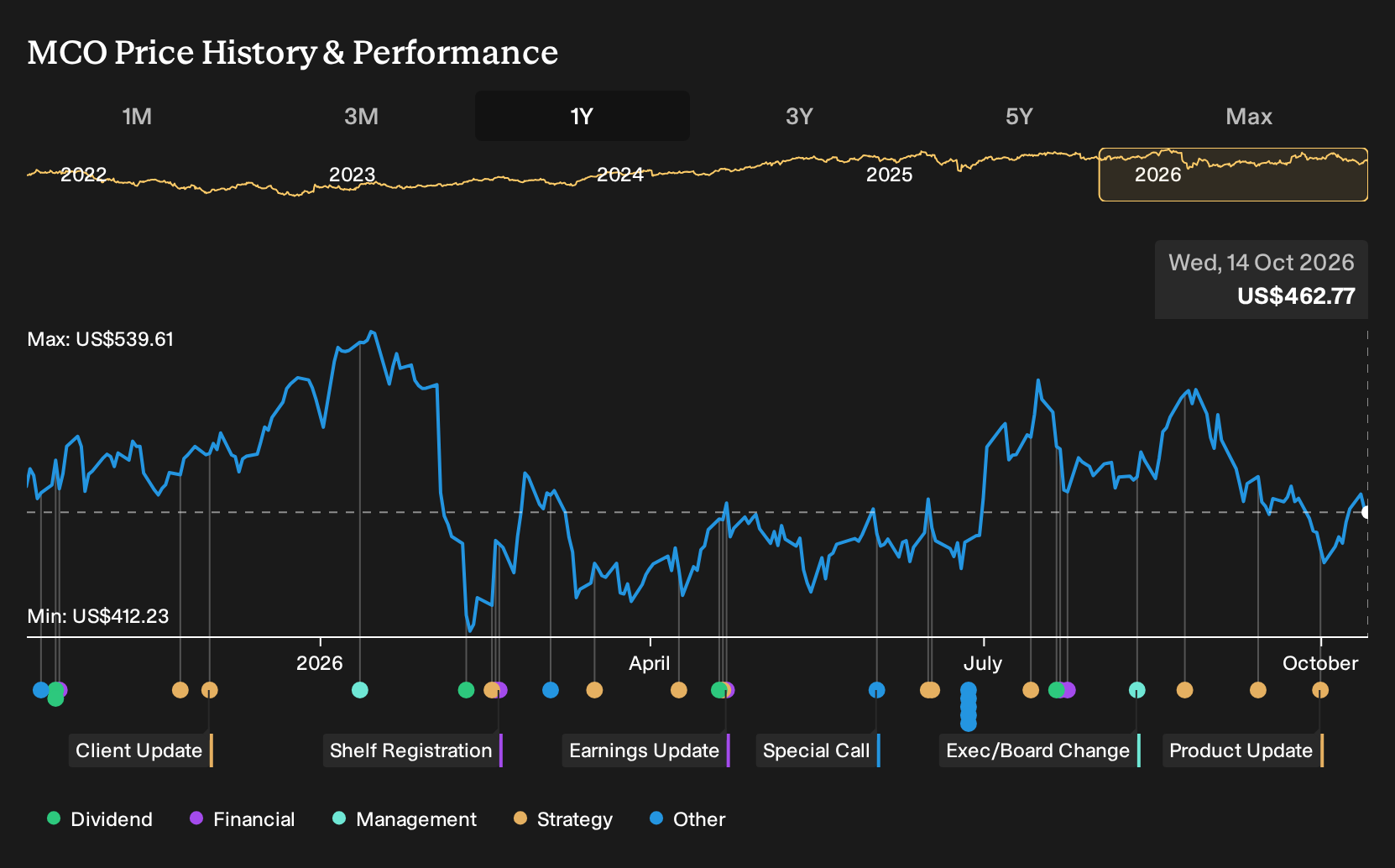
Eight fair value estimates from the Simply Wall St Community cluster between about US$433 and US$562 per share, with some users seeing Moody’s as deeply undervalued while others lean toward a fuller price. Set that against risks around issuance cooling or cash returns proving softer, plus catalysts tied to private credit and AI partnerships, and you can see how sharply opinions can diverge. Use that spread to test your own thesis and explore several alternative viewpoints before deciding how Moody’s fits into your portfolio.
Explore 7 other Moody's fair value estimates, including one that suggests as much as 6% downside from the current price.
Decide For Yourself
Don't just follow the ticker. Dig into the data and build a conviction that's truly your own.
- A great starting point for your Moody's research is our analysis highlighting 4 key rewards and 1 important warning sign that could impact your investment decision.
- See our latest analysis for Moody's. The report includes a comprehensive fundamental analysis summarized in a single visual, the Snowflake, making it easy to evaluate Moody's overall financial health at a glance.
Looking For More Investment Ideas Beyond Moody's?
If the Moody's story has sharpened your view on risk, cash flow and recurring analytics, it can help to line that thinking up against a broader watchlist. The Simply Wall St Screener lets you scan for other businesses with balance sheets, income profiles and risk characteristics that match the style of portfolio you want to build.
- For investors who care about defense first, review a list of solid balance sheet and fundamentals (25 results) that can help you focus on companies where financial strength is a priority.
- If you are hunting for value, scan a 32 high quality undervalued stocks that might align better with your return and risk expectations.
- When dependable cash returns matter most, check a 7 dividend fortresses that could complement a position in Moody's with income focused holdings.
This article by Simply Wall St is general in nature. We provide commentary based on historical data and analyst forecasts only using an unbiased methodology and our articles are not intended to be financial advice. It does not constitute a recommendation to buy or sell any stock, and does not take account of your objectives, or your financial situation. We aim to bring you long-term focused analysis driven by fundamental data. Note that our analysis may not factor in the latest price-sensitive company announcements or qualitative material. Simply Wall St has no position in any stocks mentioned.
Have feedback on this article? Concerned about the content? Get in touch with us directly. Alternatively, email editorial-team@simplywallst.com