


Debt-Laden Neocloud Stocks Are Collapsing as Inflation Comes in Hot
The artificial intelligence (AI) boom runs on computing power, electricity, and borrowed money. That last ingredient became more troublesome on Wednesday after the U.S. Bureau of Labor Statistics reported September consumer prices rose 0.6%, lifting annual inflation to 3.7%. Core prices climbed 0.3%, above the 0.2% economists expected. Treasury yields also rose as investors reassessed the interest-rate outlook.
For companies borrowing billions of dollars to build AI infrastructure, persistent inflation threatens both construction budgets and financing costs. Customers may still want more computing capacity, but shareholders need that demand to produce returns that exceed the cost of supplying it. Growth alone won’t pay the interest bill.
Why Neocloud Stocks Are Falling
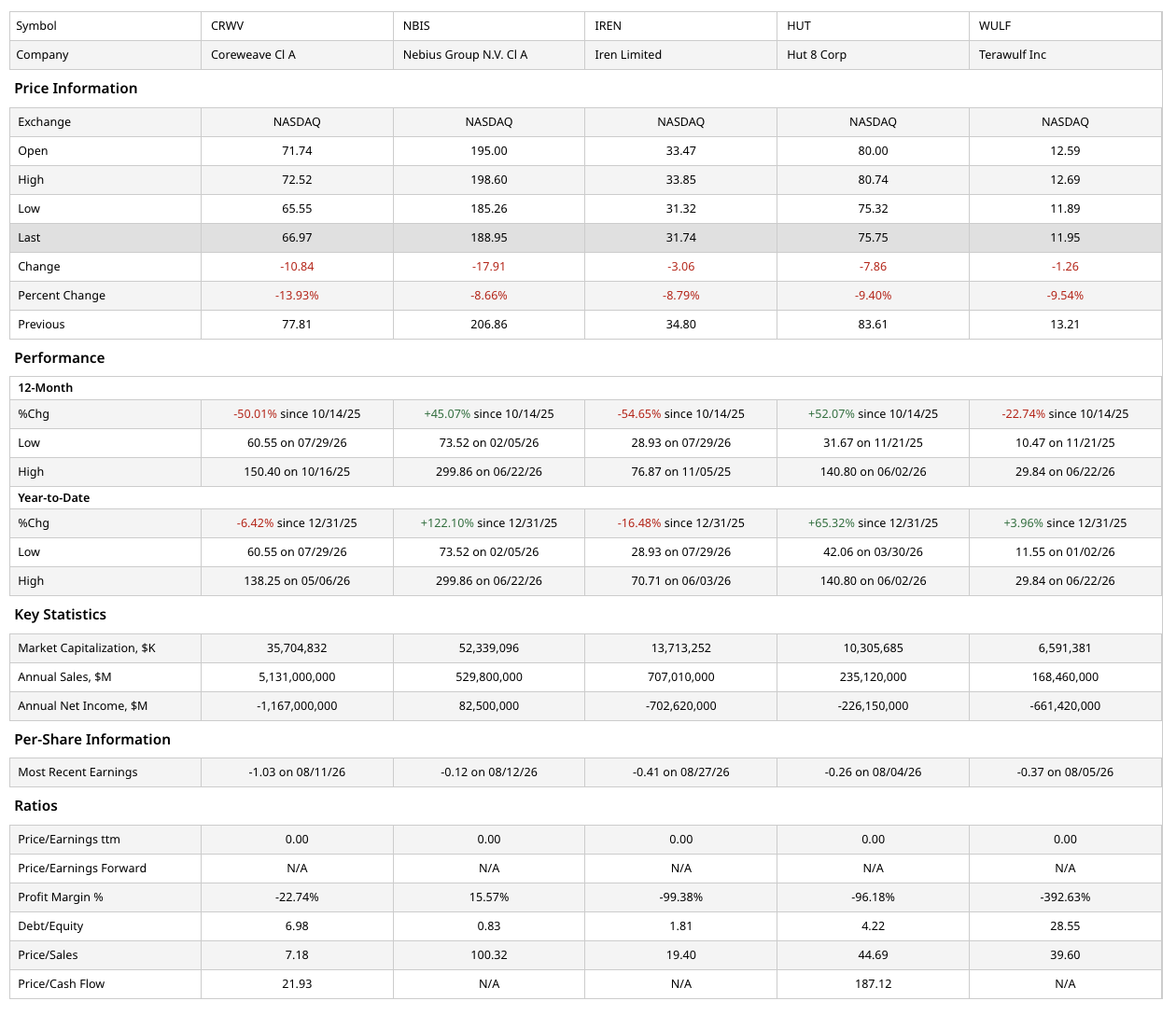
CoreWeave (CRWV) stock led the retreat, falling more than 15% on Oct. 14. Nebius Group (NBIS) and IREN (IREN) dropped about 10% and 12%, respectively, while Hut 8 (HUT) and TeraWulf (WULF) declined roughly 10% and 13%.
These AI infrastructure businesses face a common financing challenge, although their business models and balance sheets differ. Building capacity requires spending before the resulting revenue arrives.
Higher rates make new borrowing and refinancing more expensive. Existing fixed-rate coupons don’t automatically change, but floating-rate loans can reset higher. Even continued AI infrastructure spending cannot guarantee attractive shareholder returns when funding costs consume the profits.
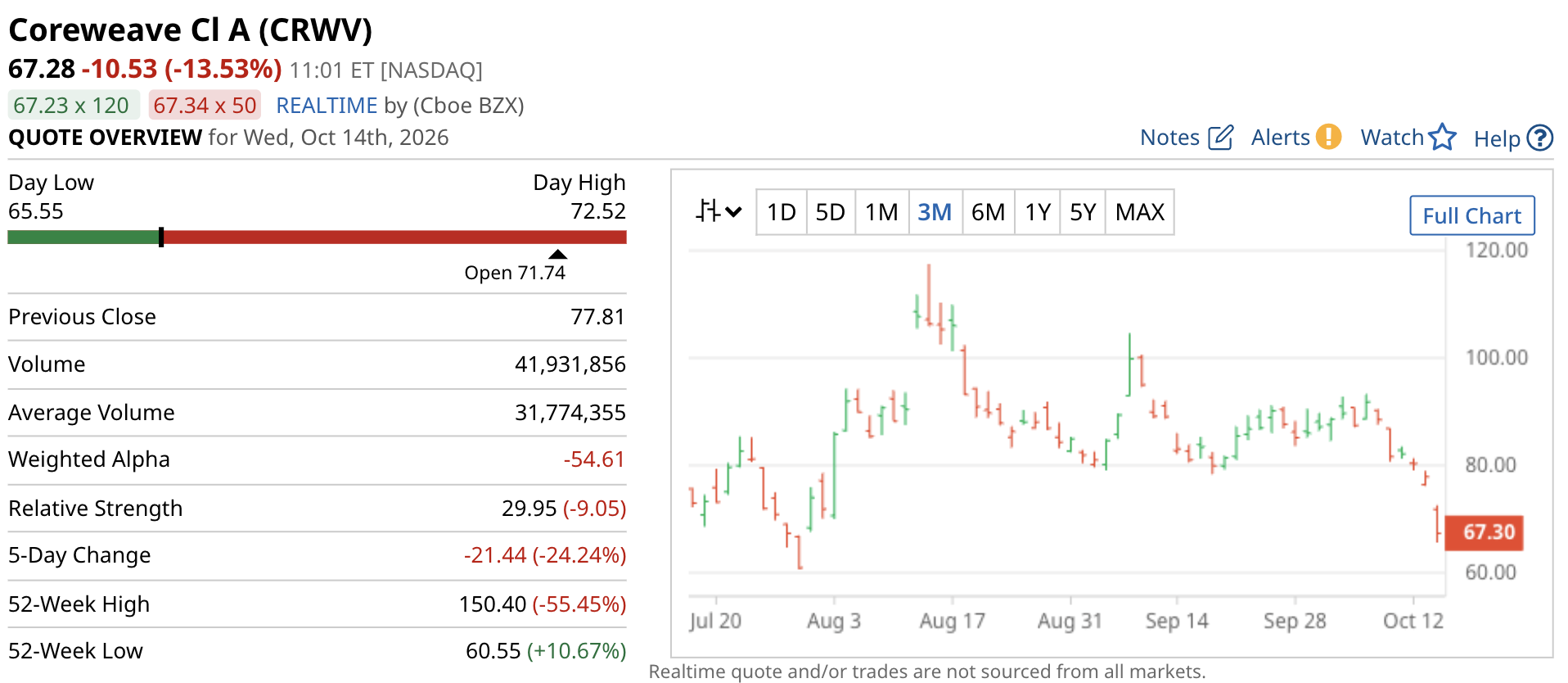
CoreWeave’s $35.6 Billion Problem
CoreWeave’s second-quarter earnings saw $35.6 billion in debt. The release showed $640 million in net interest expense against $2.575 billion in revenue — almost $0.25 of every revenue dollar. The company lost $626 million despite revenue growing 112% year-over-year (YOY). Those figures explain why earnings growth hasn’t silenced debt concerns.
CoreWeave's peers also carry substantial obligations:
Company |
Reported Borrowings at June 30, 2026 |
| Nebius | $8.55 billion in current and noncurrent debt |
| IREN | $7.59 billion in current and noncurrent debt |
| Hut 8 | $7.64 billion carrying value of loans, notes, and other financial liabilities |
| TeraWulf | Approximately $5.7 billion in convertible and secured notes |
However, cash cushions matter, too. CoreWeave held $5.5 billion in unrestricted cash against $35.6 billion in indebtedness as of June 30. Nebius had approximately $8 billion in cash against $8.55 billion in debt, while IREN held $5.9 billion against $7.59 billion. All three face costly expansion plans, but CoreWeave’s borrowing burden towers over its available cash.
What One Analyst's Zero-Dollar Warning Means
On Wednesday’s Prof G Markets podcast, D.A. Davidson analyst Gil Luria argued that CoreWeave borrows at roughly 9% while earning investment returns he estimated near 1%. Even the 4% to 5% returns he described as its target would fall short. Those are Luria’s estimates, not audited return measures.
His warning that equity could become worthless assumes the AI investment cycle weakens enough to undermine debt repayment. Creditors rank ahead of shareholders in a restructuring; valuable infrastructure can survive while its stockholders lose everything.
Granted, CoreWeave reported a $104.2 billion revenue backlog, and confidence in neocloud demand remains strong. But contracted sales are not cash profits available today.
Key Takeaway
Investors shouldn’t mistake a 15% decline for a bargain. I would avoid buying CoreWeave’s dip until operating earnings cover its interest burden more convincingly. AI demand can keep expanding while expensive financing leaves shareholders with disappointing returns.
On the date of publication, Rich Duprey did not have (either directly or indirectly) positions in any of the securities mentioned in this article. All information and data in this article is solely for informational purposes. For more information please view the Barchart Disclosure Policy here.