


Inflation rates double, Russell fell 11% from the August high in 2000, and experienced a technical correction for the first time since March
The Zhitong Finance App notes that the Russell 2000 Index entered a correction range with the sharp fall on Wednesday, and rising inflation and interest rates are pushing the riskiest stocks in the market below the important moving average.
This small-cap indicator has now fallen more than 10% from its recent peak. After falling 1.9% on Wednesday, it recorded its first technical correction since March. Wednesday's decline was widespread, and the number of stocks falling in the index was about five times the number of rising stocks. Overall, the indicator has fallen 11% from its August high.
The inflation report released on Wednesday showed that prices rose at the fastest rate since April in September, and core inflation was higher than expected.
Stefano Pascal, head of US stock derivatives research at Barclays, said, “Small-cap stocks are highly sensitive to interest rates, and as far as today's data increases the risk of policy interest rates rising, this is a bad sign for small-cap stocks.”
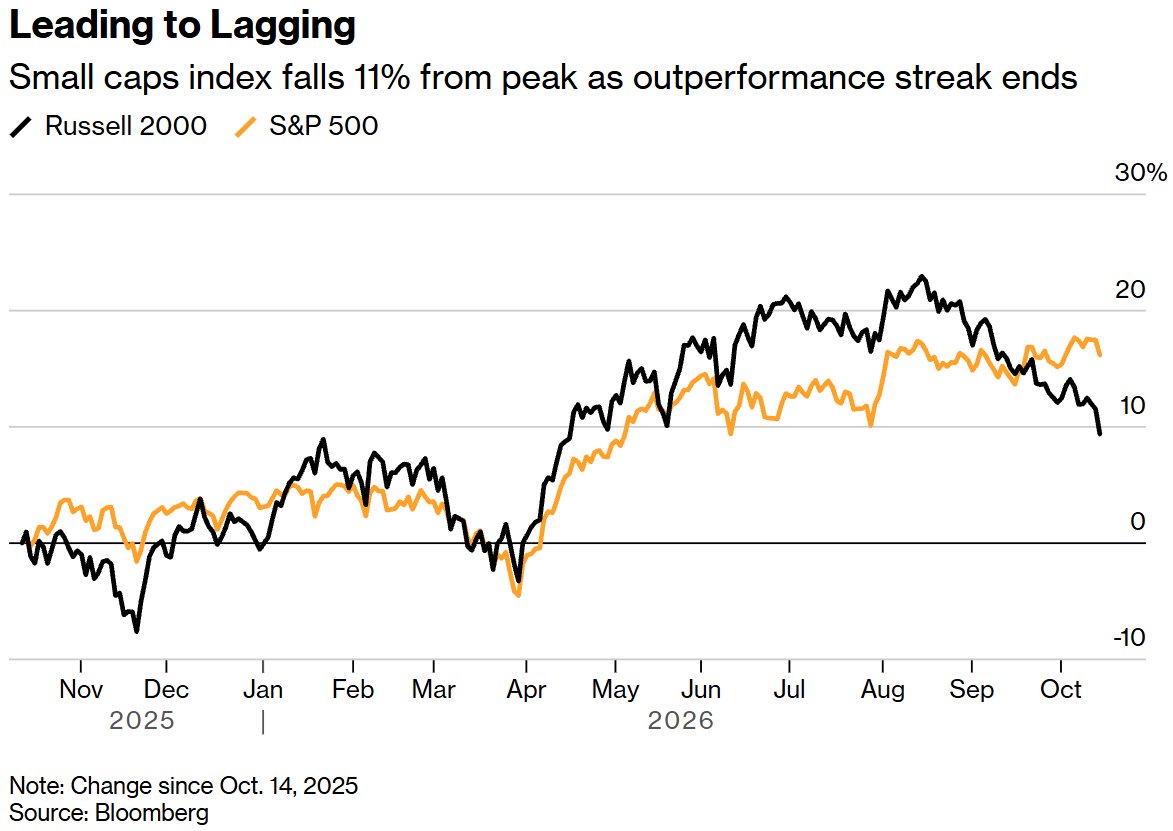
The small-cap index fell 11% from its peak
For most of this year, the Russell 2000 index has outperformed the S&P 500 because small-cap stocks are highly correlated with economic growth, which has been driven by strong consumer spending and large-scale corporate investment in artificial intelligence (AI) infrastructure.
However, the index relinquished its lead last month after the Federal Reserve raised interest rates and soared yields on bonds and treasury bonds. Small-cap stocks tend to be more sensitive to interest rates than large-cap stocks.
In fact, as interest rates have risen, the index has fallen below several support levels, falling below the 200-day moving average for the first time since March this week. Previously, in September and August, it had successively fallen below the 100-day and 50-day EMAs.
The index has been in a downward trend since it formed a bearish V-shaped reversal pattern in August. This week, it fell below the 23.6% Fibonacci retracement level — around 2,754 points — a level that had previously been a support level.
Dennis Debusscher, president and chief market strategist at 22V Research LLC, said that Wednesday's CPI increase increased the risk of further tightening financial conditions, and this would “pose a continuing longer-term headwind for small-cap stocks,” as well as individual consumer and transportation stocks.
Earlier this year, after a large-scale index rebalancing, the high-quality constituent stocks in this small-cap index also fell sharply. As of June 29, Bloom Energy Corp. (BE.US), Credo Technology Group Holding (CRDO.US), Sterling Infrastructure Inc. (STRL.US), and TTM Technologies Inc. (TTMI.US) together contributed two-thirds of the increase in the Russell 2000 Index, and on the same day, all four companies were moved into the Russell 1000 Index.