


What Ally Financial Stock Downgrade Means For Shareholders
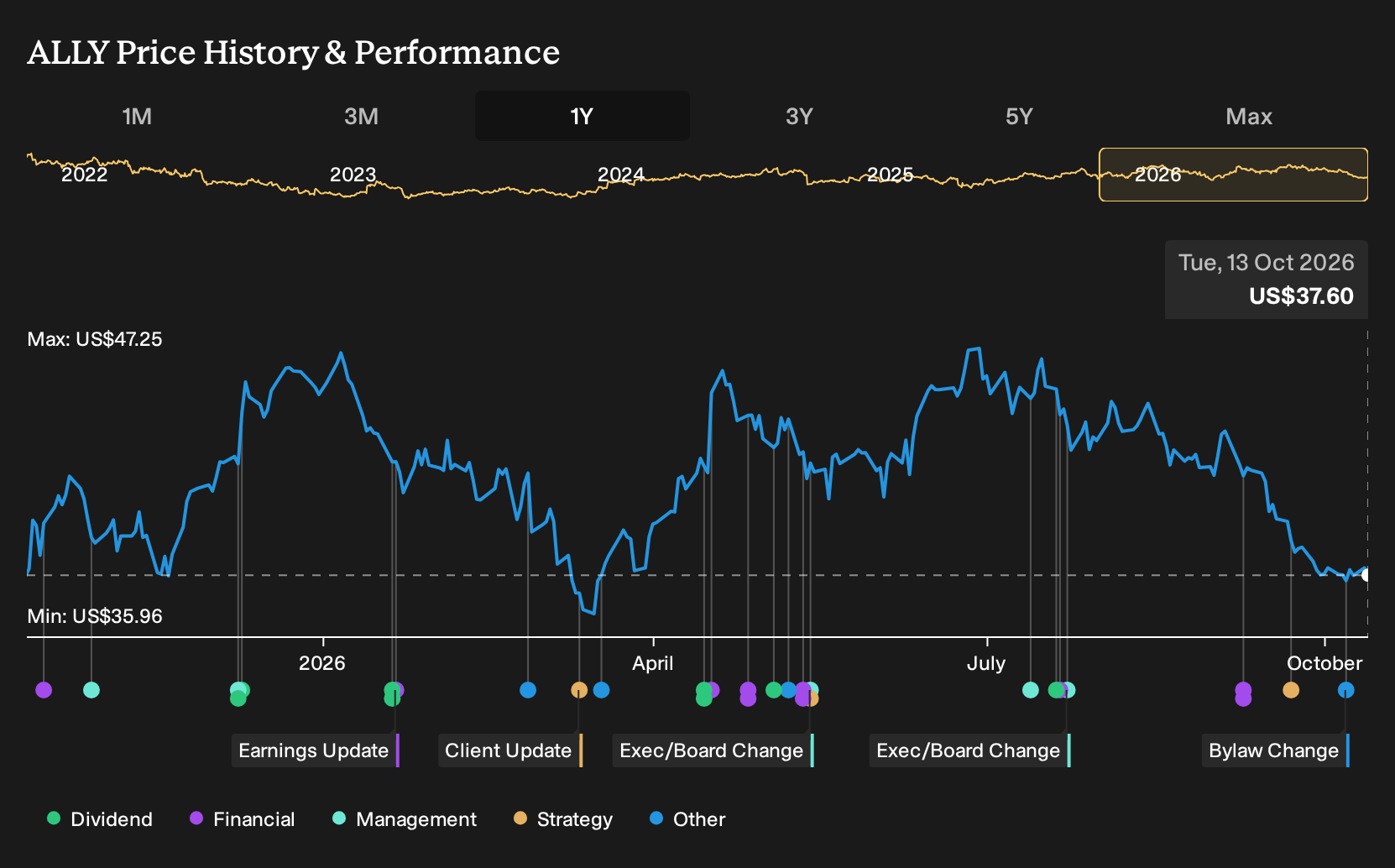
- Ally Financial recently revised its corporate bylaws, aligning director elections, officer authority, record dates, and electronic communications more closely with Delaware law and modern governance practices.
- The tightened guardrails around board size and clearer advance notice rules for shareholder proposals point to a firmer framework for how future ownership and governance debates will play out.
- We will now examine how Ally Financial's investment narrative could be influenced by Morgan Stanley's concerns over earnings resilience and auto credit.
Compare Ally Financial's governance and earnings risk profile with hand-picked peers by scanning for 32 resilient stocks with low risk scores that may offer a different balance of credit quality and interest rate exposure.
Ally Financial Investment Narrative Recap
To own Ally Financial, you need to believe its digital model and auto finance engine can keep producing solid earnings even while higher rates and consumer credit risk stay in focus. The key near term swing factor is how net interest margin and auto charge offs trend in the upcoming results, given the stock has already slipped about 19% over 3 months.
The biggest risk right now is that pressure on auto lending volumes or losses from weaker borrowers eats into that mid teens net margin profile and forces higher provisions. Recent bylaw changes do not materially change the operating outlook. They mainly frame how future capital allocation, board composition, and any shareholder pushes might be handled.
The bylaw overhaul announced on 7 October looks most relevant here because it affects how Ally Financial can respond if returns stay under pressure and investors push harder on governance. Clearer voting standards, advance notice rules, and board size limits give more structure around potential debates on risk appetite, auto exposure, and digital growth priorities.
For investors, that means the near term earnings catalyst around the late October quarter now sits alongside a more defined rulebook for any future activism or board refresh. Analyst downgrades that flag auto credit and net interest margin headwinds now play out against a governance setup that is more tightly aligned with Delaware law and modern bank peers.
Ally Financial Long Term Earnings Setup
Ally Financial's narrative projects US$9.9b revenue and US$1.8b earnings by 2029. This rests on analysts modelling 7.7% yearly revenue growth and an earnings increase of roughly US$500m from US$1.3b today.
Uncover why Ally Financial's fair value indicates a 38% potential upside to its current price, which could narrow quickly.
Exploring Other Perspectives
You have a very different picture if you focus on the bullish catalyst around Ally Financial’s Corporate Finance arm. The most optimistic analysts were pencilling in revenue climbing toward US$11.0b and earnings of US$2.2b by 2029, before these bylaw changes. Those expectations could shift if governance tweaks influence future risk appetite.
Explore 4 other Ally Financial fair value estimates, including one that suggests as much as 54% upside from the current price.
Reach Your Own Conclusion
Disagree with existing narratives? Extraordinary investment returns rarely come from following the herd, so consider your own analysis carefully.
- A great starting point for your Ally Financial research is our analysis highlighting 6 key rewards that could impact your investment decision.
- See our latest analysis for Ally Financial. The report includes a comprehensive fundamental analysis summarized in a single visual, the Snowflake, making it easy to evaluate Ally Financial's overall financial health at a glance.
Looking for more investment ideas beyond Ally Financial?
If the Ally Financial story leaves you wanting a broader watchlist, use this moment to widen your search and line up a few alternatives that fit different risk and income preferences.
- For investors who care most about capital protection and steadier profiles, scan a 32 resilient stocks with low risk scores that could offer a different mix of volatility and downside resilience.
- If your priority is finding companies with solid finances behind their share prices, filter for a list of solid balance sheet and fundamentals (25 results) to spot businesses where debt and liquidity look more robust.
- Income focused readers who want cash returns from their holdings can review a 8 dividend fortresses that may align better with long term payout goals.
This article by Simply Wall St is general in nature. We provide commentary based on historical data and analyst forecasts only using an unbiased methodology and our articles are not intended to be financial advice. It does not constitute a recommendation to buy or sell any stock, and does not take account of your objectives, or your financial situation. We aim to bring you long-term focused analysis driven by fundamental data. Note that our analysis may not factor in the latest price-sensitive company announcements or qualitative material. Simply Wall St has no position in any stocks mentioned.
Have feedback on this article? Concerned about the content? Get in touch with us directly. Alternatively, email editorial-team@simplywallst.com