


Elon Musk’s SpaceX Caps Military Starlink Speeds in Ukraine, Adviser Suspects Political Motive: ‘Cannot Be a Coincidence’
Space Exploration Technologies Corp. (NASDAQ:SPCX) imposed a 100 mph (160 km/h) speed limit on its military-grade Starlink service in Ukraine early Wednesday, disrupting combat missions, according to a Ukrainian official.
Adviser Calls Starlink Cap Political
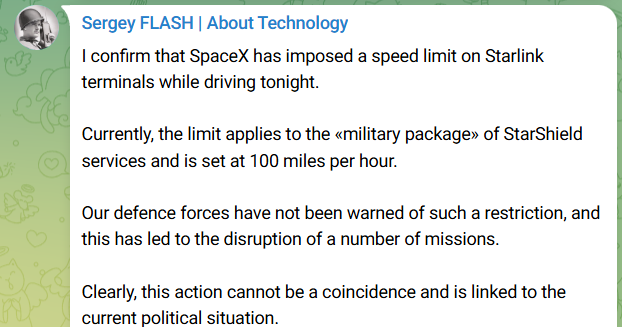
Ukrainian presidential adviser Serhiy Beskrestnov wrote on Telegram that the cap applies to the "military package" of Starshield, SpaceX’s military-focused satellite service. It affects terminals while they are moving.
Ukraine’s defense forces "did not receive a warning about this limitation," he said, and several missions were disrupted.
He added that the move "cannot be a coincidence" and is linked to the current political situation. He gave no further explanation in the statement.
Ukraine’s 7th Rapid Reaction Corps, deployed on the southeastern front, noted that Starlink services had been disrupted, Reuters reported. SpaceX had not publicly explained the change in available reports.
SpaceX did not immediately respond to Benzinga‘s request for comment.
Trump-Zelensky Rift Adds Political Backdrop
The restriction follows a sharp turn in U.S.-Ukraine relations. President Donald Trump said Saturday that Ukraine should get "a new president," a day after announcing a deal to ease sanctions on Russian diesel exports.
Ukrainian President Volodymyr Zelensky strongly criticized the deal. He said Russia answered the sanctions relief with strikes on Zaporizhzhia that killed 20 people.
Elon Musk, SpaceX’s CEO, had led the Department of Government Efficiency under Trump in 2025 before leaving the role.
Speed limits on Starlink in Ukraine are not new. On Jan. 29, then-Defense Minister Mykhailo Fedorov announced that SpaceX had agreed to cap terminals in Ukraine at 90 km/h (56 mph) and to allow only approved terminals. SpaceX implemented the changes within 48 hours, Hvylya reported.
The cap targeted Russian drones, including Molniya-2 and Geran models fitted with Starlink antennas, which could hit moving targets more than 80 km behind the front line. Ukraine’s slower FPV drones were unaffected.
Disclaimer: This content was partially produced with the help of AI tools and was reviewed and published by Benzinga editors.
Image via Shutterstock