


Microsoft Stock Alert: Michael Burry Warns of $3 Trillion in AI Liabilities
Michael Burry is at it again. The investor famous for calling the 2008 housing crash just went after Microsoft (MSFT) and its massive artificial intelligence (AI) spending spree.
Burry believes Microsoft may be using its financial figures “as a lever to get what it wants,” and called out Big Tech management. “The only reason the CEOs of these tech monopolies are spending wildly on data centers like they are is because they assume they will be granted an oligopoly that is too big to fail,” he said, flagging roughly $3 trillion in off-balance-sheet AI data-center liabilities across major tech names.
That is a serious number. Microsoft has poured billions of dollars into OpenAI and built data centers at breakneck speed. In a blog post, Burry wrote that companies like Microsoft “are spending as if their lives depended on it when their lives clearly do not.”
He has a point worth examining. But Microsoft is not your average overspending tech company. Earlier this year, for instance, Microsoft Azure crossed $100 billion in annual revenue. The company's cloud backlog reportedly sits at $678 billion. This is a business with real demand behind the spending.
Microsoft Stock Has Been a Laggard
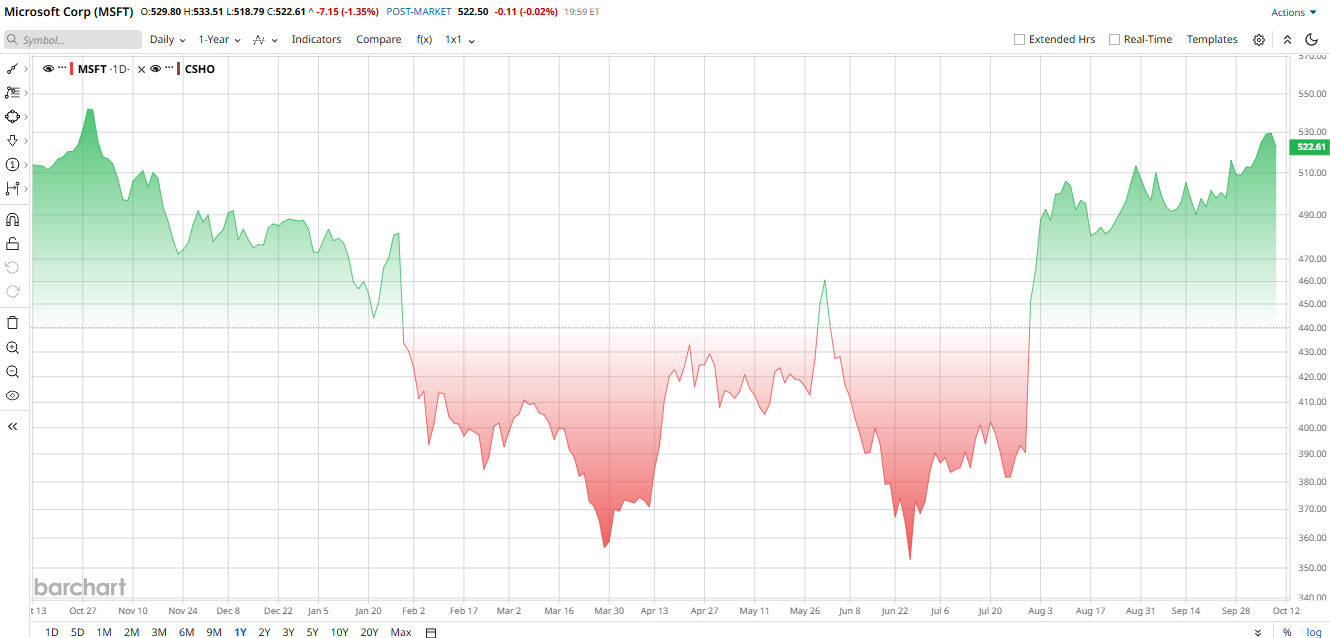
MSFT stock has performed modestly over the past year — up by 6% over the past 52 weeks — as heavy AI spending, margin pressure, and a sluggish Windows and Xbox business have weighed on shares. The market wants proof that all the company's spending will pay off. However, shares have soared 41% in the past three months, bringing MSFT stock up 12% year-to-date (YTD) as quarterly results beat expectations and guidance reinforced confidence that AI infrastructure spending can translate into revenue. Analyst upgrades have added further support.
Among all “Magnificent Seven” names, Microsoft's valuation looks relatively reasonable at a trailing price-to-earnings (P/E) ratio of 30.2 times and a forward P/E ratio of 26.6 times. The sector's median trailing P/E is roughly 37 times, while the forward P/E multiple is about 30 times. So, Microsoft trades at a discount to its peers on both metrics. Meanwhile, the P/E-to-growth (PEG) ratio sits at 1.68 times versus the sector median of roughly 1.5 times. MSFT stock is not a bargain-bin pick, but it is fairly valued for a company growing this fast.
What Does Burry's Criticism Really Mean?
Burry's main thesis is that these tech companies are not competing to meet real customer demand but instead to defend their turf against each other, including invaders like Amazon (AMZN). In his post, Burry considered whether they are monopolies, given that even OpenAI and Anthropic are dedicated to spending heaps of cash.
This is certainly a reasonable worry. Microsoft's capital spending in the June quarter was $41 billion, a 70% increase from a year ago. That is a lot of money.
However, there is a flip side. Microsoft's commercial remaining performance obligations (RPO) — contracted revenue that has not been recognized yet — now exceeds $678 billion, while the company is working to keep up with Azure demand. So, Microsoft's capital spending isn't necessarily money going down the drain. It is matching actual demand, although Burry's warning on hidden liabilities does command attention.
The Latest Quarterly Results Were Strong
Microsoft reported fiscal fourth-quarter results on July 29, and the numbers came in above expectations. Revenue hit $90 billion, up 18% from $76.4 billion a year ago. Net income was $35.8 billion, up 31% year-over-year (YOY), while adjusted EPS landed at $4.74, up 23% YOY.
Free cash flow was $19.6 billion in Q4, down 23% YOY. That decline reflects the company's heavy capital spending, but $19.6 billion in free cash flow is still a massive number. For all of fiscal 2026, Microsoft generated $67 billion in free cash flow.
“It was a very strong close to what was a record fiscal year for us,” CEO Satya Nadella noted on the earnings call. The executive pointed out that annual revenue surpassed $331 billion, up 18% YOY, with Microsoft Cloud coming in above $214 billion and Azure surpassing $100 billion, up 27% and 41%, respectively.
For Q1 fiscal 2027, Microsoft guided revenue between $89.85 billion and $90.95 billion. Analysts expect revenue of $90.7 billion and earnings of $4.71 per share for the upcoming quarter. For full-year fiscal 2027, analysts also project earnings growth of 14% YOY to $19.65 per share.
What Do Analysts Think of Microsoft Stock?
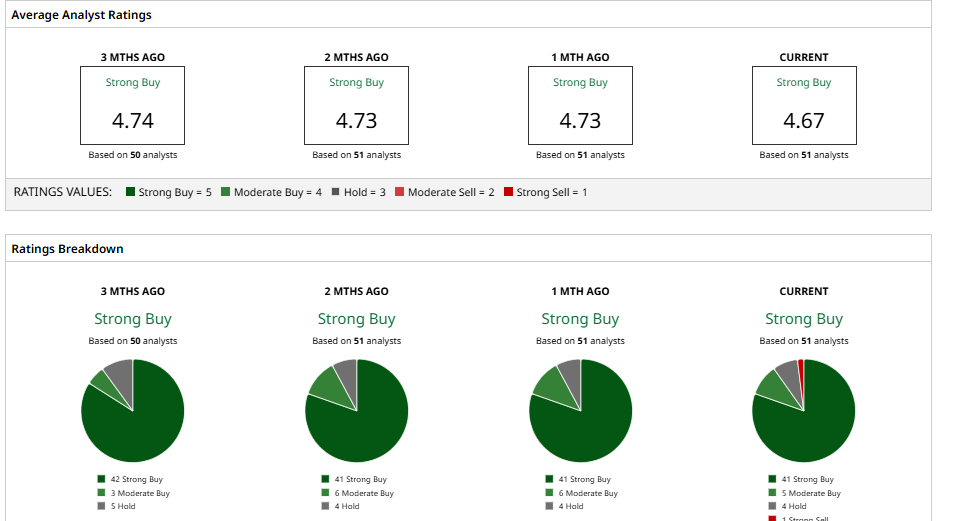
Despite Burry's concerns, Wall Street remains bullish on Microsoft. Overall, MSFT stock has a consensus “Strong Buy” rating based on 51 analysts with coverage. The average price target of $577.98 represents potential upside of approximately 7% from current levels.
Recently, Stifel analyst Brad Reback upgraded MSFT stock to a "Buy" rating and raised his price target from $530 to $575. Meanwhile, Morgan Stanley has a price target of $600 per share, Goldman Sachs has a $640 target, and Wells Fargo analyst Michael Turrin has a price target of $725.
The recent upgrade and bullish price targets point to confidence in Microsoft maintaining growth even in the face of its heavy investments. Analysts appear to believe current AI investments will yield returns, and whether Burry is wrong or right, Wall Street is not retreating from the likes of Microsoft. MSFT stock may not be as cheap as it was at the end of 2012, but it's not overpriced. Longer-term investors may want to consider betting on AI spending rather than running.
On the date of publication, Nauman Khan did not have (either directly or indirectly) positions in any of the securities mentioned in this article. All information and data in this article is solely for informational purposes. For more information please view the Barchart Disclosure Policy here.