


Small-Cap Stocks Are in Grave Danger Thanks to an Impending Debt Cliff. Use These 2 ETFs for Protection and Profit.
Small-cap stocks are telling a dangerous story.
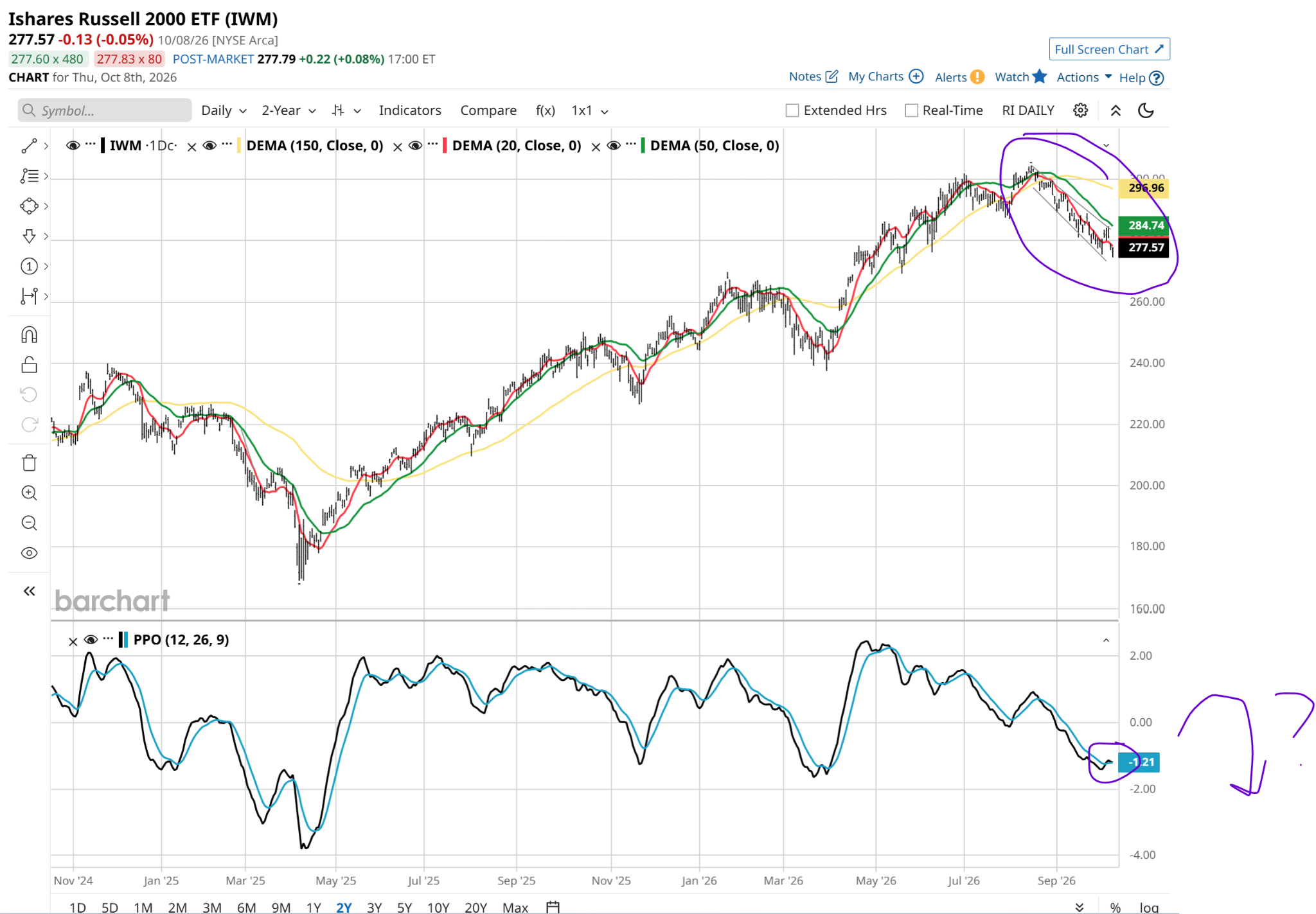
The story is one of persistent selling pressure. And with the iShares Russell 2000 ETF (IWM) sliding to correction territory, dropping more than 10% off its recent highs, investors dare not be complacent.
For nearly two years, an endless parade of wealth advisors and TV strategists has been pitching the “broadening out” narrative. They told investors to buy small-cap stocks simply because they were “cheap” or “out of favor,” or “due for a mean reversion.” But buying an asset strictly because it has underperformed isn’t a strategy. It’s a drug called hope-ium.
The 40% Zombie Debt Cliff
IWM is struggling in part because of the balance sheets beneath the wrapper. Approximately 40% of the companies inside the Russell 2000 are currently unprofitable.
During the zero-interest-rate policy (ZIRP) era following the 2020 market shock, hundreds of weak, non-viable companies issued lots of 5-year corporate debt at artificially low coupons of 2% to 4%.
That pandemic-era debt wall is coming due right now. Unprofitable companies cannot fund debt service out of free cash flow. When forced to refinance 3% debt at prevailing rates of 8% to 10% from private credit lenders, these “zombie” firms face a grim choice: cut operating expenses to the bone, issue highly dilutive stock offerings at depressed valuations, or hand the keys over to creditors.
A benchmark where four out of 10 constituents face an existential refinancing cliff is not a candidate for a sustained bull market. And it is showing up in other places too.
Because when confronted with the junk debt inside IWM, the knee-jerk reaction is to recommend the iShares Core S&P Small-Cap ETF (IJR). Unlike the Russell 2000, IJR screens for profitability, requiring companies to post positive cumulative earnings over four consecutive quarters.
On paper, screening out zombie firms sounds great. In reality, IJR’s chart looks just as broken as IWM’s. However, if I’m choosing between the two and “none of the above” is not an acceptable response, IJR looks marginally better to me.
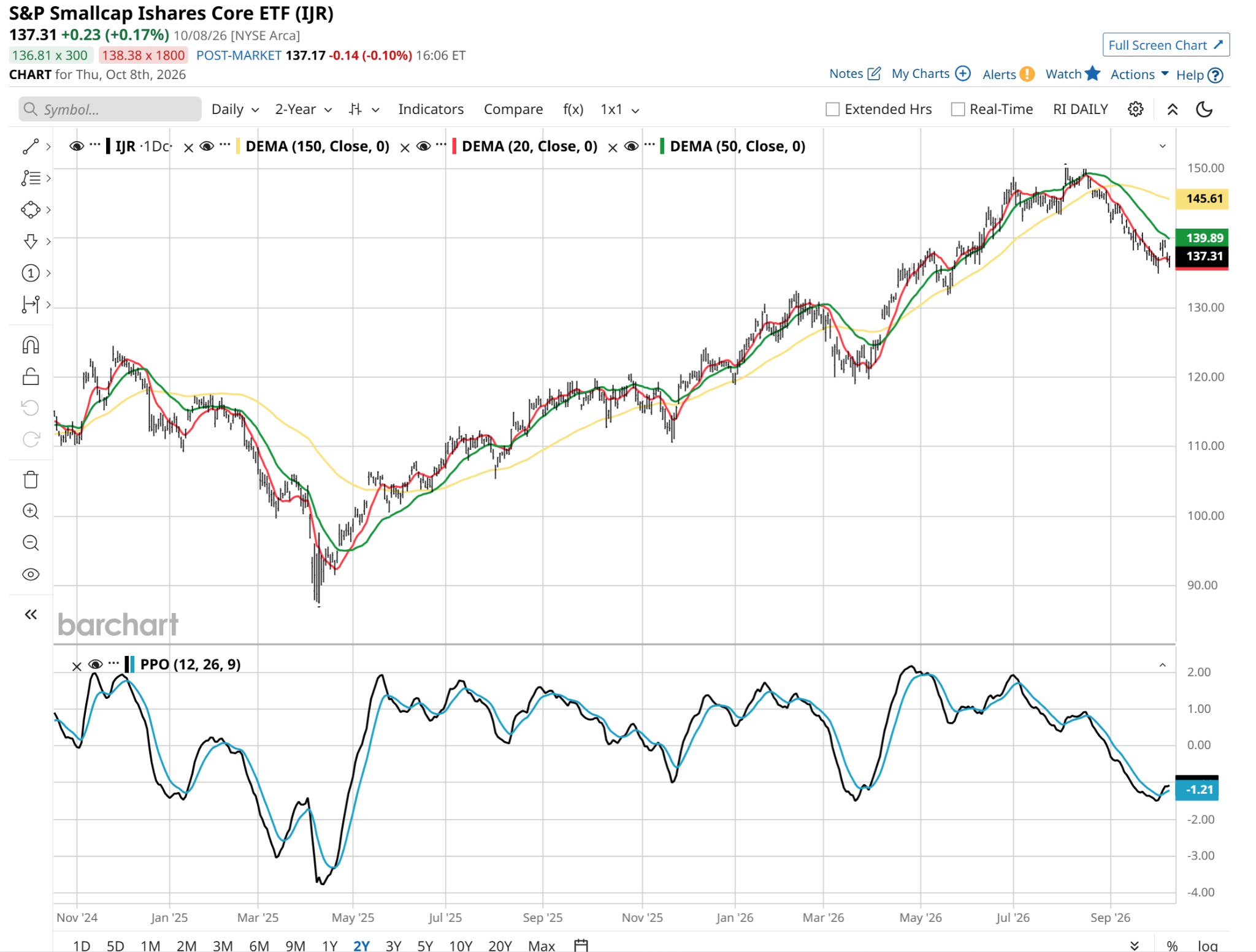
Positive earnings do not make a small company immune to higher costs. I am talking about refinancing, but also the enduring higher costs of energy.
Even profitable small businesses lack the pricing power of mega-caps. Small-cap stocks rely heavily on regional bank lending. With regional banks tightening lending standards to protect their own balance sheets, access to flexible credit has dried up. So it is no wonder KRE’s chart looks like it is related to IWM.
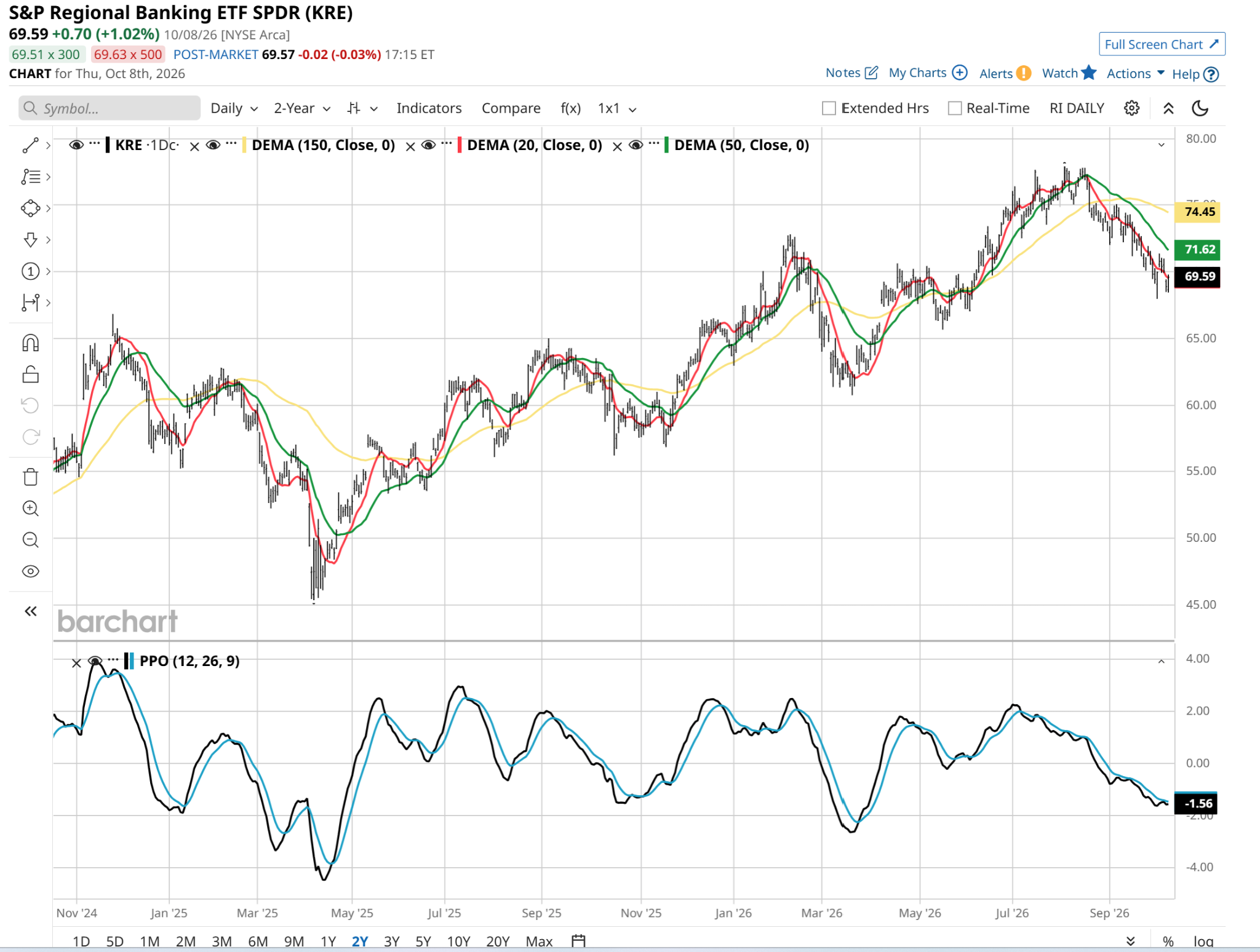
Why Is the Buy-the-Dip Strategy Failing Now?
This comes down to the same modern market structure problems I’ve cited many times before. Gone are the hordes of fundamental stock-pickers allocating capital to undervaluation. The market is currently driven by passive, cap-weighted index ETFs and automated 401(k) inflows.
When an investor buys a standard broad-market fund, 35% to 50% of every dollar automatically flows directly into the top mega-cap tech hyperscalers. Virtually zero capital trickles down to a $1.5 billion industrial name.
What Would It Actually Take for a Small-Cap Turnaround?
A genuine, sustainable bottom in small-cap stocks will not happen just because they are statistically cheap as a group. A drop in real borrowing costs would help. Federal Reserve rate cuts alone won’t save small caps if economic growth is cratering. If the Fed cuts rates because a recession is starting, credit spreads on high-yield and small-cap debt will widen sharply, completely offsetting lower benchmark rates. Small caps need lower borrowing costs alongside stable economic demand.
I have felt for years (no, more like a decade) that the market must go through a cleansing cycle. That’s where insolvent, zero-earnings companies inside the Russell 2000 default, restructure, or get removed from the index, lifting the fundamental drag on IWM.
Stop waiting for a “broadening out” trade that looks in increasing peril. I don’t typically see a multi-month selling drip like those charts above snap back so quickly. Not before a real bloodletting first.
The ProShares Short Russell 2000 ETF (RWM) is a single inverse ETF to do some research on. And the Direxion Daily Small Cap Bear 3X ETF (TZA) is one I’ve used at times, when I want a smaller position, but triple the octane via a leveraged inverse ETF.
Rob Isbitts is a semi-retired CIO, former fiduciary investment advisor, and Barchart columnist. Check out his other work at ETFYourself.com (featuring the Fresh Charts weekly trading post), and ROAR.PiTrade.com, helping investors to better-manage their own portfolios.
On the date of publication, Rob Isbitts did not have (either directly or indirectly) positions in any of the securities mentioned in this article. All information and data in this article is solely for informational purposes. For more information please view the Barchart Disclosure Policy here.