


Should Neighborhood Pharmacy Expansion Require Action From CVS (CVS) Investors?
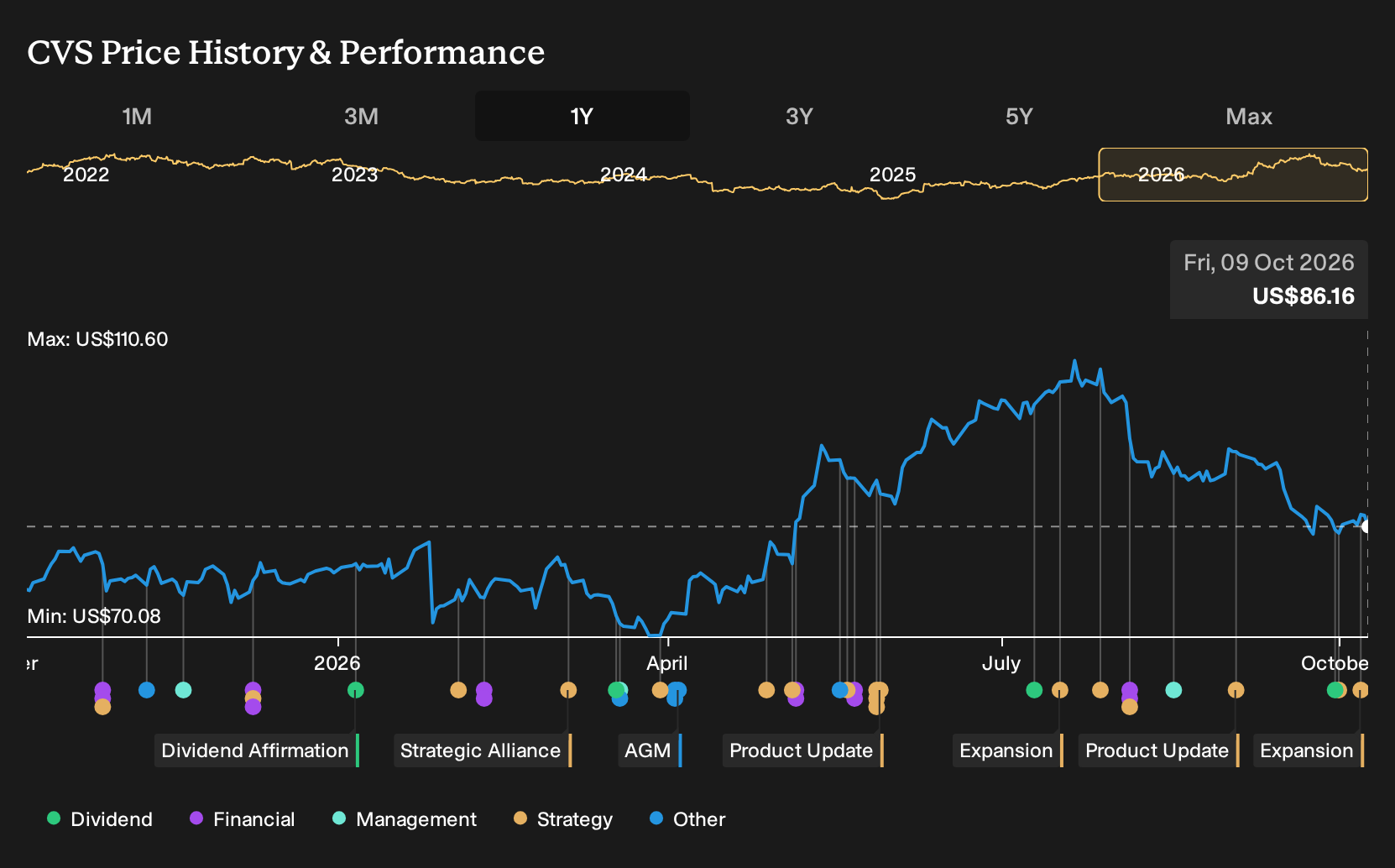
- CVS Health recently opened its first pharmacy-focused CVS Pharmacy in the Boston area and plans nearly 20 similar neighborhood sites across the US in 2026, alongside more than 40 additional pharmacy openings in both traditional stores and Target locations.
- At the same time, Aetna’s updated Medicare Advantage star ratings, ongoing legal scrutiny and an extended Cardinal Health distribution agreement all shape how CVS Health balances growth in pharmacy access with pressure on its insurance and regulatory risk profile.
- Next, the article will look at how CVS Health's neighborhood pharmacy rollout could reshape its broader investment narrative and risk profile.
CVS Health Investment Narrative Recap
To own CVS Health today, you need to believe the integrated model can turn pharmacy access, Aetna underwriting discipline and tech driven efficiencies into steadier earnings, even with moving parts in Medicare Advantage and the PBM. The new neighborhood pharmacies fit that story as a focused way to keep prescription volume and patient touchpoints inside the ecosystem.
The near term swing factor still sits in health insurance profitability and medical cost trends, while the biggest risk remains pressure in Health Care Benefits and 340B related PBM revenue. The Boston rollout itself looks incremental to that earnings debate rather than a material near term catalyst or new risk.
The Cardinal Health letter of intent to extend distribution through June 2032 is the announcement that ties most directly into this pharmacy expansion. For an investor, that long dated agreement underpins CVS Health’s ability to stock these smaller sites efficiently and keep supply chain friction from becoming a near term headache.
With membership and margin pressure already flagged as key risks, simple operational reliability matters. A locked in wholesaler relationship supports the pharmacy and Caremark catalyst of lowest net cost and fair margin per script, while attention stays on whether Aetna margin restoration and PBM headwinds track management’s existing plans.
What The CVS Health Forecasts Assume
For CVS Health, the analyst story on neighborhood pharmacies only really makes sense when lined up against the earnings and revenue path embedded in current models. Forecasts point to revenue of US$458.7b and earnings of US$11.3b by 2029, with that profit target tied to a margin lift from 1.2% today to 2.5% over the next three years and an assumed 3.6% yearly revenue growth rate across that stretch.
On this view, earnings would move from US$4.9b today to US$11.3b by 2029, an increase of roughly US$6.4b, even as the analyst case still allows for a higher US$13.5b outcome at the top end of the range. That jump in profit underpins the consensus P/E of 16.9x on 2029 earnings compared with 23.2x today, and sets the hurdle for any claim that new pharmacy openings, Aetna margin repair and PBM contract discipline can carry the rest of the story.
CVS Health's narrative projects US$458.7b revenue and US$11.3b earnings by 2029. This requires 3.6% yearly revenue growth and an earnings increase of about US$6.4b from US$4.9b today.
Uncover why CVS Health's fair value indicates a 35% potential upside to its current price, which could narrow quickly.
Exploring Other Perspectives
Five fair value estimates from the Simply Wall St Community span roughly US$104 to US$271 per share, so some retail investors see CVS Health as deeply underpriced while others project much richer outcomes. Set those expectations against Medicare Advantage rating pressure, PBM headwinds and the new neighborhood pharmacy rollout, and then compare several contrasting viewpoints before deciding how this fits your portfolio.
Explore 4 other CVS Health fair value estimates, including one that suggests it could be worth just $104.01!
Decide For Yourself
Disagree with existing narratives? Extraordinary investment returns rarely come from following the herd, so go with your instincts.
- A great starting point for your CVS Health research is our analysis highlighting 4 key rewards and 2 important warning signs that could impact your investment decision.
- See our latest analysis for CVS Health. The report includes a comprehensive fundamental analysis summarized in a single visual, the Snowflake, making it easy to evaluate CVS Health's overall financial health at a glance.
Looking For More Investment Ideas Beyond CVS Health?
If the CVS Health story has sharpened your view on risk, cash flow quality and balance sheets, you can use that same lens across the wider market. The Simply Wall St Screener lets you filter for financial strength, income potential and potential mispriced opportunities in a more disciplined way, instead of relying on headlines or hunches.
- For investors who want resilience first, you can start with companies that pair healthy finances with measured risk profiles by reviewing the 31 resilient stocks with low risk scores.
- If dependable income is higher on your priority list, you can focus on businesses with stronger yields and sturdier payout histories by scanning the curated 8 dividend fortresses.
- When the goal is to look for quality before the wider market pays attention, you can widen your search to the curated 20 high quality undiscovered gems that may deserve a closer look.
This article by Simply Wall St is general in nature. We provide commentary based on historical data and analyst forecasts only using an unbiased methodology and our articles are not intended to be financial advice. It does not constitute a recommendation to buy or sell any stock, and does not take account of your objectives, or your financial situation. We aim to bring you long-term focused analysis driven by fundamental data. Note that our analysis may not factor in the latest price-sensitive company announcements or qualitative material. Simply Wall St has no position in any stocks mentioned.
Have feedback on this article? Concerned about the content? Get in touch with us directly. Alternatively, email editorial-team@simplywallst.com