


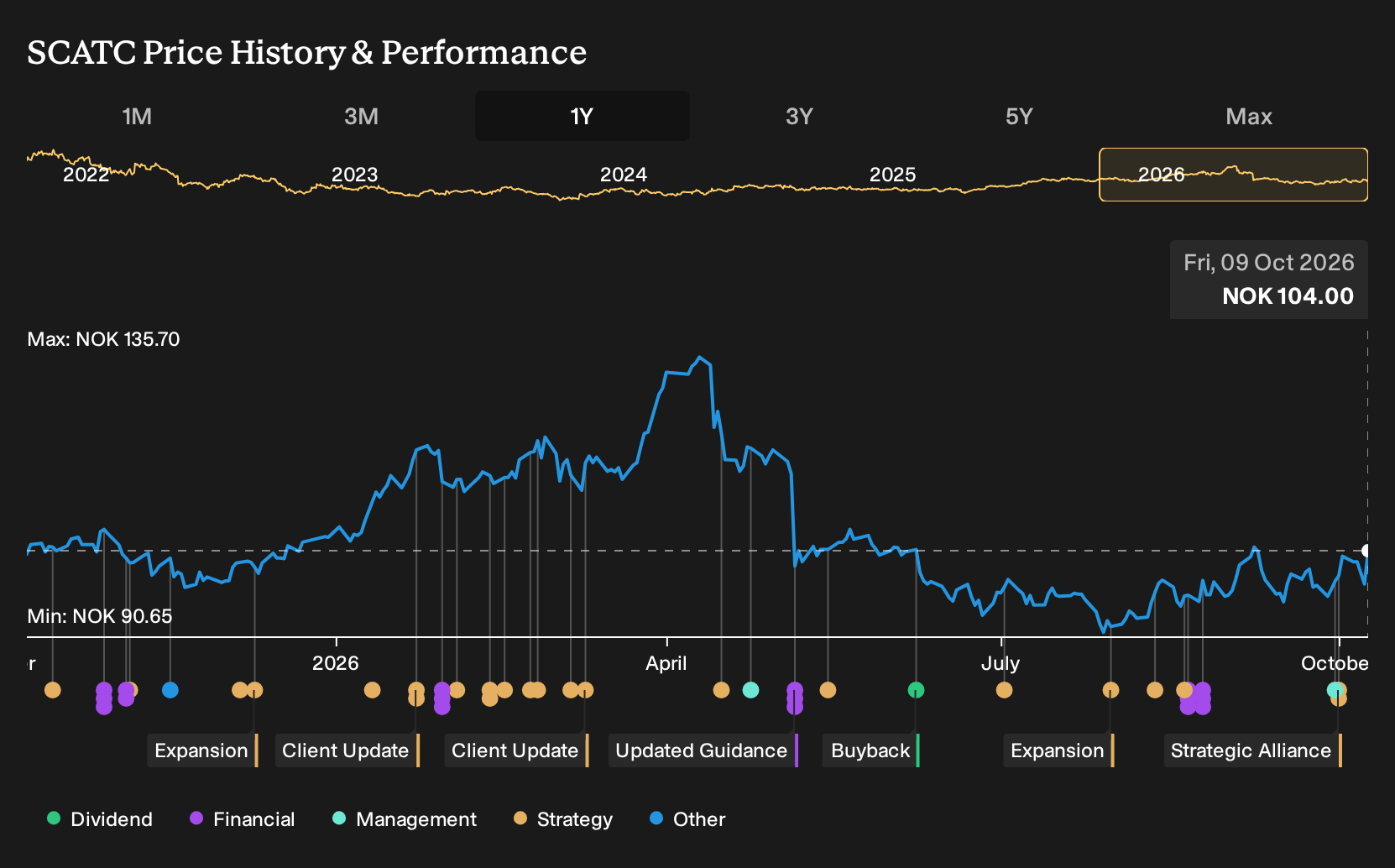
Why Scatec (OB:SCATC) Is Up 5.5% And What's Next
- Scatec ASA reported that construction has started on the 900 MW Shadwan onshore wind project in Egypt with EDF, backed by a US$150 million equity bridge loan and a total project capex of US$716 million.
- The equity bridge loan from The Arab Energy Fund, together with Scatec's development and construction cash flows, indicates a capital efficient approach to funding both Shadwan and the large Energy Valley solar and battery project.
- Investors will now be able to observe how Scatec's investment narrative may be shaped by the Shadwan build out and its new equity bridge financing.
Scatec Investment Narrative Recap
To own Scatec, you need to believe the company can turn its large Egypt and broader emerging markets portfolio into stable, contracted cash flows while managing construction, funding and political risk. The Shadwan wind build and linked Energy Valley financing speak directly to that, since they test Scatec's integrated model and capital efficiency in real time.
The key near term catalyst remains visible progress on delivering its backlog and projects under construction into operating assets. The biggest operational risk is still execution slippage or cost pressure on large projects in higher risk jurisdictions, which could strain a balance sheet where interest costs are already only modestly covered by earnings.
The joint development agreement with EDF for Shadwan, with Scatec targeting a 29% equity stake and room for additional partners, is especially relevant here. It signals an approach where Scatec can keep meaningful operational exposure while sharing project level funding needs with EDF and future investors. This matters when debt servicing already bites into earnings.
For you as a shareholder, the combination of a phased Shadwan rollout toward an initial COD at the end of 2027 and the US$150 million equity bridge loan package shapes the near term story. Execution on this Egypt cluster now ties directly into the main upside driver, converting the pipeline into cash flow, while also intersecting with the primary risk that project delays or funding frictions could slow that transition.
What The Current Scatec Forecasts Assume
Analysts currently model a steep ramp for Scatec, with revenue expected to grow by 48.0% a year over the next three years and profit margins moving from 1.5% today to 21.7% by 2029. On their numbers, earnings would rise from NOK 56.0 million today to NOK 2.5 billion in 2029, which is roughly a 45x step up in profit, although individual forecasts range widely between NOK 1.0 billion and NOK 3.8 billion. That profit path underpins a projected P/E of 11.0x on 2029 earnings, compared with 278.6x today and a current sector multiple of 21.5x for the GB renewable energy peer group. These expectations also sit on top of modest share count growth of 0.31% a year and a discount rate assumption of just over 10%.
On the valuation side, consensus ties this growth profile to a target price of NOK 129.89, framed against a current share price of NOK 97.60 and a spread of NOK 120.00 to NOK 150.00 across individual analyst targets. To align with that view, you would need to accept that by 2029 Scatec could be generating NOK 11.7 billion of revenue and NOK 2.5 billion of earnings while trading at around 11.0x earnings under a discount rate of roughly 10.4%. The gap between the present price and the target, quoted at 24.9%, is simply a mechanical outcome of those inputs and does not by itself say anything about how likely the scenario is.
Scatec's narrative projects NOK 11.7 billion revenue and NOK 2.5 billion earnings by 2029. This requires 48.0% yearly revenue growth and roughly a 45x increase in earnings from NOK 56.0 million today.
Uncover why Scatec's fair value indicates a 25% potential upside to its current price, which could compress quickly if Scatec executes on its Egypt pipeline.
Exploring Other Perspectives
Two fair value estimates from the Simply Wall St Community span from just above NOK 10 to nearly NOK 130 per share, so retail opinions on Scatec differ sharply. With Shadwan and Energy Valley now moving ahead, together with recent board turnover, you can weigh how execution risk and emerging market exposure might influence which scenario feels more plausible.
Explore another Scatec fair value estimate, including one that suggests up to 90% downside from the current price!
The Verdict Is Yours
Don't just follow the ticker. Dig into the data and build a conviction that's truly your own.
- A great starting point for your Scatec research is our analysis highlighting 2 key rewards and 1 important warning sign that could impact your investment decision.
- See our latest analysis for Scatec. The report includes a comprehensive fundamental analysis summarized in a single visual, the Snowflake, making it easy to evaluate Scatec's overall financial health at a glance.
Looking For More Investment Ideas Beyond Scatec?
If the Scatec story has sharpened your thinking about risk, balance sheets and future cash flow, it can help to compare it with other opportunities that share some of those traits. The Simply Wall St Screener lets you quickly filter for different types of stocks so you can build a watchlist that actually matches your risk tolerance and income goals.
- If capital preservation comes first for you, start with a set of 222 resilient stocks with low risk scores that score well on resilience and business quality.
- If rock solid finances matter most, broaden your watchlist with a list of solid balance sheet and fundamentals (202 results) so you can compare Scatec with companies that carry less financial strain.
- If you enjoy hunting for earlier stage opportunities, round out your research with a 125 elite penny stocks with strong financials that already back their small size with relatively strong fundamentals.
This article by Simply Wall St is general in nature. We provide commentary based on historical data and analyst forecasts only using an unbiased methodology and our articles are not intended to be financial advice. It does not constitute a recommendation to buy or sell any stock, and does not take account of your objectives, or your financial situation. We aim to bring you long-term focused analysis driven by fundamental data. Note that our analysis may not factor in the latest price-sensitive company announcements or qualitative material. Simply Wall St has no position in any stocks mentioned.
Have feedback on this article? Concerned about the content? Get in touch with us directly. Alternatively, email editorial-team@simplywallst.com