


Does Company Wide AI Rollout Change The Bull Case For SAP (XTRA:SAP)?
- Recent SAP news centers on the roll out of its Autonomous Enterprise concept, the Joule Work interface, and Joule Assistants across finance, supply chain, HR, procurement and payments, along with expanded cloud partnerships such as IBM Ready for SAP Solutions and deeper NetApp integration.
- By pairing AI agents grounded in SAP Business Data Cloud and SAP Knowledge Graph with offerings like SAP Pay and TechWolf’s work intelligence platform, SAP is pushing harder to embed AI into day to day workflows rather than treat it as a side feature.
- We will now look at how SAP's company wide Joule rollout could influence the investment narrative built around AI driven cloud ERP.
SAP Investment Narrative Recap
To be comfortable owning SAP, you need to buy into a simple idea. The more core workflows move onto SAP Cloud ERP with embedded Joule agents and data services, the easier it becomes to justify outcome based pricing and a higher mix of recurring subscriptions. The near term swing factor is how quickly customers adopt these AI rich suites without putting further pressure on cloud gross margin, which already reflects higher AI and infrastructure expense.
The biggest risk sits on that same fault line. If token usage, new AI test environments and sovereignty requirements keep adding cost while adoption or pricing power lag, the long term margin story weakens. Recent Joule and Autonomous Enterprise news mainly sharpens the execution bar rather than changing the near term catalyst or risk profile in a fundamental way.
Among the recent items, IBM Ready for SAP Solutions is the clearest operational link to the Joule rollout. It packages IBM’s consulting and AI delivery platform to move midsize and fast growing enterprises onto SAP Cloud ERP faster, as seen with Volumetric Building Companies and Second Nature Brands. That kind of program directly touches two levers investors watch closely: cloud migration pace and deal quality.
If offerings like this scale, they can feed the existing catalysts around S/4HANA Cloud adoption, Business Data Cloud attach rates and agent usage, while also testing whether consumption and value based pricing can land cleanly in real projects. The flip side is execution risk. Large, services heavy transformations can drag on timelines or economics if complexity, integration issues or AI usage costs are not tightly controlled.
What The SAP Consensus Numbers Assume
SAP's current consensus story is built around analysts expecting revenue to expand by 11.7% per year over the next 3 years, paired with profit margins moving from 20.4% today to 21.0% by 2029. That earnings path runs from €7.8b today to a forecast €11.2b in 2029, which is a gain of about €3.4b. On these figures, the stock would be trading on a P/E of 25.8x those 2029 earnings, compared with 27.8x today, while revenues are projected to reach €53.2b and earnings €11.2b in 2029 if the consensus valuation case plays out as modeled.
For you as an investor, those inputs boil down to a few simple questions. Are you comfortable with double digit annual top line expansion tied to cloud ERP and AI agent adoption? Do you think a modest lift in margin from 20.4% to 21.0% is realistic as Joule usage, Business Data Cloud and AI units roll through the P&L? And does a P/E that stays well above the cited US software industry level of 17.0x feel acceptable for a large, slower moving enterprise software platform that is trying to rewire its economics around usage based and outcome based pricing?
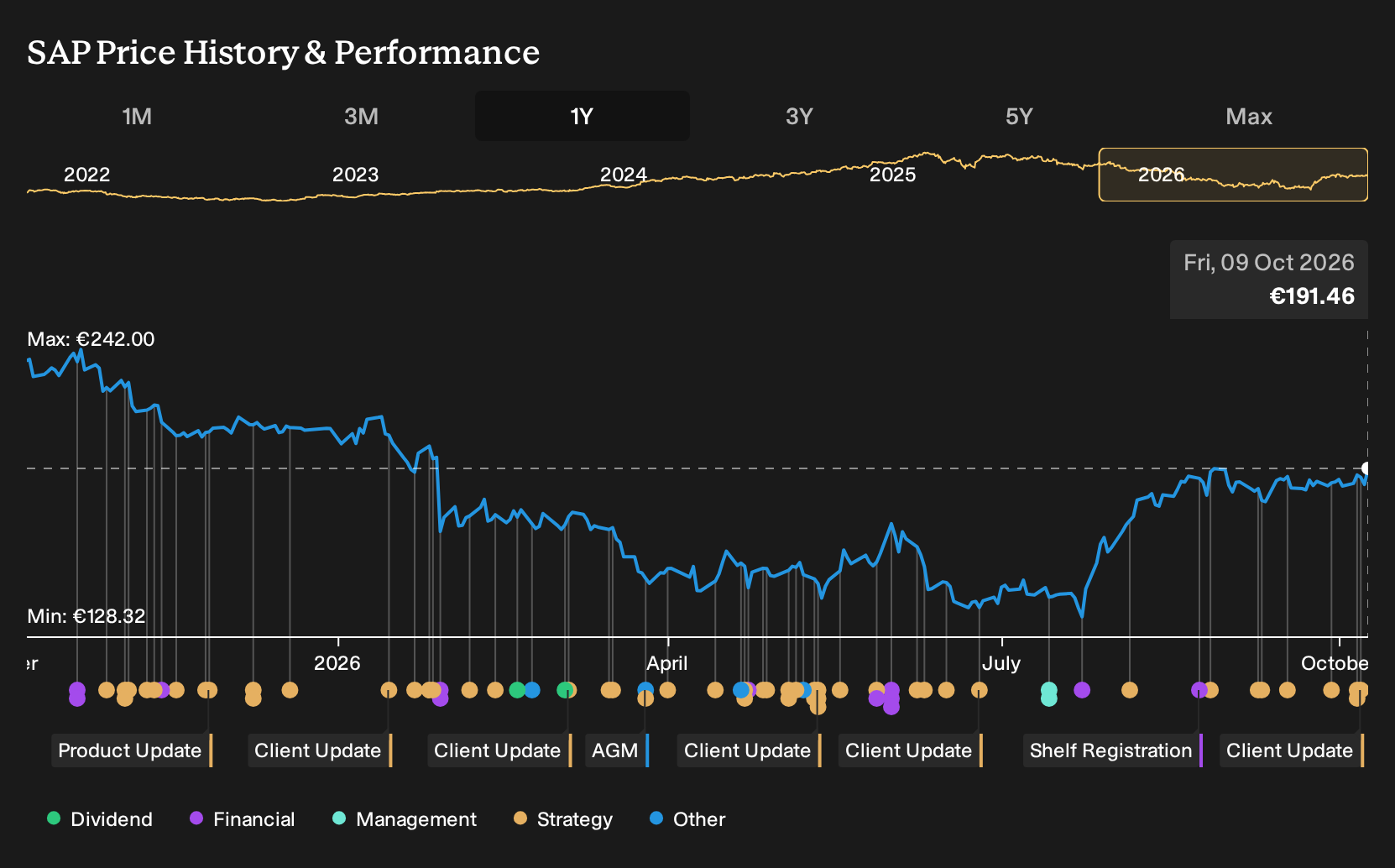
The disconnect between the average price target of €210.39 and the current price of €187.62, with a spread of 10.8%, reflects that analysts see some headroom if these revenue and profit assumptions hold. The range of targets from €160.0 to €290.0 also shows you how wide opinion runs on Joule execution, Autonomous Enterprise traction and the ability to keep AI infrastructure costs from eating into those projected earnings. Your task is to decide where on that spectrum your own expectations for SAP actually sit.
SAP's narrative projects €53.2b revenue and €11.2b earnings by 2029. This implies 11.7% yearly revenue growth and an earnings increase of about €3.4b from €7.8b today.
Uncover why SAP's fair value indicates a 10% potential upside to its current price, which could narrow quickly.
Exploring Other Perspectives
One alternate SAP angle puts far more weight on IBM Ready for SAP Solutions as a revenue catalyst. The most optimistic analysts were already pencilling in €57.1b of sales and €12.7b of earnings by 2029, compared with bearish views closer to €10.9b. That spread shows how sharply opinions can diverge, so it makes sense to explore these different narratives and decide which one you find more convincing as this new AI and consulting news beds in.
Explore 12 other SAP fair value estimates, including one that suggests as much as 59% upside from the current price.
Decide For Yourself
Disagree with existing narratives? Extraordinary investment returns rarely come from following the herd, so go with your instincts.
- A great starting point for your SAP research is our analysis highlighting 3 key rewards that could impact your investment decision.
- See our latest analysis for SAP. The report includes a comprehensive fundamental analysis summarized in a single visual, the Snowflake, making it easy to evaluate SAP's overall financial health at a glance.
Looking For More Investment Ideas Beyond SAP?
If the SAP story has you thinking more broadly about where to put fresh capital, it can help to scan for other businesses with clear financial profiles that match your own risk and income preferences. The Simply Wall St Screener lets you do exactly that by filtering for quality, balance sheet strength and yield in a few clicks.
- If capital protection is a priority, focus on companies that pair resilience with measured risk by starting with a 222 resilient stocks with low risk scores that fit a more defensive playbook.
- For investors who care about steady cash returns, zero in on high payout opportunities by reviewing a curated set of 223 dividend fortresses that aim to support ongoing income needs.
- If the goal is to find tomorrow's potential compounders before they are widely followed, concentrate on quality fundamentals and smaller coverage lists through a 618 high quality undiscovered gems that might warrant a closer look.
This article by Simply Wall St is general in nature. We provide commentary based on historical data and analyst forecasts only using an unbiased methodology and our articles are not intended to be financial advice. It does not constitute a recommendation to buy or sell any stock, and does not take account of your objectives, or your financial situation. We aim to bring you long-term focused analysis driven by fundamental data. Note that our analysis may not factor in the latest price-sensitive company announcements or qualitative material. Simply Wall St has no position in any stocks mentioned.
Have feedback on this article? Concerned about the content? Get in touch with us directly. Alternatively, email editorial-team@simplywallst.com